Temasek Life Sciences Laboratorygrid.226688.0, Singapore.
Genome Institute of Singapore, A*STAR, Singapore.
Microbiol Spectr. 2022 Aug 31;10(4):e0084922. doi: 10.1128/spectrum.00849-22. Epub 2022 Jun 14.
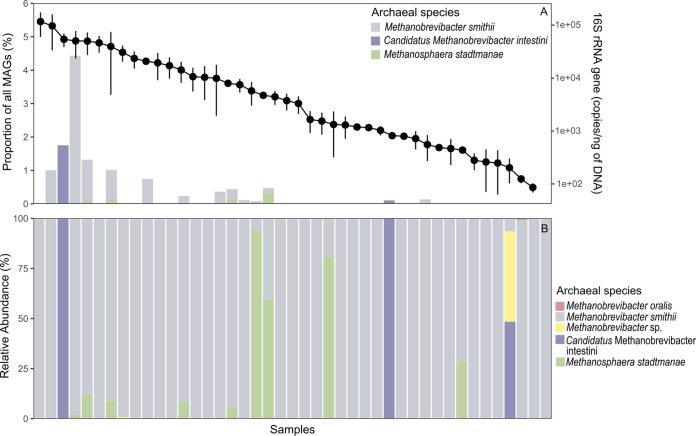
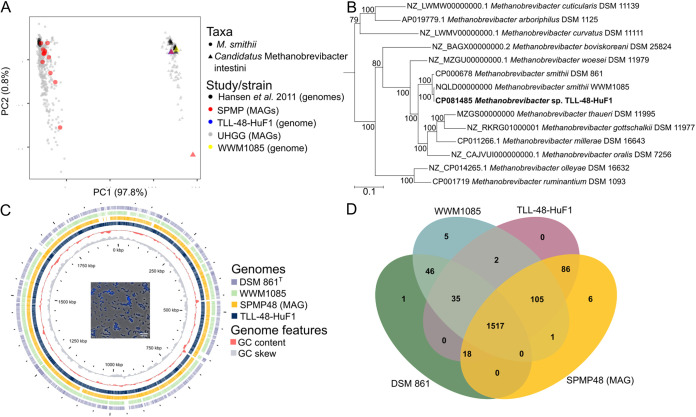
Methanogenic Archaea (methanogens) are a phylogenetically diverse group of microorganisms and are considered to be the most abundant archaeal representatives in the human gut. However, the gut methanogen diversity of human populations in many global regions remains poorly investigated. Here, we report the abundance and diversity of gut methanogenic Archaea in a multi-ethnic cohort of healthy Singaporeans by using a concerted approach of metagenomic sequencing, 16S rRNA gene amplicon sequencing, and quantitative PCR. Our results indicate a mutual exclusion of species, i.e., the highly prevalent Methanobrevibacter smithii and the less prevalent Methanobrevibacter intestini in more than 80% of the samples when using an amplicon sequencing-based approach. Leveraging on this finding, we were able to select a fecal sample to isolate a representative strain, TLL-48-HuF1, for Methanobrevibacter intestini. The analyzed physiological parameters of M. smithii DSM 861 and strain TLL-48-HuF1 suggest high similarity of the two species. Comparative genome analysis and the mutual exclusion of the species indicate potentially different niche adaptation strategies in the human host, which may support the designation of M. intestini as a novel species. Methanogens are important hydrogen consumers in the gut and are associated with differing host health. Here, we determine the prevalence and abundance of archaeal species in the guts of a multi-ethnic cohort of healthy Singapore residents. While Methanobrevibacter smithii is the most prevalent and abundant methanogen in the human gut of local subjects, the recently proposed Methanobrevibacter intestini is the abundant methanogen in a minority of individuals that harbor them. The observed potential mutual exclusion of M. smithii and . M. intestini provides further support to the proposal that the two physiologically similar strains may belong to different species.
产甲烷古菌(methanogens)是一组具有多样系统发育的微生物,被认为是人类肠道中最丰富的古菌代表。然而,许多全球区域的人群肠道产甲烷古菌的多样性仍未得到充分研究。在这里,我们通过宏基因组测序、16S rRNA 基因扩增子测序和定量 PCR 的协同方法,报告了新加坡多民族队列中健康人群肠道产甲烷古菌的丰度和多样性。我们的结果表明,在使用扩增子测序方法时,超过 80%的样本中存在物种相互排斥的现象,即高度流行的 Methanobrevibacter smithii 和较少流行的 Methanobrevibacter intestini。利用这一发现,我们能够选择一个粪便样本来分离出一个代表菌株,即 Methanobrevibacter intestini 的 TLL-48-HuF1。对 M. smithii DSM 861 和菌株 TLL-48-HuF1 的分析生理参数表明,这两个物种具有高度相似性。比较基因组分析和物种的相互排斥表明,在人类宿主中可能存在不同的生态位适应策略,这可能支持将 Methanobrevibacter intestini 指定为一个新物种。产甲烷菌是肠道中重要的氢气消费者,与宿主健康状况有关。在这里,我们确定了一个多民族健康新加坡居民队列的肠道古菌物种的流行率和丰度。虽然 Methanobrevibacter smithii 是当地人群肠道中最普遍和丰富的产甲烷菌,但最近提出的 Methanobrevibacter intestini 是在少数携带它们的个体中丰富的产甲烷菌。M. smithii 和. M. intestini 之间观察到的潜在相互排斥现象进一步支持了这两个生理相似的菌株可能属于不同 物种的提议。