Rinaldi Eugenia, Stellmach Caroline, Rajkumar Naveen Moses Raj, Caroccia Natascia, Dellacasa Chiara, Giannella Maddalena, Guedes Mariana, Mirandola Massimo, Scipione Gabriella, Tacconelli Evelina, Thun Sylvia
Berlin Institute of Health (BIH), Charité - Universitätsmedizin Berlin, Berlin, Germany.
University of Bologna, Bologna, Italy.
NPJ Digit Med. 2022 Jun 14;5(1):75. doi: 10.1038/s41746-022-00620-x.
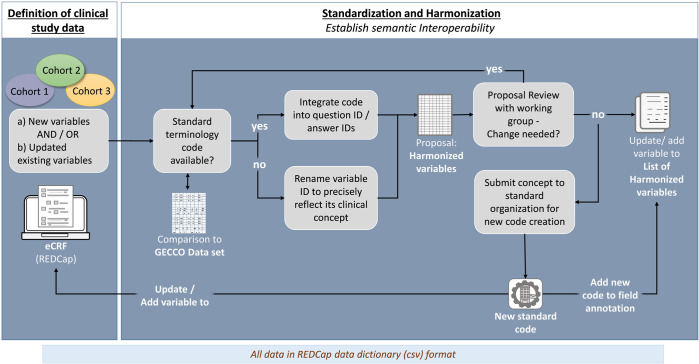
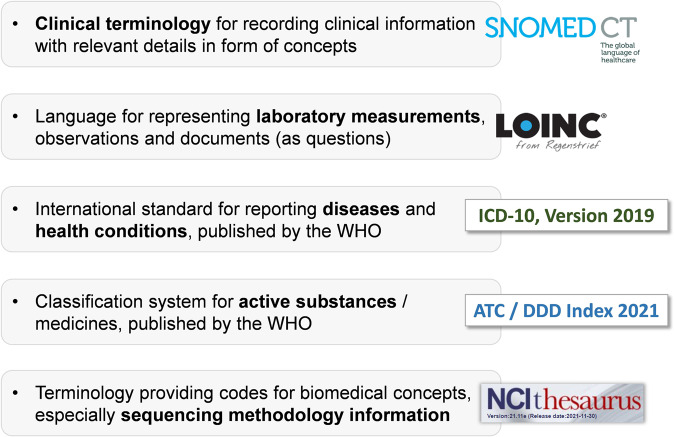
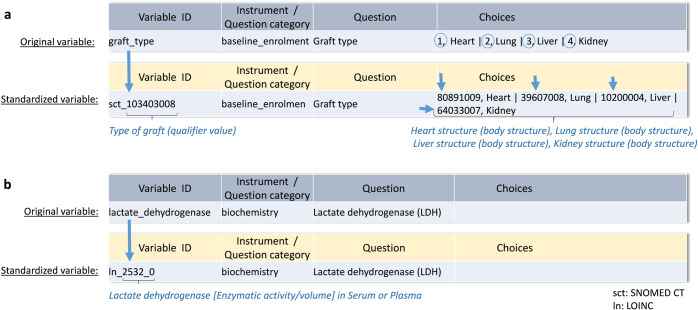
The European project ORCHESTRA intends to create a new pan-European cohort to rapidly advance the knowledge of the effects and treatment of COVID-19. Establishing processes that facilitate the merging of heterogeneous clusters of retrospective data was an essential challenge. In addition, data from new ORCHESTRA prospective studies have to be compatible with earlier collected information to be efficiently combined. In this article, we describe how we utilized and contributed to existing standard terminologies to create consistent semantic representation of over 2500 COVID-19-related variables taken from three ORCHESTRA studies. The goal is to enable the semantic interoperability of data within the existing project studies and to create a common basis of standardized elements available for the design of new COVID-19 studies. We also identified 743 variables that were commonly used in two of the three prospective ORCHESTRA studies and can therefore be directly combined for analysis purposes. Additionally, we actively contributed to global interoperability by submitting new concept requests to the terminology Standards Development Organizations.
欧洲项目“ORCHESTRA”旨在创建一个新的泛欧队列,以迅速推进对新冠病毒病(COVID-19)影响及治疗的认识。建立有助于合并异质性回顾性数据集群的流程是一项重大挑战。此外,来自“ORCHESTRA”新前瞻性研究的数据必须与早期收集的信息兼容,以便有效合并。在本文中,我们描述了如何利用现有标准术语并对其做出贡献,以创建来自三项“ORCHESTRA”研究的2500多个与COVID-19相关变量的一致语义表示。目标是实现现有项目研究中数据的语义互操作性,并创建一个标准化元素的共同基础,以供设计新的COVID-19研究使用。我们还识别出743个在三项前瞻性“ORCHESTRA”研究中的两项中常用的变量,因此可直接合并用于分析目的。此外,我们通过向术语标准制定组织提交新的概念请求,积极推动全球互操作性。