• 文献检索
  • 文档翻译
  • 深度研究
  • 学术资讯
  • Suppr Zotero 插件Zotero 插件
  • 邀请有礼
  • 套餐&价格
  • 历史记录
应用&插件
Suppr Zotero 插件Zotero 插件浏览器插件Mac 客户端Windows 客户端微信小程序
定价
高级版会员购买积分包购买API积分包
服务
文献检索文档翻译深度研究API 文档MCP 服务
关于我们
关于 Suppr公司介绍联系我们用户协议隐私条款
关注我们

Suppr 超能文献

核心技术专利:CN118964589B侵权必究
粤ICP备2023148730 号-1Suppr @ 2026

文献检索

告别复杂PubMed语法,用中文像聊天一样搜索,搜遍4000万医学文献。AI智能推荐,让科研检索更轻松。

立即免费搜索

文件翻译

保留排版,准确专业,支持PDF/Word/PPT等文件格式,支持 12+语言互译。

免费翻译文档

深度研究

AI帮你快速写综述,25分钟生成高质量综述,智能提取关键信息,辅助科研写作。

立即免费体验

墨西哥洞穴鱼的代谢组显示出趋同特征,突出了糖、抗氧化剂和与衰老相关的代谢物。

The metabolome of Mexican cavefish shows a convergent signature highlighting sugar, antioxidant, and Ageing-Related metabolites.

机构信息

Stowers Institute for Medical Research, Kansas City, United States.

Department of Molecular and Integrative Physiology, University of Kansas Medical Center, Kansas City, United States.

出版信息

Elife. 2022 Jun 15;11:e74539. doi: 10.7554/eLife.74539.

DOI:10.7554/eLife.74539
PMID:35703366
原文链接:https://pmc.ncbi.nlm.nih.gov/articles/PMC9200406/
Abstract

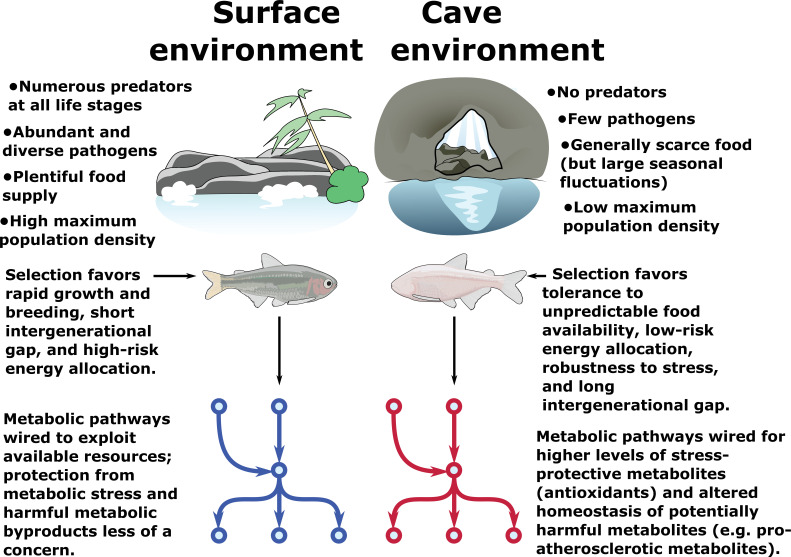
Insights from organisms, which have evolved natural strategies for promoting survivability under extreme environmental pressures, may help guide future research into novel approaches for enhancing human longevity. The cave-adapted Mexican tetra, , has attracted interest as a model system for , a term we use to denote the property of maintaining health and longevity under conditions that would be highly deleterious in other organisms (Figure 1). Cave-dwelling populations of Mexican tetra exhibit elevated blood glucose, insulin resistance and hypertrophic visceral adipocytes compared to surface-dwelling counterparts. However, cavefish appear to avoid pathologies typically associated with these conditions, such as accumulation of advanced-glycation-end-products (AGEs) and chronic tissue inflammation. The metabolic strategies underlying the resilience properties of cavefish, and how they relate to environmental challenges of the cave environment, are poorly understood. Here, we provide an untargeted metabolomics study of long- and short-term fasting in two cave populations and one surface population. We find that, although the metabolome of cavefish bears many similarities with pathological conditions such as metabolic syndrome, cavefish also exhibit features not commonly associated with a pathological condition, and in some cases considered indicative of an overall robust metabolic condition. These include a reduction in cholesteryl esters and intermediates of protein glycation, and an increase in antioxidants and metabolites associated with hypoxia and longevity. This work suggests that certain metabolic features associated with human pathologies are either not intrinsically harmful, or can be counteracted by reciprocal adaptations. We provide a transparent pipeline for reproducing our analysis and a Shiny app for other researchers to explore and visualize our dataset.

摘要

从已经进化出在极端环境压力下促进生存能力的自然策略的生物体中获得的见解,可能有助于指导未来研究增强人类寿命的新方法。穴居适应的墨西哥四尾鱼,已作为一种模型系统引起了人们的兴趣,我们用“长寿适应”一词来表示在其他生物体中高度有害的条件下保持健康和长寿的特性(图 1)。与表面栖息的同类相比,穴居墨西哥四尾鱼的血液葡萄糖、胰岛素抵抗和肥大内脏脂肪细胞水平升高。然而,穴居鱼似乎避免了与这些条件相关的病理,如晚期糖基化终产物(AGEs)的积累和慢性组织炎症。穴居鱼具有弹性的代谢策略及其与洞穴环境的环境挑战之间的关系,目前还知之甚少。在这里,我们对两个洞穴种群和一个表面种群进行了长期和短期禁食的非靶向代谢组学研究。我们发现,尽管穴居鱼的代谢组与代谢综合征等病理状况有许多相似之处,但穴居鱼也表现出与病理状况通常不相关的特征,在某些情况下,这些特征被认为是整体稳健代谢状况的标志。这些特征包括胆固醇酯和蛋白质糖化中间体减少,抗氧化剂和与缺氧和长寿相关的代谢物增加。这项工作表明,与人类病理相关的某些代谢特征要么不是内在有害的,要么可以通过相互适应来抵消。我们提供了一个可重现我们分析的透明管道,以及一个闪亮的应用程序,供其他研究人员探索和可视化我们的数据集。
https://cdn.ncbi.nlm.nih.gov/pmc/blobs/b317/9200406/13a9c5a974e0/elife-74539-fig8.jpg
https://cdn.ncbi.nlm.nih.gov/pmc/blobs/b317/9200406/d19450c61121/elife-74539-fig1.jpg
https://cdn.ncbi.nlm.nih.gov/pmc/blobs/b317/9200406/4a5e9f069cc5/elife-74539-fig2.jpg
https://cdn.ncbi.nlm.nih.gov/pmc/blobs/b317/9200406/c2c9a747c75c/elife-74539-fig3.jpg
https://cdn.ncbi.nlm.nih.gov/pmc/blobs/b317/9200406/8918068eb1a4/elife-74539-fig4.jpg
https://cdn.ncbi.nlm.nih.gov/pmc/blobs/b317/9200406/f3d6d12b4335/elife-74539-fig5.jpg
https://cdn.ncbi.nlm.nih.gov/pmc/blobs/b317/9200406/24fd4e8adf12/elife-74539-fig5-figsupp1.jpg
https://cdn.ncbi.nlm.nih.gov/pmc/blobs/b317/9200406/aa6914d3c6da/elife-74539-fig5-figsupp2.jpg
https://cdn.ncbi.nlm.nih.gov/pmc/blobs/b317/9200406/213bc1ece85a/elife-74539-fig6.jpg
https://cdn.ncbi.nlm.nih.gov/pmc/blobs/b317/9200406/07ddcbc90a39/elife-74539-fig6-figsupp1.jpg
https://cdn.ncbi.nlm.nih.gov/pmc/blobs/b317/9200406/1e866ac5d72a/elife-74539-fig6-figsupp2.jpg
https://cdn.ncbi.nlm.nih.gov/pmc/blobs/b317/9200406/dcf21a46d94e/elife-74539-fig7.jpg
https://cdn.ncbi.nlm.nih.gov/pmc/blobs/b317/9200406/9076562060e0/elife-74539-fig7-figsupp1.jpg
https://cdn.ncbi.nlm.nih.gov/pmc/blobs/b317/9200406/7b89636f9a52/elife-74539-fig7-figsupp2.jpg
https://cdn.ncbi.nlm.nih.gov/pmc/blobs/b317/9200406/b182fa40d641/elife-74539-fig7-figsupp3.jpg
https://cdn.ncbi.nlm.nih.gov/pmc/blobs/b317/9200406/7572908d556d/elife-74539-fig7-figsupp4.jpg
https://cdn.ncbi.nlm.nih.gov/pmc/blobs/b317/9200406/bd2fcf7a36d7/elife-74539-fig7-figsupp5.jpg
https://cdn.ncbi.nlm.nih.gov/pmc/blobs/b317/9200406/13a9c5a974e0/elife-74539-fig8.jpg
https://cdn.ncbi.nlm.nih.gov/pmc/blobs/b317/9200406/d19450c61121/elife-74539-fig1.jpg
https://cdn.ncbi.nlm.nih.gov/pmc/blobs/b317/9200406/4a5e9f069cc5/elife-74539-fig2.jpg
https://cdn.ncbi.nlm.nih.gov/pmc/blobs/b317/9200406/c2c9a747c75c/elife-74539-fig3.jpg
https://cdn.ncbi.nlm.nih.gov/pmc/blobs/b317/9200406/8918068eb1a4/elife-74539-fig4.jpg
https://cdn.ncbi.nlm.nih.gov/pmc/blobs/b317/9200406/f3d6d12b4335/elife-74539-fig5.jpg
https://cdn.ncbi.nlm.nih.gov/pmc/blobs/b317/9200406/24fd4e8adf12/elife-74539-fig5-figsupp1.jpg
https://cdn.ncbi.nlm.nih.gov/pmc/blobs/b317/9200406/aa6914d3c6da/elife-74539-fig5-figsupp2.jpg
https://cdn.ncbi.nlm.nih.gov/pmc/blobs/b317/9200406/213bc1ece85a/elife-74539-fig6.jpg
https://cdn.ncbi.nlm.nih.gov/pmc/blobs/b317/9200406/07ddcbc90a39/elife-74539-fig6-figsupp1.jpg
https://cdn.ncbi.nlm.nih.gov/pmc/blobs/b317/9200406/1e866ac5d72a/elife-74539-fig6-figsupp2.jpg
https://cdn.ncbi.nlm.nih.gov/pmc/blobs/b317/9200406/dcf21a46d94e/elife-74539-fig7.jpg
https://cdn.ncbi.nlm.nih.gov/pmc/blobs/b317/9200406/9076562060e0/elife-74539-fig7-figsupp1.jpg
https://cdn.ncbi.nlm.nih.gov/pmc/blobs/b317/9200406/7b89636f9a52/elife-74539-fig7-figsupp2.jpg
https://cdn.ncbi.nlm.nih.gov/pmc/blobs/b317/9200406/b182fa40d641/elife-74539-fig7-figsupp3.jpg
https://cdn.ncbi.nlm.nih.gov/pmc/blobs/b317/9200406/7572908d556d/elife-74539-fig7-figsupp4.jpg
https://cdn.ncbi.nlm.nih.gov/pmc/blobs/b317/9200406/bd2fcf7a36d7/elife-74539-fig7-figsupp5.jpg
https://cdn.ncbi.nlm.nih.gov/pmc/blobs/b317/9200406/13a9c5a974e0/elife-74539-fig8.jpg

相似文献

1
The metabolome of Mexican cavefish shows a convergent signature highlighting sugar, antioxidant, and Ageing-Related metabolites.墨西哥洞穴鱼的代谢组显示出趋同特征,突出了糖、抗氧化剂和与衰老相关的代谢物。
Elife. 2022 Jun 15;11:e74539. doi: 10.7554/eLife.74539.
2
Unraveling stress resilience: Insights from adaptations to extreme environments by Astyanax mexicanus cavefish.解析压力韧性:墨西哥脂鲤适应极端环境的启示。
J Exp Zool B Mol Dev Evol. 2024 May;342(3):178-188. doi: 10.1002/jez.b.23238. Epub 2024 Jan 21.
3
Genetic mapping of metabolic traits in the blind Mexican cavefish reveals sex-dependent quantitative trait loci associated with cave adaptation.遗传图谱代谢特征在盲眼墨西哥洞穴鱼揭示性别依赖数量性状位点与洞穴适应。
BMC Ecol Evol. 2021 May 21;21(1):94. doi: 10.1186/s12862-021-01823-8.
4
Phenotypic plasticity as a mechanism of cave colonization and adaptation.表型可塑性作为洞穴生物的适应和适应机制。
Elife. 2020 Apr 21;9:e51830. doi: 10.7554/eLife.51830.
5
Convergence on reduced aggression through shared behavioral traits in multiple populations of Astyanax mexicanus.通过多个墨西哥脂鲤群体的共同行为特征实现侵略行为的减少。
BMC Ecol Evol. 2022 Oct 14;22(1):116. doi: 10.1186/s12862-022-02069-8.
6
Repeated evolution of eye loss in Mexican cavefish: Evidence of similar developmental mechanisms in independently evolved populations.墨西哥洞穴鱼眼退化的重复进化:独立进化群体中相似发育机制的证据。
J Exp Zool B Mol Dev Evol. 2020 Nov;334(7-8):423-437. doi: 10.1002/jez.b.22977. Epub 2020 Jul 2.
7
Reproductive adaptation of Astyanax mexicanus under nutrient limitation.墨西哥丽脂鲤在营养限制下的生殖适应性
Dev Biol. 2025 Jul;523:82-98. doi: 10.1016/j.ydbio.2025.04.006. Epub 2025 Apr 11.
8
Reproductive Adaptation of Under Nutrient Limitation.营养限制下的生殖适应性
bioRxiv. 2025 Feb 17:2025.02.13.638191. doi: 10.1101/2025.02.13.638191.
9
Genetic architecture underlying changes in carotenoid accumulation during the evolution of the blind Mexican cavefish, Astyanax mexicanus.盲眼墨西哥脂鲤(Astyanax mexicanus)在进化过程中类胡萝卜素积累变化的遗传结构。
J Exp Zool B Mol Dev Evol. 2020 Nov;334(7-8):405-422. doi: 10.1002/jez.b.22954. Epub 2020 Jun 2.
10
Evolution of the acoustic startle response of Mexican cavefish.墨西哥洞穴鱼的听觉惊跳反应的进化。
J Exp Zool B Mol Dev Evol. 2020 Nov;334(7-8):474-485. doi: 10.1002/jez.b.22988. Epub 2020 Aug 10.

引用本文的文献

1
Reproductive adaptation of Astyanax mexicanus under nutrient limitation.墨西哥丽脂鲤在营养限制下的生殖适应性
Dev Biol. 2025 Jul;523:82-98. doi: 10.1016/j.ydbio.2025.04.006. Epub 2025 Apr 11.
2
Comparative mitogenomic analysis of Chinese cavefish Triplophysa (Cypriniformes: Nemacheilidae): novel gene tandem duplication and evolutionary implications.中国洞穴鱼类高原鳅属(鲤形目:条鳅科)的线粒体基因组比较分析:新的基因串联重复及其进化意义
BMC Genomics. 2025 Mar 24;26(1):293. doi: 10.1186/s12864-025-11486-0.
3
Population Genomics of Premature Termination Codons in Cavefish With Substantial Trait Loss.

本文引用的文献

1
Genome-wide analysis of cis-regulatory changes underlying metabolic adaptation of cavefish.洞穴鱼代谢适应性潜在顺式调控变化的全基因组分析。
Nat Genet. 2022 May;54(5):684-693. doi: 10.1038/s41588-022-01049-4. Epub 2022 May 12.
2
Alpha-Ketoglutarate, an Endogenous Metabolite, Extends Lifespan and Compresses Morbidity in Aging Mice.α-酮戊二酸,一种内源性代谢物,可延长衰老小鼠的寿命并压缩发病。
Cell Metab. 2020 Sep 1;32(3):447-456.e6. doi: 10.1016/j.cmet.2020.08.004.
3
Interaction between hormone-sensitive lipase and ChREBP in fat cells controls insulin sensitivity.
具有显著性状丧失的洞穴鱼中提前终止密码子的群体基因组学
Mol Biol Evol. 2025 Feb 3;42(2). doi: 10.1093/molbev/msaf012.
4
Postprandial Sleep in Short-Sleeping Mexican Cavefish.短眠墨西哥洞螈的餐后睡眠。
J Exp Zool A Ecol Integr Physiol. 2024 Dec;341(10):1084-1096. doi: 10.1002/jez.2880. Epub 2024 Nov 13.
5
Postprandial sleep in short-sleeping Mexican cavefish.短睡眠型墨西哥洞穴鱼的餐后睡眠
bioRxiv. 2024 Jul 5:2024.07.03.602003. doi: 10.1101/2024.07.03.602003.
6
Sporadic feeding regulates robust food entrainable circadian clocks in blind cavefish.间歇性进食调节盲穴鱼中强大的食物可调节生物钟。
iScience. 2024 Jun 4;27(7):110171. doi: 10.1016/j.isci.2024.110171. eCollection 2024 Jul 19.
7
Elevated DNA Damage without signs of aging in the short-sleeping Mexican Cavefish.睡眠少的墨西哥洞螈虽无衰老迹象,但DNA损伤却增加。
bioRxiv. 2024 Oct 21:2024.04.18.590174. doi: 10.1101/2024.04.18.590174.
8
Starvation-resistant cavefish reveal conserved mechanisms of starvation-induced hepatic lipotoxicity.抗饥饿洞穴鱼揭示了饥饿诱导的肝脏脂毒性的保守机制。
Life Sci Alliance. 2024 Mar 11;7(5). doi: 10.26508/lsa.202302458. Print 2024 May.
9
Phylogenetic conservation of the interdependent homeostatic relationship of sleep regulation and redox metabolism.睡眠调节与氧化还原代谢的相互依存的稳态关系的系统发育保守性。
J Comp Physiol B. 2024 Jun;194(3):241-252. doi: 10.1007/s00360-023-01530-4. Epub 2024 Feb 7.
10
3D spheroid culturing of Astyanax mexicanus liver-derived cell lines recapitulates distinct transcriptomic and metabolic states of in vivo tissue environment.墨西哥脂鲤肝脏细胞系的 3D 球体培养物再现了体内组织环境的独特转录组和代谢状态。
J Exp Zool B Mol Dev Evol. 2024 May;342(3):301-312. doi: 10.1002/jez.b.23236. Epub 2024 Jan 8.
脂肪细胞中激素敏感性脂肪酶和 ChREBP 的相互作用控制着胰岛素敏感性。
Nat Metab. 2019 Jan;1(1):133-146. doi: 10.1038/s42255-018-0007-6. Epub 2018 Dec 3.
4
Adaptation to low parasite abundance affects immune investment and immunopathological responses of cavefish.适应低寄生虫丰度会影响洞穴鱼的免疫投资和免疫病理反应。
Nat Ecol Evol. 2020 Oct;4(10):1416-1430. doi: 10.1038/s41559-020-1234-2. Epub 2020 Jul 20.
5
surface and cave fish morphs.地表鱼和洞穴鱼变种
Evodevo. 2020 Jul 11;11:14. doi: 10.1186/s13227-020-00159-6. eCollection 2020.
6
Sleep Loss Can Cause Death through Accumulation of Reactive Oxygen Species in the Gut.睡眠缺失可通过肠道内活性氧的积累导致死亡。
Cell. 2020 Jun 11;181(6):1307-1328.e15. doi: 10.1016/j.cell.2020.04.049. Epub 2020 Jun 4.
7
Catalytic prior distributions with application to generalized linear models.具有应用于广义线性模型的催化先验分布。
Proc Natl Acad Sci U S A. 2020 Jun 2;117(22):12004-12010. doi: 10.1073/pnas.1920913117. Epub 2020 May 15.
8
Positive Reinforcing Mechanisms between GPR120 and PPARγ Modulate Insulin Sensitivity.GPR120 与 PPARγ 之间的正反馈调节机制可调节胰岛素敏感性。
Cell Metab. 2020 Jun 2;31(6):1173-1188.e5. doi: 10.1016/j.cmet.2020.04.020. Epub 2020 May 14.
9
Comparative transcriptome analysis of wild and lab populations of Astyanax mexicanus uncovers differential effects of environment and morphotype on gene expression.野生和实验室条件下的墨西哥脂鲤种群的比较转录组分析揭示了环境和形态对基因表达的不同影响。
J Exp Zool B Mol Dev Evol. 2020 Nov;334(7-8):530-539. doi: 10.1002/jez.b.22933. Epub 2020 Feb 4.
10
Profound Perturbation of the Metabolome in Obesity Is Associated with Health Risk.肥胖症患者的代谢组发生深刻变化,与健康风险相关。
Cell Metab. 2019 Feb 5;29(2):488-500.e2. doi: 10.1016/j.cmet.2018.09.022. Epub 2018 Oct 11.