Gallman Kathryn, Rastogi Aakriti, North Owen, O'Gorman Morgan, Hutton Pierce, Lloyd Evan, Warren Wes, Kowalko Johanna E, Duboue Erik R, Rohner Nicolas, Keene Alex C
Department of Biology, Texas A&M University, College Station, TX 77840.
Department of Genomics, University of Missouri, Columbia, MO 65201.
bioRxiv. 2024 Jul 5:2024.07.03.602003. doi: 10.1101/2024.07.03.602003.
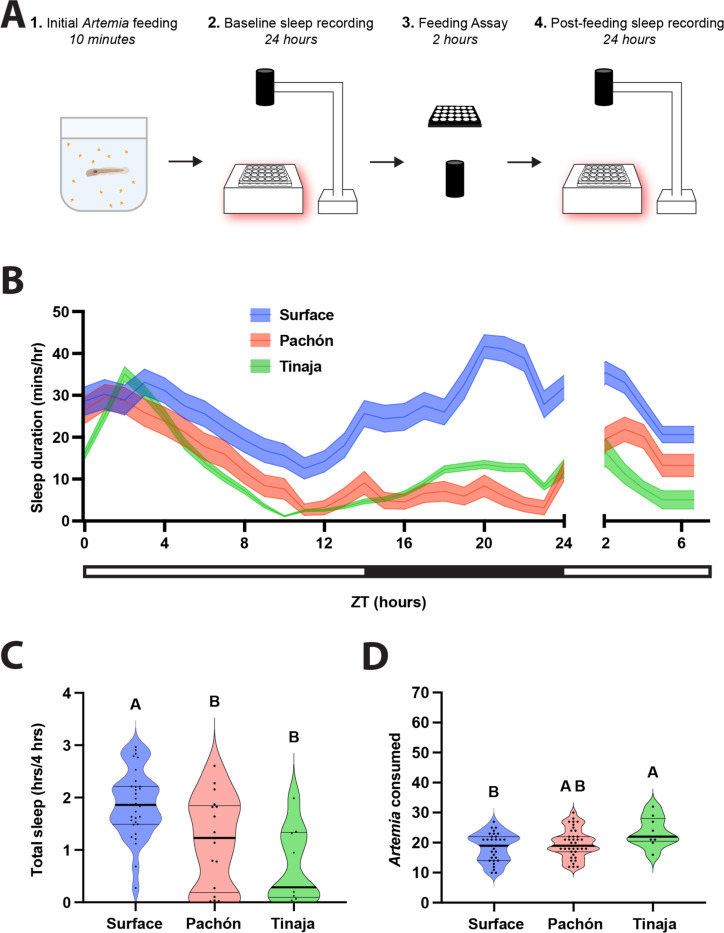
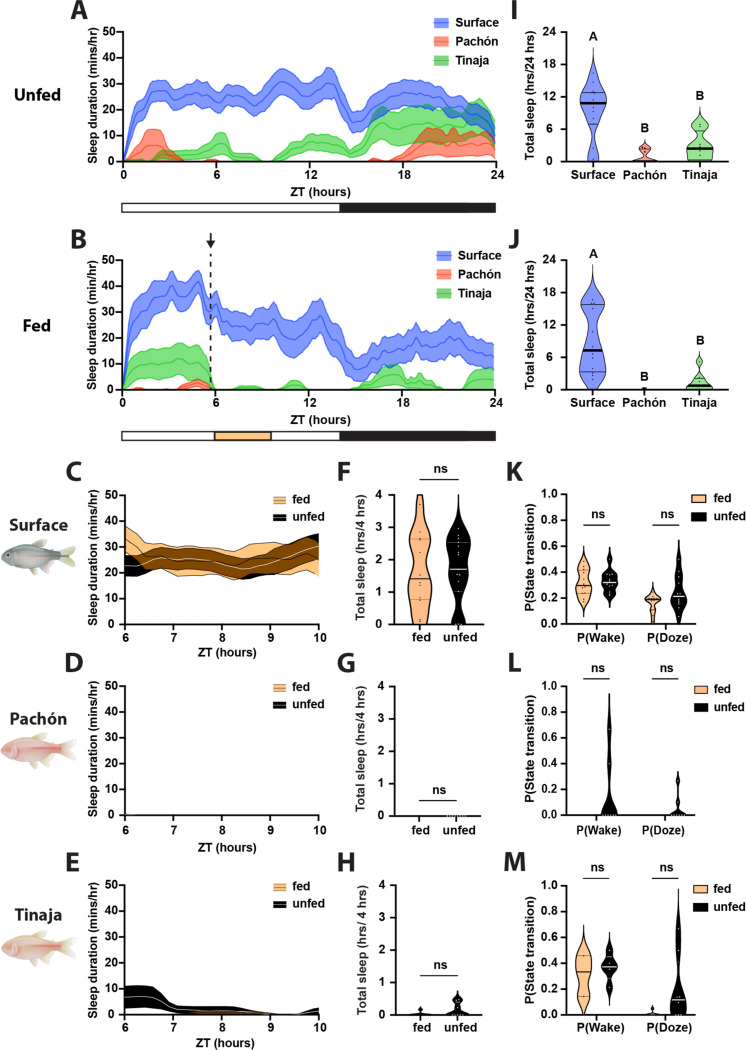
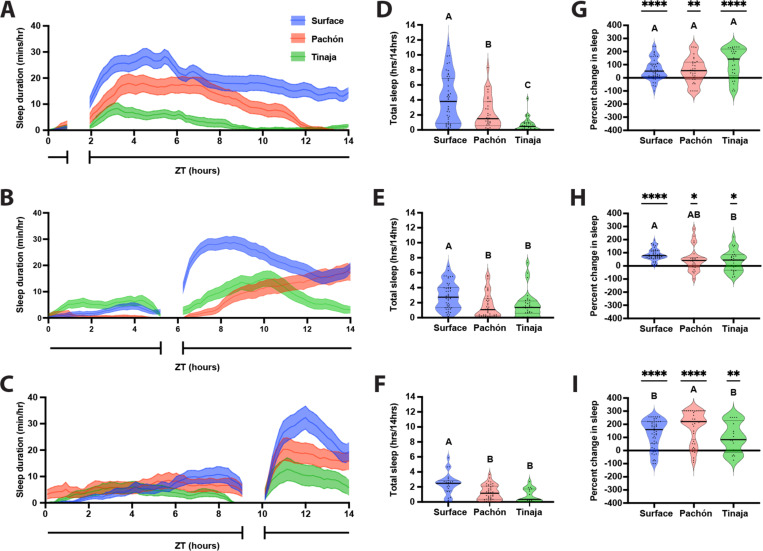
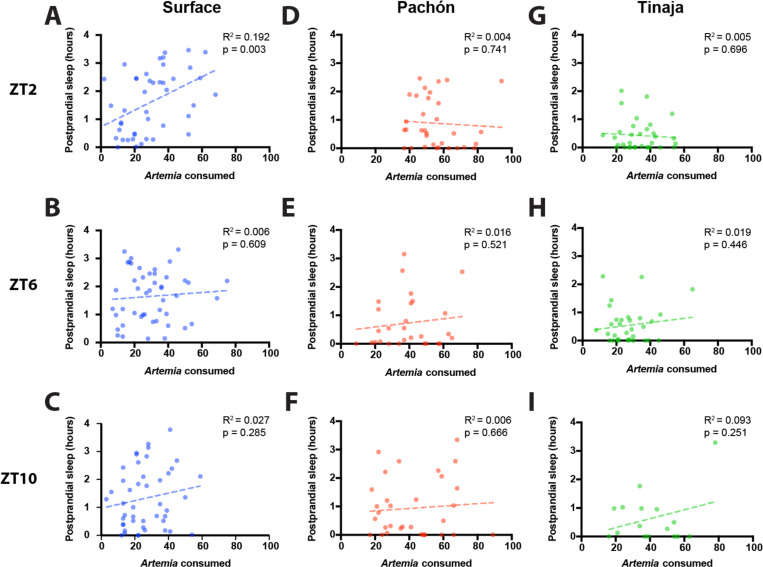
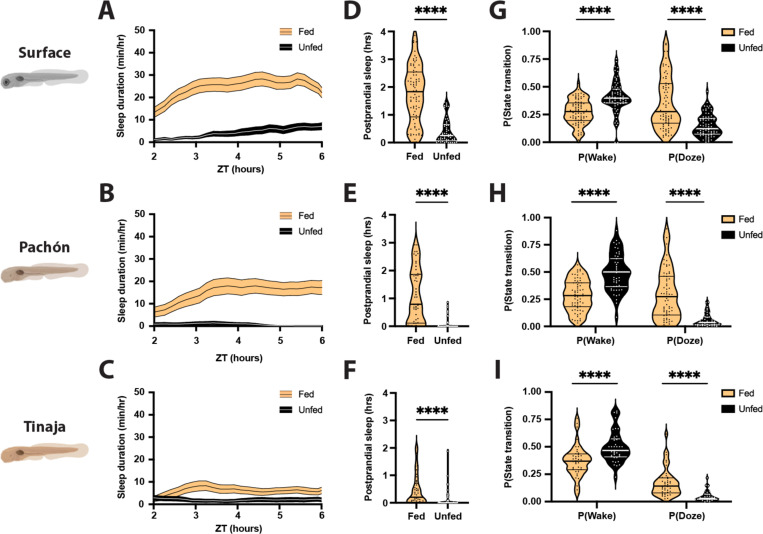
Interaction between sleep and feeding behaviors are critical for adaptive fitness. Diverse species suppress sleep when food is scarce to increase the time spent foraging. Post-prandial sleep, an increase in sleep time following a feeding event, has been documented in vertebrate and invertebrate animals. While interactions between sleep and feeding appear to be highly conserved, the evolution of postprandial sleep in response to changes in food availability remains poorly understood. Multiple populations of the Mexican cavefish, have independently evolved sleep loss and increased food consumption compared to surface-dwelling fish of the same species, providing the opportunity to investigate the evolution of interactions between sleep and feeding. Here, we investigate effects of feeding on sleep in larval and adult surface fish, and two parallelly evolved cave populations of Larval surface and cave populations of increase sleep immediately following a meal, providing the first evidence of postprandial sleep in a fish model. The amount of sleep was not correlated to meal size and occurred independently of feeding time. In contrast to larvae, postprandial sleep was not detected in adult surface or cavefish, that can survive for months without food. Together, these findings reveal that postprandial sleep is present in multiple short-sleeping populations of cavefish, suggesting sleep-feeding interactions are retained despite the evolution of sleep loss. These findings raise the possibility that postprandial sleep is critical for energy conservation and survival in larvae that are highly sensitive to food deprivation.
睡眠与进食行为之间的相互作用对适应性健康至关重要。在食物稀缺时,多种物种会抑制睡眠以增加觅食时间。餐后睡眠,即进食事件后睡眠时间的增加,已在脊椎动物和无脊椎动物中得到记录。虽然睡眠与进食之间的相互作用似乎高度保守,但餐后睡眠随食物可利用性变化的进化仍知之甚少。与同物种的表层鱼类相比,墨西哥洞螈的多个种群独立进化出了睡眠缺失和食物消耗增加的现象,这为研究睡眠与进食之间相互作用的进化提供了机会。在这里,我们研究了进食对幼体和成体表层鱼类以及两个平行进化的洞螈种群睡眠的影响。幼体表层和洞螈种群在进食后立即增加睡眠,这为鱼类模型中的餐后睡眠提供了首个证据。睡眠量与进食量无关,且与进食时间无关。与幼体不同,在成体表层或洞螈中未检测到餐后睡眠,它们可以数月不进食而存活。总之,这些发现表明餐后睡眠存在于多个睡眠较少的洞螈种群中,这表明尽管睡眠缺失在进化,但睡眠与进食的相互作用仍然保留。这些发现增加了餐后睡眠对高度敏感于食物剥夺的幼体的能量保存和生存至关重要的可能性。