Division of Human Nutrition and Health, Wageningen University & Research, P.O. Box 12, 6700 AA, Wageningen, The Netherlands.
Department of Public Health and Caring Sciences, Clinical Nutrition and Metabolism, Uppsala University, Uppsala, Sweden.
Eur J Nutr. 2022 Oct;61(7):3731-3739. doi: 10.1007/s00394-022-02924-w. Epub 2022 Jun 15.
Trials aiming to lower homocysteine by B-vitamin supplementation have reported mixed results on slowing cognitive decline. We investigated if efficacy of B-vitamin supplementation is affected by baseline plasma omega-3 fatty acid levels.
This post-hoc analysis of the B-proof trial included 191 adults aged 65 years or older with baseline plasma total homocysteine ≥ 12 μmol/L, randomly assigned to 400 µg folic acid and 500 µg vitamin B12 or placebo daily for 2 years. Global and domain-specific cognitive functioning were assessed at baseline and after 2 years. The effect of B-vitamin supplementation was analyzed according to tertiles of baseline plasma omega-3 fatty acids concentrations combined, and eicosapentaenoic acid (EPA) and docosahexaenoic acid (DHA) individually using multiple linear regression analyses.
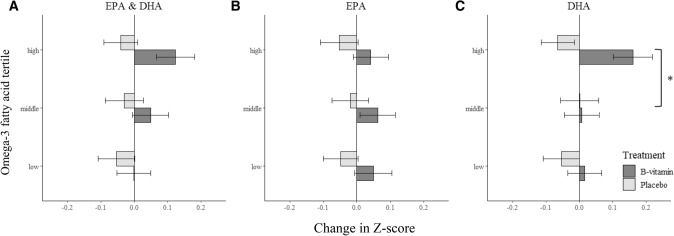
The mean ± SD age of the participants was 71.6 ± 5.9 years and median [IQR] Mini-Mental State Examination was 29 [28-30]. The treatment effect of B-vitamins on global cognition was larger in participants in the high compared to the middle DHA tertile (difference in z-score, mean ± SE 0.22 ± 0.10, p = 0.03). There was no significant interaction between B-vitamin supplementation and combined omega-3 fatty acid (p = 0.49) and EPA (p = 0.99) tertiles. Similarly, the efficacy of B-vitamin treatment on domain-specific cognitive functioning did not link to omega-3 fatty acid, DHA, or EPA plasma levels.
This post-hoc analysis indicated that efficacy of B-vitamin supplementation in slowing cognitive decline relates to DHA status, with individuals with higher plasma DHA levels benefitting more from vitamin B12 and folic acid use. The results support earlier observations that positive effects of B-vitamins in cognitive ageing may be subgroup-specific.
Registered at clinicaltrials.gov (NCT00696514) on June 12, 2008.
通过补充维生素 B 来降低同型半胱氨酸的试验报告显示,其对减缓认知能力下降的效果存在差异。我们研究了补充维生素 B 的效果是否受到基线血浆 ω-3 脂肪酸水平的影响。
本项 B-证明试验的事后分析纳入了 191 名年龄在 65 岁或以上、基线血浆总同型半胱氨酸≥12 μmol/L 的成年人,他们被随机分配每天服用 400 μg 叶酸和 500 μg 维生素 B12 或安慰剂,为期 2 年。在基线和 2 年后评估整体和特定领域的认知功能。根据基线血浆 ω-3 脂肪酸浓度的三分位数,以及 EPA 和 DHA 单独的情况,使用多元线性回归分析,分析补充维生素 B 的效果。
参与者的平均年龄为 71.6±5.9 岁,中位数[IQR]简易精神状态检查为 29[28-30]。与中间 DHA 三分位数相比,高 DHA 三分位数的参与者补充维生素 B 对整体认知的治疗效果更大(z 分数差值,均值±SE 0.22±0.10,p=0.03)。维生素 B 补充与组合 ω-3 脂肪酸(p=0.49)和 EPA(p=0.99)三分位数之间没有显著的相互作用。同样,补充维生素 B 对特定领域认知功能的疗效与 ω-3 脂肪酸、DHA 或 EPA 血浆水平无关。
本项事后分析表明,补充维生素 B 减缓认知能力下降的效果与 DHA 状况有关,血浆 DHA 水平较高的个体从维生素 B12 和叶酸的使用中获益更多。这些结果支持了之前的观察结果,即维生素 B 在认知老化中的积极作用可能具有亚组特异性。
2008 年 6 月 12 日在 clinicaltrials.gov 注册(NCT00696514)。