• 文献检索
  • 文档翻译
  • 深度研究
  • 学术资讯
  • Suppr Zotero 插件Zotero 插件
  • 邀请有礼
  • 套餐&价格
  • 历史记录
应用&插件
Suppr Zotero 插件Zotero 插件浏览器插件Mac 客户端Windows 客户端微信小程序
定价
高级版会员购买积分包购买API积分包
服务
文献检索文档翻译深度研究API 文档MCP 服务
关于我们
关于 Suppr公司介绍联系我们用户协议隐私条款
关注我们

Suppr 超能文献

核心技术专利:CN118964589B侵权必究
粤ICP备2023148730 号-1Suppr @ 2026

文献检索

告别复杂PubMed语法,用中文像聊天一样搜索,搜遍4000万医学文献。AI智能推荐,让科研检索更轻松。

立即免费搜索

文件翻译

保留排版,准确专业,支持PDF/Word/PPT等文件格式,支持 12+语言互译。

免费翻译文档

深度研究

AI帮你快速写综述,25分钟生成高质量综述,智能提取关键信息,辅助科研写作。

立即免费体验

基于 122969 次筛查检查的回顾性数据,探讨人工智能在乳腺 X 线摄影筛查阅读中的应用策略。

Possible strategies for use of artificial intelligence in screen-reading of mammograms, based on retrospective data from 122,969 screening examinations.

机构信息

Section for Breast Cancer Screening, Cancer Registry of Norway, Oslo, Norway.

Department of Radiology, Ålesund Hospital, Møre og Romsdal Hospital Trust, Ålesund, Norway.

出版信息

Eur Radiol. 2022 Dec;32(12):8238-8246. doi: 10.1007/s00330-022-08909-x. Epub 2022 Jun 15.

DOI:10.1007/s00330-022-08909-x
PMID:35704111
原文链接:https://pmc.ncbi.nlm.nih.gov/articles/PMC9705475/
Abstract

OBJECTIVES

Artificial intelligence (AI) has shown promising results when used on retrospective data from mammographic screening. However, few studies have explored the possible consequences of different strategies for combining AI and radiologists in screen-reading.

METHODS

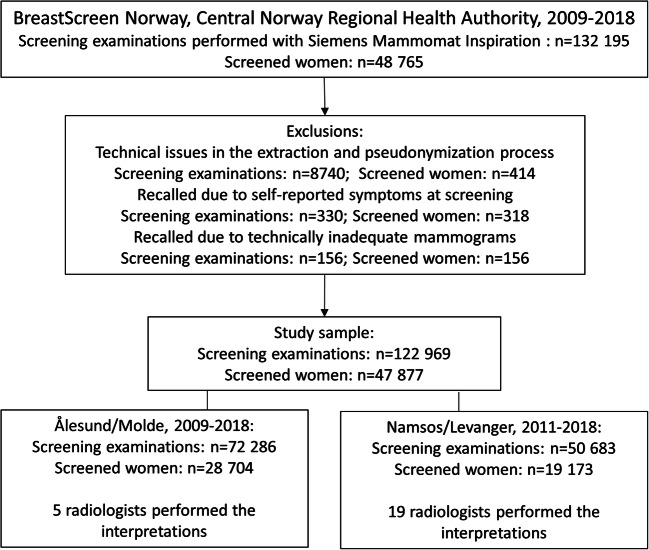
A total of 122,969 digital screening examinations performed between 2009 and 2018 in BreastScreen Norway were retrospectively processed by an AI system, which scored the examinations from 1 to 10; 1 indicated low suspicion of malignancy and 10 high suspicion. Results were merged with information about screening outcome and used to explore consensus, recall, and cancer detection for 11 different scenarios of combining AI and radiologists.

RESULTS

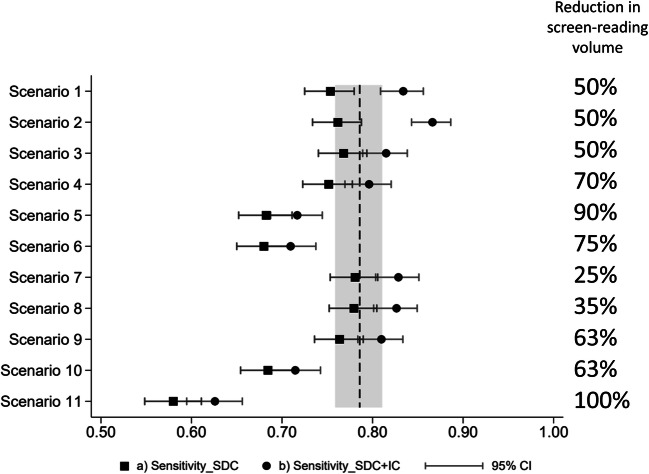
Recall was 3.2%, screen-detected cancer 0.61% and interval cancer 0.17% after independent double reading and served as reference values. In a scenario where examinations with AI scores 1-5 were considered negative and 6-10 resulted in standard independent double reading, the estimated recall was 2.6% and screen-detected cancer 0.60%. When scores 1-9 were considered negative and score 10 double read, recall was 1.2% and screen-detected cancer 0.53%. In these two scenarios, potential rates of screen-detected cancer could be up to 0.63% and 0.56%, if the interval cancers selected for consensus were detected at screening. In the former scenario, screen-reading volume would be reduced by 50%, while the latter would reduce the volume by 90%.

CONCLUSION

Several theoretical scenarios with AI and radiologists have the potential to reduce the volume in screen-reading without affecting cancer detection substantially. Possible influence on recall and interval cancers must be evaluated in prospective studies.

KEY POINTS

• Different scenarios using artificial intelligence in combination with radiologists could reduce the screen-reading volume by 50% and result in a rate of screen-detected cancer ranging from 0.59% to 0.60%, compared to 0.61% after standard independent double reading • The use of artificial intelligence in combination with radiologists has the potential to identify negative screening examinations with high precision in mammographic screening and to reduce the rate of interval cancer.

摘要

目的

人工智能(AI)在使用乳腺筛查的回顾性数据时显示出了有前景的结果。然而,很少有研究探讨在乳腺筛查中结合 AI 和放射科医生的不同策略的可能后果。

方法

2009 年至 2018 年间,挪威乳腺筛查项目共对 122969 例数字筛查检查进行了回顾性处理,由一个 AI 系统对这些检查进行评分,从 1 到 10 分;1 分表示恶性肿瘤低怀疑度,10 分表示高怀疑度。结果与筛查结果信息合并,用于探索 11 种不同的 AI 与放射科医生结合场景下的共识、召回率和癌症检出率。

结果

独立双读时的召回率为 3.2%,检出的癌症为 0.61%,间隔癌为 0.17%,作为参考值。在一种情况下,将 AI 评分 1-5 的检查视为阴性,将 6-10 分的检查进行标准独立双读,估计的召回率为 2.6%,检出的癌症为 0.60%。当评分 1-9 视为阴性,评分 10 分时进行双读,召回率为 1.2%,检出的癌症为 0.53%。在这两种情况下,如果为了共识而选择的间隔癌在筛查中被检出,潜在的检出癌症率可能高达 0.63%和 0.56%。在前一种情况下,乳腺筛查的阅读量将减少 50%,而后一种情况将减少 90%。

结论

使用 AI 与放射科医生结合的几种理论场景有可能在不显著影响癌症检出率的情况下减少阅读量。在前瞻性研究中必须评估对召回率和间隔癌的可能影响。

重点

  • 使用 AI 与放射科医生结合的不同场景可以将阅读量减少 50%,并使检出癌症的比例在 0.59%到 0.60%之间,而标准独立双读的比例为 0.61%。

  • 在乳腺筛查中使用 AI 与放射科医生结合有可能以高精度识别阴性筛查检查,并降低间隔癌的发生率。
https://cdn.ncbi.nlm.nih.gov/pmc/blobs/5ff9/9705475/10ccc45376a8/330_2022_8909_Fig2_HTML.jpg
https://cdn.ncbi.nlm.nih.gov/pmc/blobs/5ff9/9705475/3a51ee338002/330_2022_8909_Fig1_HTML.jpg
https://cdn.ncbi.nlm.nih.gov/pmc/blobs/5ff9/9705475/10ccc45376a8/330_2022_8909_Fig2_HTML.jpg
https://cdn.ncbi.nlm.nih.gov/pmc/blobs/5ff9/9705475/3a51ee338002/330_2022_8909_Fig1_HTML.jpg
https://cdn.ncbi.nlm.nih.gov/pmc/blobs/5ff9/9705475/10ccc45376a8/330_2022_8909_Fig2_HTML.jpg

相似文献

1
Possible strategies for use of artificial intelligence in screen-reading of mammograms, based on retrospective data from 122,969 screening examinations.基于 122969 次筛查检查的回顾性数据,探讨人工智能在乳腺 X 线摄影筛查阅读中的应用策略。
Eur Radiol. 2022 Dec;32(12):8238-8246. doi: 10.1007/s00330-022-08909-x. Epub 2022 Jun 15.
2
Artificial intelligence in BreastScreen Norway: a retrospective analysis of a cancer-enriched sample including 1254 breast cancer cases.挪威乳腺 X 线筛查中的人工智能:包括 1254 例乳腺癌病例的癌症富集样本的回顾性分析。
Eur Radiol. 2023 May;33(5):3735-3743. doi: 10.1007/s00330-023-09461-y. Epub 2023 Mar 14.
3
Artificial intelligence-supported screen reading versus standard double reading in the Mammography Screening with Artificial Intelligence trial (MASAI): a clinical safety analysis of a randomised, controlled, non-inferiority, single-blinded, screening accuracy study.人工智能支持的屏幕阅读与人工智能筛查中的标准双读(MASAI)试验:一项随机、对照、非劣效、单盲、筛查准确性研究的临床安全性分析。
Lancet Oncol. 2023 Aug;24(8):936-944. doi: 10.1016/S1470-2045(23)00298-X.
4
Artificial intelligence (AI) for breast cancer screening: BreastScreen population-based cohort study of cancer detection.人工智能(AI)在乳腺癌筛查中的应用:基于乳腺筛查人群队列的癌症检测研究。
EBioMedicine. 2023 Apr;90:104498. doi: 10.1016/j.ebiom.2023.104498. Epub 2023 Feb 28.
5
Breast cancer screening with digital breast tomosynthesis: comparison of different reading strategies implementing artificial intelligence.数字乳腺断层合成筛查乳腺癌:不同人工智能阅读策略的比较。
Eur Radiol. 2023 May;33(5):3754-3765. doi: 10.1007/s00330-022-09316-y. Epub 2022 Dec 11.
6
Performance of an Artificial Intelligence System for Breast Cancer Detection on Screening Mammograms from BreastScreen Norway.基于挪威乳腺筛查项目的筛查性乳腺钼靶 X 光片评估乳腺癌检测人工智能系统的性能。
Radiol Artif Intell. 2024 May;6(3):e230375. doi: 10.1148/ryai.230375.
7
AI performance by mammographic density in a retrospective cohort study of 99,489 participants in BreastScreen Norway.挪威乳腺筛查项目中 99489 名参与者的回顾性队列研究中乳腺密度对 AI 性能的影响。
Eur Radiol. 2024 Oct;34(10):6298-6308. doi: 10.1007/s00330-024-10681-z. Epub 2024 Mar 25.
8
Artificial Intelligence Evaluation of 122 969 Mammography Examinations from a Population-based Screening Program.基于人群筛查计划的 122969 例乳腺 X 线摄影检查的人工智能评估。
Radiology. 2022 Jun;303(3):502-511. doi: 10.1148/radiol.212381. Epub 2022 Mar 29.
9
An Artificial Intelligence-based Mammography Screening Protocol for Breast Cancer: Outcome and Radiologist Workload.基于人工智能的乳腺癌 X 光筛查协议:结果和放射科医生的工作量。
Radiology. 2022 Jul;304(1):41-49. doi: 10.1148/radiol.210948. Epub 2022 Apr 19.
10
How do AI markings on screening mammograms correspond to cancer location? An informed review of 270 breast cancer cases in BreastScreen Norway.乳腺 X 线筛查片上的人工智能标记与癌症位置如何对应?对 270 例挪威乳腺筛查乳腺癌病例的知情审查。
Eur Radiol. 2024 Sep;34(9):6158-6167. doi: 10.1007/s00330-024-10662-2. Epub 2024 Feb 23.

引用本文的文献

1
Current Strategies to Reducing Interval Breast Cancers: A Systematic Review.降低间期乳腺癌的当前策略:一项系统综述
Breast Cancer (Dove Med Press). 2025 Jun 27;17:531-544. doi: 10.2147/BCTT.S532884. eCollection 2025.
2
Workload reduction of digital breast tomosynthesis screening using artificial intelligence and synthetic mammography: a simulation study.使用人工智能和合成乳腺摄影术降低数字乳腺断层合成筛查的工作量:一项模拟研究。
J Med Imaging (Bellingham). 2025 Nov;12(Suppl 2):S22005. doi: 10.1117/1.JMI.12.S2.S22005. Epub 2025 Apr 30.
3
Mammographic classification of interval breast cancers and artificial intelligence performance.

本文引用的文献

1
A Warning about Warning Signals for Interpreting Mammograms.关于解读乳房X光检查警示信号的一则警告。
Radiology. 2022 Feb;302(2):284-285. doi: 10.1148/radiol.2021212092. Epub 2021 Nov 9.
2
Use of artificial intelligence for image analysis in breast cancer screening programmes: systematic review of test accuracy.人工智能在乳腺癌筛查计划中的图像分析应用:测试准确性的系统评价。
BMJ. 2021 Sep 1;374:n1872. doi: 10.1136/bmj.n1872.
3
Does it matter for the radiologists' performance whether they read short or long batches in organized mammographic screening?
间期乳腺癌的乳腺钼靶分类及人工智能性能
J Natl Cancer Inst. 2025 Apr 18. doi: 10.1093/jnci/djaf103.
4
Impact of human and artificial intelligence collaboration on workload reduction in medical image interpretation.人类与人工智能协作对医学图像解读中工作量减少的影响。
NPJ Digit Med. 2024 Nov 30;7(1):349. doi: 10.1038/s41746-024-01328-w.
5
Artificial Intelligence and Radiologist Burnout.人工智能与放射科医生 burnout(职业倦怠)。
JAMA Netw Open. 2024 Nov 4;7(11):e2448714. doi: 10.1001/jamanetworkopen.2024.48714.
6
Microwave imaging for breast cancer screening: protocol for an open, multicentric, interventional, prospective, non-randomised clinical investigation to evaluate cancer detection capabilities of MammoWave system on an asymptomatic population across multiple European countries.用于乳腺癌筛查的微波成象:一项开放性、多中心、介入性、前瞻性、非随机临床研究的方案,旨在评估 MammoWave 系统在多个欧洲国家的无症状人群中对癌症检测能力。
BMJ Open. 2024 Nov 2;14(11):e088431. doi: 10.1136/bmjopen-2024-088431.
7
AI-integrated Screening to Replace Double Reading of Mammograms: A Population-wide Accuracy and Feasibility Study.人工智能集成筛查取代乳腺钼靶双读片:一项全人群准确性和可行性研究。
Radiol Artif Intell. 2024 Nov;6(6):e230529. doi: 10.1148/ryai.230529.
8
Simulated arbitration of discordance between radiologists and artificial intelligence interpretation of breast cancer screening mammograms.放射科医生与人工智能对乳腺癌筛查乳房X光片解读不一致的模拟仲裁
J Med Screen. 2025 Mar;32(1):48-52. doi: 10.1177/09691413241262960. Epub 2024 Aug 11.
9
Modeling Radiologists' Assessments to Explore Pairing Strategies for Optimized Double Reading of Screening Mammograms.建立放射科医生的评估模型,探索优化筛查性乳房 X 光照片双读的配对策略。
Med Decis Making. 2024 Oct;44(7):828-842. doi: 10.1177/0272989X241264572. Epub 2024 Jul 30.
10
Frequency and characteristics of errors by artificial intelligence (AI) in reading screening mammography: a systematic review.人工智能(AI)在阅读筛查性乳房 X 光摄影中出现错误的频率和特征:系统评价。
Breast Cancer Res Treat. 2024 Aug;207(1):1-13. doi: 10.1007/s10549-024-07353-3. Epub 2024 Jun 9.
对于在有组织的乳腺筛查中,放射科医生阅读短批次还是长批次的影像,其表现是否有影响?
Eur Radiol. 2021 Dec;31(12):9548-9555. doi: 10.1007/s00330-021-08010-9. Epub 2021 Jun 10.
4
A Review of Applications of Machine Learning in Mammography and Future Challenges.机器学习在乳腺 X 线摄影中的应用综述及未来挑战
Oncology. 2021;99(8):483-490. doi: 10.1159/000515698. Epub 2021 May 21.
5
Adoption of artificial intelligence in breast imaging: evaluation, ethical constraints and limitations.人工智能在乳腺成像中的应用:评估、伦理限制和局限性。
Br J Cancer. 2021 Jul;125(1):15-22. doi: 10.1038/s41416-021-01333-w. Epub 2021 Mar 26.
6
Effect of artificial intelligence-based triaging of breast cancer screening mammograms on cancer detection and radiologist workload: a retrospective simulation study.基于人工智能的乳腺癌筛查钼靶图像分诊对癌症检出率和放射科医生工作量的影响:一项回顾性模拟研究。
Lancet Digit Health. 2020 Sep;2(9):e468-e474. doi: 10.1016/S2589-7500(20)30185-0.
7
Radiological review of prior screening mammograms of screen-detected breast cancer.筛查性乳腺钼靶 X 光检查检出乳腺癌的既往筛查钼靶 X 光片影像学评价
Eur Radiol. 2021 Apr;31(4):2568-2579. doi: 10.1007/s00330-020-07130-y. Epub 2020 Oct 1.
8
Identifying normal mammograms in a large screening population using artificial intelligence.利用人工智能识别大规模筛查人群中的正常乳腺 X 光片。
Eur Radiol. 2021 Mar;31(3):1687-1692. doi: 10.1007/s00330-020-07165-1. Epub 2020 Sep 2.
9
External Evaluation of 3 Commercial Artificial Intelligence Algorithms for Independent Assessment of Screening Mammograms.商业人工智能算法独立评估筛查性乳房 X 光照片的外部评估。
JAMA Oncol. 2020 Oct 1;6(10):1581-1588. doi: 10.1001/jamaoncol.2020.3321.
10
Risk of breast cancer by prior screening results among women participating in BreastScreen Norway.挪威乳腺筛查项目中既往筛查结果与乳腺癌发病风险的关系。
Cancer. 2019 Oct 1;125(19):3330-3337. doi: 10.1002/cncr.32330. Epub 2019 Jun 17.