From the Section for Breast Cancer Screening (M.L., C.F.A., S.H.) and Department of Register Informatics (J.F.N.), Cancer Registry of Norway (G.U.), P.O. Box 5313, 0304 Oslo, Norway; Department of Health and Care Sciences, Faculty of Health Sciences, The Arctic University of Norway, Tromsø, Norway (S.H.); Department of Radiology, University of Washington School of Medicine, Seattle, Wash (C.I.L.); Department of Health Systems and Population Health, University of Washington School of Public Health, Seattle, Wash (C.I.L.); Department of Radiology, Ålesund Hospital, Møre og Romsdal Hospital Trust, Ålesund, Norway (S.R.H.); Department of Circulation and Medical Imaging, Faculty of Medicine and Health Sciences, National University for Science and Technology, Trondheim, Norway (S.R.H.); Department of Radiology and Nuclear Medicine, St Olavs University Hospital, Trondheim, Norway (H.L.H.); Department of Translational Medicine, Lund University, Lund, Sweden (K.L.); and Unilabs Mammography Unit, Skåne University Hospital, Malmö, Sweden (K.L.).
Radiology. 2022 Jun;303(3):502-511. doi: 10.1148/radiol.212381. Epub 2022 Mar 29.
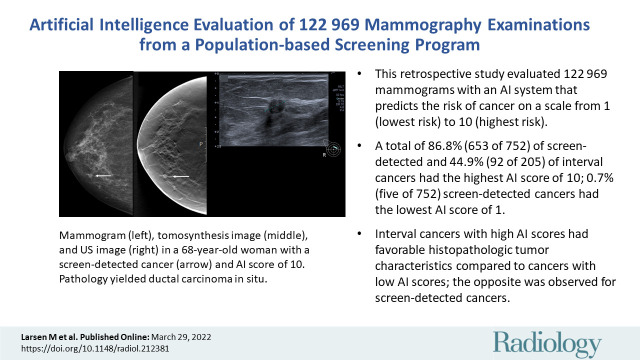
Background Artificial intelligence (AI) has shown promising results for cancer detection with mammographic screening. However, evidence related to the use of AI in real screening settings remain sparse. Purpose To compare the performance of a commercially available AI system with routine, independent double reading with consensus as performed in a population-based screening program. Furthermore, the histopathologic characteristics of tumors with different AI scores were explored. Materials and Methods In this retrospective study, 122 969 screening examinations from 47 877 women performed at four screening units in BreastScreen Norway from October 2009 to December 2018 were included. The data set included 752 screen-detected cancers (6.1 per 1000 examinations) and 205 interval cancers (1.7 per 1000 examinations). Each examination had an AI score between 1 and 10, where 1 indicated low risk of breast cancer and 10 indicated high risk. Threshold 1, threshold 2, and threshold 3 were used to assess the performance of the AI system as a binary decision tool (selected vs not selected). Threshold 1 was set at an AI score of 10, threshold 2 was set to yield a selection rate similar to the consensus rate (8.8%), and threshold 3 was set to yield a selection rate similar to an average individual radiologist (5.8%). Descriptive statistics were used to summarize screening outcomes. Results A total of 653 of 752 screen-detected cancers (86.8%) and 92 of 205 interval cancers (44.9%) were given a score of 10 by the AI system (threshold 1). Using threshold 3, 80.1% of the screen-detected cancers (602 of 752) and 30.7% of the interval cancers (63 of 205) were selected. Screen-detected cancer with AI scores not selected using the thresholds had favorable histopathologic characteristics compared to those selected; opposite results were observed for interval cancer. Conclusion The proportion of screen-detected cancers not selected by the artificial intelligence (AI) system at the three evaluated thresholds was less than 20%. The overall performance of the AI system was promising according to cancer detection. © RSNA, 2022.
背景 人工智能(AI)在乳腺筛查的癌症检测中显示出有前景的结果。然而,在基于人群的筛查计划中使用 AI 的相关证据仍然很少。目的 比较一种商业上可用的 AI 系统与常规的、独立的双读片并以共识方式进行的表现,这种双读片并以共识方式在人群筛查项目中进行。此外,还探讨了不同 AI 评分的肿瘤的组织病理学特征。材料与方法 在这项回顾性研究中,纳入了 2009 年 10 月至 2018 年 12 月在挪威乳腺筛查中心的四个筛查单位进行的 47877 名女性的 122969 次筛查检查。数据集包括 752 例筛查发现的癌症(每 1000 次检查中 6.1 例)和 205 例间隔期癌症(每 1000 次检查中 1.7 例)。每次检查的 AI 评分为 1 至 10 分,其中 1 分表示乳腺癌风险低,10 分表示乳腺癌风险高。使用阈值 1、阈值 2 和阈值 3 来评估 AI 系统作为二分类决策工具的性能(选择与未选择)。阈值 1 设置为 AI 评分 10,阈值 2 设置为选择率与共识率相似(8.8%),阈值 3 设置为选择率与平均个体放射科医生相似(5.8%)。使用描述性统计来总结筛查结果。结果 在 AI 系统中,653 例筛查发现的癌症(86.8%)和 205 例间隔期癌症(44.9%)的评分均为 10(阈值 1)。使用阈值 3,752 例筛查发现的癌症中有 80.1%(602 例)和 205 例间隔期癌症中有 30.7%(63 例)被选中。与选择的癌症相比,AI 评分未被三个阈值选择的筛查发现的癌症具有有利的组织病理学特征;而间隔期癌症的结果则相反。结论 在三个评估阈值下,人工智能(AI)系统未选择的筛查发现的癌症比例小于 20%。根据癌症检出率,AI 系统的整体性能很有前景。