John Walsh Centre for Rehabilitation Research, The Kolling Institute, Northern Sydney Local Health District, St Leonards, NSW, Australia.
Sydney Medical School - Northern, Faculty of Medicine and Health, The University of Sydney, Sydney, NSW, Australia.
Spinal Cord. 2022 Dec;60(12):1069-1079. doi: 10.1038/s41393-022-00817-7. Epub 2022 Jun 15.
Cross-sectional survey.
To identify common problems across key domains of functioning, health and wellbeing, as well as evaluate self-reported quality of life (QoL) by people with SCI, examining differences by age, gender, injury characteristics and level of mobility.
Data from four state-wide SCI clinical services, one government insurance agency and three not-for-profit consumer organisations.
Participants were 18 years or over with SCI and at least 12 months post-injury, recruited between Mar'18 and Jan'19. The Aus-InSCI questionnaire comprised 193 questions, including socio-demographics, SCI characteristics, body functions and structures, activities and participation, environmental and personal factors, and appraisal of health and well-being. General linear model was used to examine differences in functioning and QoL.
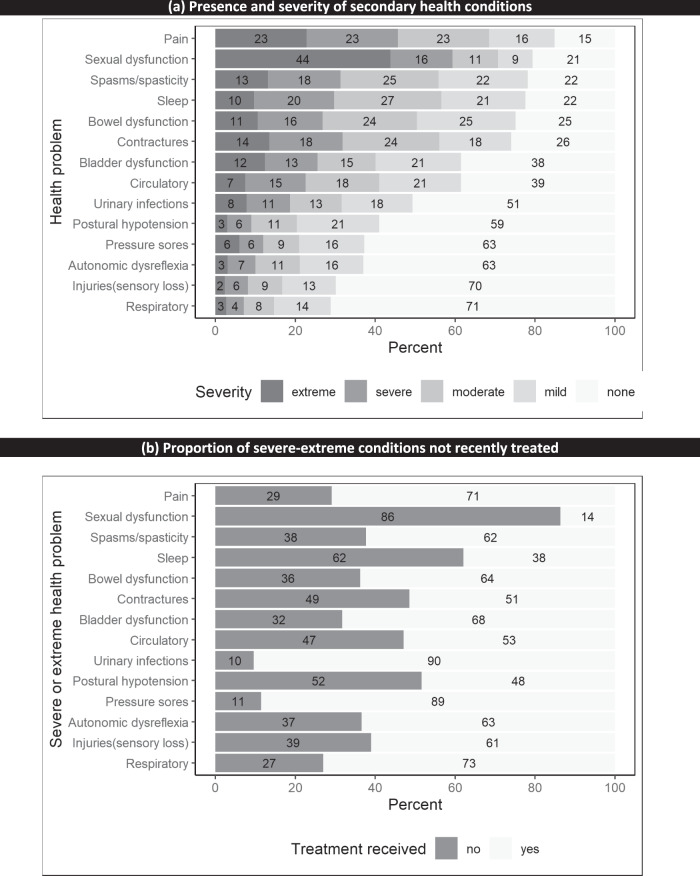
Participants (mean age 57 years, range 19-94 years) with tetraplegia and/or complete injuries had more health problems, activity/participation problems and environmental barriers. However, self-rated overall QoL did not differ for injury level or completeness. Participants with more recent injuries exhibited lower independence levels, more mental health problems and poorer satisfaction with self and their living conditions. Major activity/participation problems related to intimate relationships and accessing public transportation. Less than half of the working age population were engaged in paid work. The top two environmental barriers frequently related to accessing public places or homes and unfavourable climatic conditions.
This large, comprehensive community survey draws a detailed picture of the lived experience of people with SCI in Australia, identifying priority needs, gaps in services and barriers to achieving a full and satisfying life.
横断面调查。
确定关键功能、健康和幸福感领域的常见问题,并评估 SCI 患者的自我报告生活质量(QoL),同时检查年龄、性别、损伤特征和移动能力的差异。
数据来自四个全州范围的 SCI 临床服务机构、一个政府保险机构和三个非营利性消费者组织。
参与者年龄在 18 岁或以上,SCI 后至少 12 个月,于 2018 年 3 月至 2019 年 1 月期间招募。Aus-InSCI 问卷由 193 个问题组成,包括社会人口统计学、SCI 特征、身体功能和结构、活动和参与、环境和个人因素以及健康和幸福感评估。使用一般线性模型检查功能和 QoL 的差异。
参与者(平均年龄 57 岁,范围 19-94 岁)四肢瘫痪和/或完全损伤者有更多的健康问题、活动/参与问题和环境障碍。然而,损伤水平或完整性对自我报告的整体 QoL 没有差异。最近受伤的参与者表现出较低的独立性水平、更多的心理健康问题和对自我和生活条件的较差满意度。主要的活动/参与问题与亲密关系和使用公共交通工具有关。不到一半的工作年龄人口从事有薪工作。前两个环境障碍经常与进入公共场所或家庭以及不利的气候条件有关。
这项大型、综合的社区调查详细描绘了澳大利亚 SCI 患者的生活体验,确定了优先需求、服务差距和实现充实和满意生活的障碍。