Liu Nan, Liu Mingxuan, Chen Xinru, Ning Yilin, Lee Jin Wee, Siddiqui Fahad Javaid, Saffari Seyed Ehsan, Ho Andrew Fu Wah, Shin Sang Do, Ma Matthew Huei-Ming, Tanaka Hideharu, Ong Marcus Eng Hock
Duke-NUS Medical School, National University of Singapore, 8 College Road, Singapore 169857, Singapore.
Health Services Research Centre, Singapore Health Services, Singapore, Singapore.
EClinicalMedicine. 2022 May 6;48:101422. doi: 10.1016/j.eclinm.2022.101422. eCollection 2022 Jun.
Return of spontaneous circulation (ROSC) before arrival at the emergency department is an early indicator of successful resuscitation in out-of-hospital cardiac arrest (OHCA). Several ROSC prediction scores have been developed with European cohorts, with unclear applicability in Asian settings. We aimed to develop an interpretable prehospital ROSC (P-ROSC) score for ROSC prediction based on patients with OHCA in Asia.
This retrospective study examined patients who suffered from OHCA between Jan 1, 2009 and Jun 17, 2018 using data recorded in the Pan-Asian Resuscitation Outcomes Study (PAROS) registry. AutoScore, an interpretable machine learning framework, was used to develop P-ROSC. On the same cohort, the P-ROSC was compared with two clinical scores, the RACA and the UB-ROSC. The predictive power was evaluated using the area under the curve (AUC) in the receiver operating characteristic analysis.
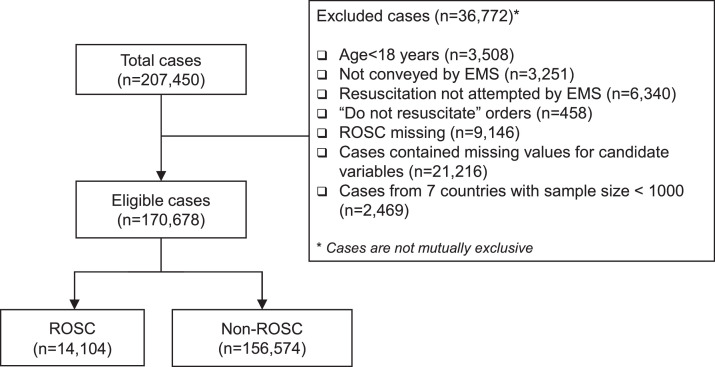
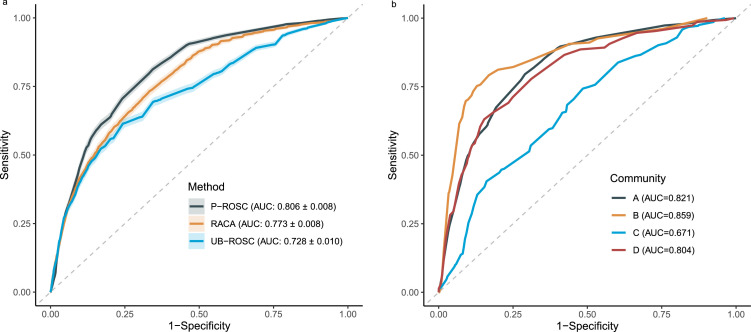
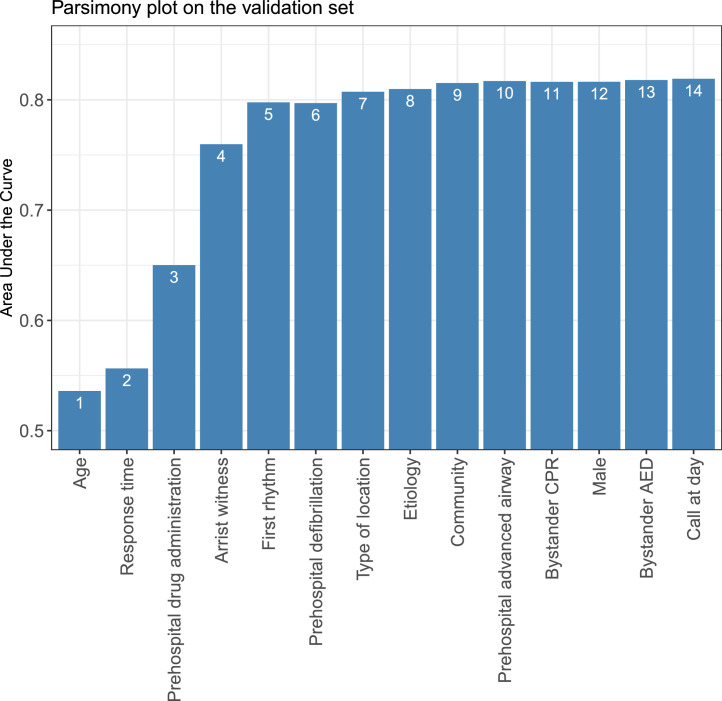
170,678 cases were included, of which 14,104 (8.26%) attained prehospital ROSC. The P-ROSC score identified a new variable, prehospital drug administration, which was not included in the RACA score or the UB-ROSC score. Using only five variables, the P-ROSC score achieved an AUC of 0.806 (95% confidence interval [CI] 0.799-0.814), outperforming both RACA and UB-ROSC with AUCs of 0.773 (95% CI 0.765-0.782) and 0.728 (95% CI 0.718-0.738), respectively.
The P-ROSC score is a practical and easily interpreted tool for predicting the probability of prehospital ROSC.
This research received funding from SingHealth Duke-NUS ACP Programme Funding (15/FY2020/P2/06-A79).
在抵达急诊科之前恢复自主循环(ROSC)是院外心脏骤停(OHCA)复苏成功的早期指标。欧洲队列已经开发了几种ROSC预测评分,但在亚洲环境中的适用性尚不清楚。我们旨在基于亚洲OHCA患者开发一种可解释的院前ROSC(P-ROSC)评分,用于预测ROSC。
这项回顾性研究使用泛亚复苏结局研究(PAROS)登记处记录的数据,检查了2009年1月1日至2018年6月17日期间发生OHCA的患者。使用可解释的机器学习框架AutoScore来开发P-ROSC。在同一队列中,将P-ROSC与两个临床评分RACA和UB-ROSC进行比较。在受试者工作特征分析中,使用曲线下面积(AUC)评估预测能力。
纳入170,678例病例,其中14,104例(8.26%)实现了院前ROSC。P-ROSC评分确定了一个新变量,即院前药物给药,这在RACA评分或UB-ROSC评分中均未包括。仅使用五个变量,P-ROSC评分的AUC达到0.806(95%置信区间[CI]0.799-0.814),优于RACA和UB-ROSC,它们的AUC分别为0.773(95%CI0.765-0.782)和0.728(95%CI0.718-0.738)。
P-ROSC评分是一种实用且易于解释的工具,用于预测院前ROSC的可能性。
本研究获得新加坡健康城杜克-国大急性冠脉综合征项目基金(15/FY2020/P2/06-A79)的资助。