Iturburu Alisson, Pallares Vela Elisa, Cruz Claudio, Yepez Mario, Ortiz Juan Fernando, Krishna Krithika, Peña Gabriela, Cordova Steven, Khurana Mahika, Bandarupalli Pranathi
General Medicine, Universidad de Guayaquil, Guayaquil, ECU.
General Medicine, California Institute of Behavioral Neurosciences & Psychology, California, USA.
Cureus. 2022 May 12;14(5):e24937. doi: 10.7759/cureus.24937. eCollection 2022 May.
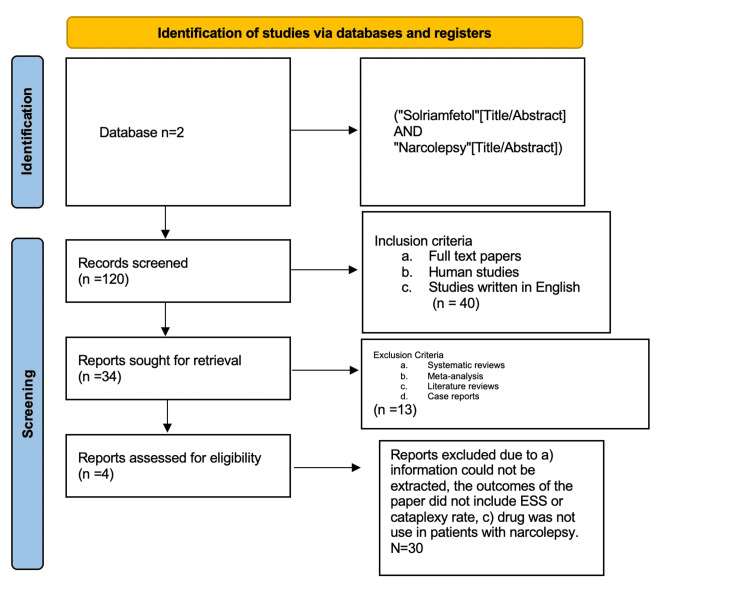
Narcolepsy is a chronic and disabling neurological disorder characterized by excessive daytime sleepiness (EDS) and cataplexy. Historically, some medications have demonstrated efficacy in managing EDS and cataplexy symptoms. However, some patients cannot tolerate them, become refractory, or may use concomitant medications that preclude the use due to drug-drug interaction. Therefore, there is a necessity to explore the efficacy of new treatments, such as solriamfetol (JZP-110), a 2019 FDA-approved drug indicated to improve wakefulness in adults with EDS associated with narcolepsy. We conducted this systematic review to investigate the effectiveness of solriamfetol in EDS and cataplexy, and the drug's overall safety. For this study, we used the PRISMA (Preferred Reporting Items for Systematic Reviews and Meta-Analyses) guidelines and MOOSE protocol. After an initial search of 119 papers, we included four clinical trials to investigate and analyze the use of solriamfetol for the treatment of narcolepsy. Solriamfetol was proven to improve objective measures of EDS in all clinical trials. We conducted this systematic review using objective measures such as the Epworth Sleepiness Scale and the Maintenance of Wakefulness Test. Overall, cataplexy was not formally evaluated in the four clinical trials; however, it demonstrated that EDS improved in patients with and without cataplexy. More clinical trials are needed to analyze the efficacy of solriamfetol on cataplexy. The effect of solriamfetol in EDS seems to be conclusive.
发作性睡病是一种慢性致残性神经疾病,其特征为日间过度嗜睡(EDS)和猝倒。从历史上看,一些药物已证明对管理EDS和猝倒症状有效。然而,一些患者无法耐受这些药物,会产生耐药性,或者可能正在使用的其他药物因药物相互作用而妨碍使用这些药物。因此,有必要探索新治疗方法的疗效,例如索利那非(JZP - 110),这是一种2019年获美国食品药品监督管理局(FDA)批准的药物,用于改善患有与发作性睡病相关的EDS的成年人的清醒状态。我们进行了这项系统评价,以研究索利那非在治疗EDS和猝倒方面的有效性以及该药物的总体安全性。在本研究中,我们采用了系统评价和Meta分析的首选报告项目(PRISMA)指南及流行病学观察性研究的Meta分析(MOOSE)方案。在初步检索119篇论文后,我们纳入了四项临床试验来研究和分析索利那非用于治疗发作性睡病的情况。在所有临床试验中,索利那非均被证明可改善EDS的客观指标。我们使用诸如爱泼沃斯嗜睡量表和清醒维持测试等客观指标进行了这项系统评价。总体而言,四项临床试验中未对猝倒进行正式评估;然而,结果表明,无论有无猝倒的患者,其EDS均有所改善。需要更多的临床试验来分析索利那非对猝倒的疗效。索利那非对EDS的疗效似乎是确凿的。