Department of Cardiology, Wuxi People's Hospital Affiliated to Nanjing Medical University, Wuxi, Jiangsu, China.
Bioengineered. 2022 May;13(5):13739-13751. doi: 10.1080/21655979.2022.2080413.
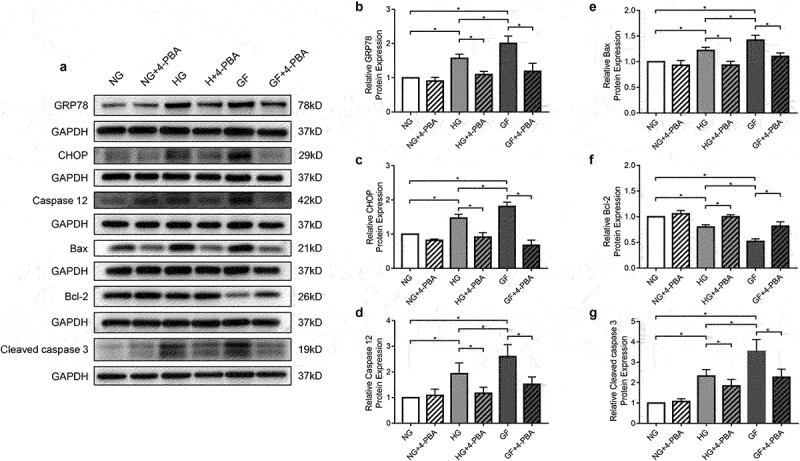
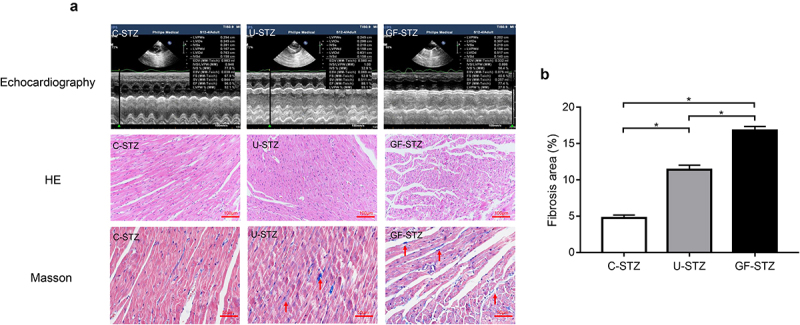
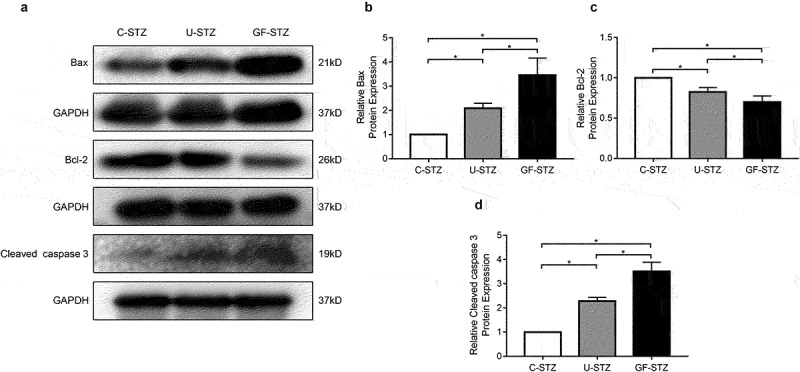
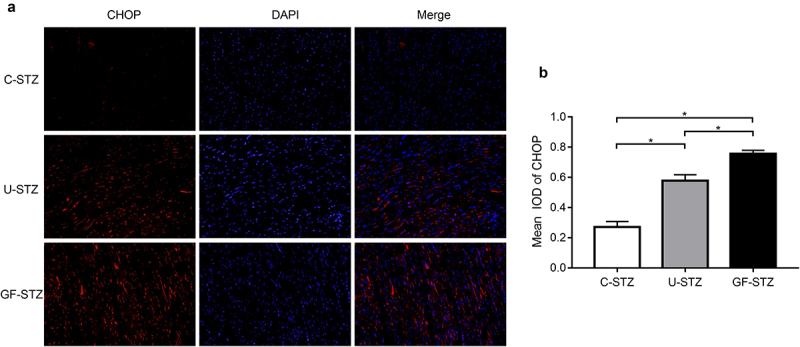
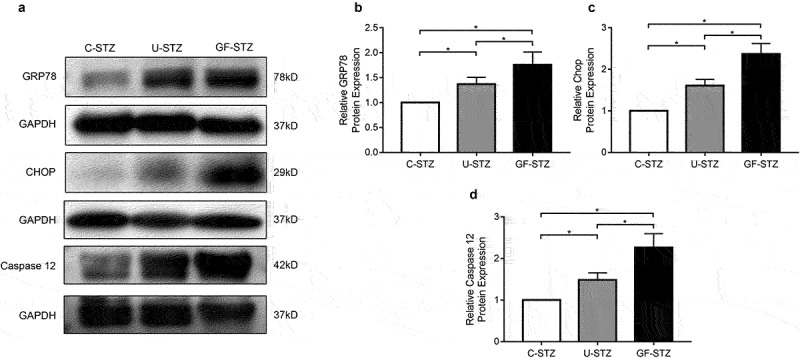
Glucose fluctuation is more harmful than sustained hyperglycemia, but the effect on cardiomyocyte apoptosis have not yet been clarified. In this study, we aim to identify the effect of glucose fluctuation on cardiomyocyte apoptosis and explore the underlying mechanism. Sprague-Dawley rats were intraperitoneally injected with streptozotocin (STZ) and divided into three groups: controlled diabetic group (C-STZ); uncontrolled diabetic group (U-STZ) and glucose fluctuated diabetic group (GF-STZ). After twelve weeks, echocardiography, Hematoxylin-eosin (HE) staining, and Masson staining were adopted to assess the cardiac function and pathological changes. TUNEL staining was used to detect apoptotic cells. Expressions of apoptosis-related proteins and key molecules in the endoplasmic reticulum (ER) stress pathway were determined via western blots. Further, primary cardiomyocytes incubated in different glucose conditions were treated with the inhibitor of ER stress to explore the causative role of ER stress in glucose fluctuation-induced cardiomyocyte apoptosis. , we demonstrated that glucose fluctuation promoted cardiomyocyte apoptosis, and were more harmful to cardiomyocytes than sustained hyperglycemia. Moreover, glucose fluctuation significantly triggered ER stress signaling pathway. , primary cardiomyocyte apoptosis induced by glucose fluctuation and the activation of ER stress were significantly attenuated by 4-PBA, which is an ER stress inhibitor. Above all, glucose fluctuation can promote cardiomyocyte apoptosis through triggering the ER stress signaling pathway in diabetic rats and in primary cardiomyocytes.
血糖波动比持续高血糖更有害,但血糖波动对心肌细胞凋亡的影响尚不清楚。在这项研究中,我们旨在确定血糖波动对心肌细胞凋亡的影响,并探讨其潜在机制。将 Sprague-Dawley 大鼠腹腔内注射链脲佐菌素(STZ),并分为三组:对照糖尿病组(C-STZ);未控制糖尿病组(U-STZ)和血糖波动糖尿病组(GF-STZ)。十二周后,采用超声心动图、苏木精-伊红(HE)染色和 Masson 染色评估心脏功能和病理变化。TUNEL 染色检测凋亡细胞。通过 Western blot 检测凋亡相关蛋白和内质网(ER)应激途径中的关键分子的表达。进一步,用 ER 应激抑制剂处理在不同葡萄糖条件下孵育的原代心肌细胞,以探讨 ER 应激在血糖波动诱导的心肌细胞凋亡中的因果作用。结果表明,血糖波动促进心肌细胞凋亡,对心肌细胞的危害大于持续高血糖。此外,血糖波动显著触发 ER 应激信号通路。进一步研究表明,用 ER 应激抑制剂 4-PBA 处理可显著减轻血糖波动诱导的原代心肌细胞凋亡和 ER 应激的激活。综上所述,血糖波动可通过触发糖尿病大鼠和原代心肌细胞中的 ER 应激信号通路促进心肌细胞凋亡。