University College Dublin Perinatal Research Centre, School of Medicine, University College Dublin, National Maternity Hospital, Dublin, Ireland.
School of Agriculture and Food Science, University College Dublin, Dublin, Ireland.
J Hum Lact. 2023 Feb;39(1):82-92. doi: 10.1177/08903344221102839. Epub 2022 Jun 16.
Women with high body mass indices are at risk of lower breastfeeding rates but the drivers of successful breastfeeding in this population are unclear.
We aimed to (a) explore the barriers and enablers to breastfeeding among women with high body mass indices and (b) map specific behaviors suitable for intervention across the antenatal to postpartum periods.
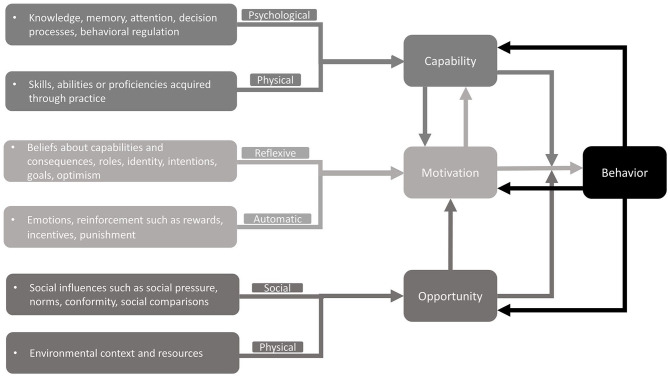
This was a prospective, cross-sectional qualitative study. We conducted semi-structured interviews with women with high body mass indices who successfully breastfed for 6 months or more ( =20), partners ( = 22), and healthcare professionals ( =19) in Ireland during 2018. Interviews were audio recorded, and transcribed verbatim. Data were inductively coded using reflexive thematic analysis and deductively mapped within the Capability, Opportunity, Motivation-Behavior model.
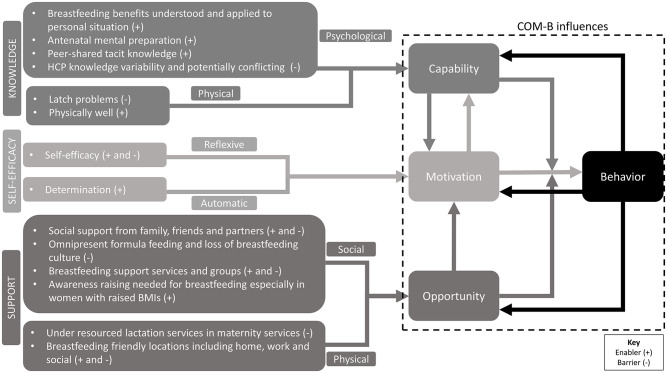
The three themes developed were knowledge, support, and self-efficacy. Knowledge supported a participant's psychological and physical capability to engage in breastfeeding. Support was related to the social and physical opportunity to enable performance of breastfeeding behaviors. Self-efficacy influenced reflective and automatic motivation to perform breastfeeding behaviors. A multifactorial intervention design is needed to support successful breastfeeding.
The barriers and enablers identified for participants with high body mass indices were similar to those for the broader population; however, the physicality and associated social bias of high body mass indices mean that additional support is warranted. Antenatal and postpartum breastfeeding services need a multifaceted, inclusive, and high-quality program to provide the necessary support to women with higher body mass indices.
体重指数较高的女性母乳喂养率较低,但该人群中成功母乳喂养的驱动因素尚不清楚。
我们旨在:(a) 探讨体重指数较高的女性母乳喂养的障碍和促进因素;(b) 绘制适合在产前至产后期间干预的具体行为。
这是一项前瞻性、横断面定性研究。我们在 2018 年期间在爱尔兰对成功母乳喂养 6 个月或以上的体重指数较高的女性(n=20)、伴侣(n=22)和医疗保健专业人员(n=19)进行了半结构式访谈。访谈以音频形式记录并逐字转录。使用反思性主题分析对数据进行归纳编码,并在能力、机会、动机-行为模型中进行演绎映射。
确定了三个主题:知识、支持和自我效能。知识支持参与者参与母乳喂养的心理和生理能力。支持与使母乳喂养行为得以执行的社会和物理机会有关。自我效能影响执行母乳喂养行为的反思性和自动动机。需要一种多因素干预设计来支持成功母乳喂养。
体重指数较高的参与者的障碍和促进因素与更广泛的人群相似;然而,体重指数较高的身体性和相关的社会偏见意味着需要额外的支持。产前和产后母乳喂养服务需要一个多方面的、包容的、高质量的计划,为体重指数较高的女性提供必要的支持。