Regeneron Pharmaceuticals, Inc., Tarrytown, New York, United States of America.
Alnylam Pharmaceuticals, Inc., Cambridge, Massachusetts, United States of America.
PLoS One. 2022 Jun 16;17(6):e0269749. doi: 10.1371/journal.pone.0269749. eCollection 2022.
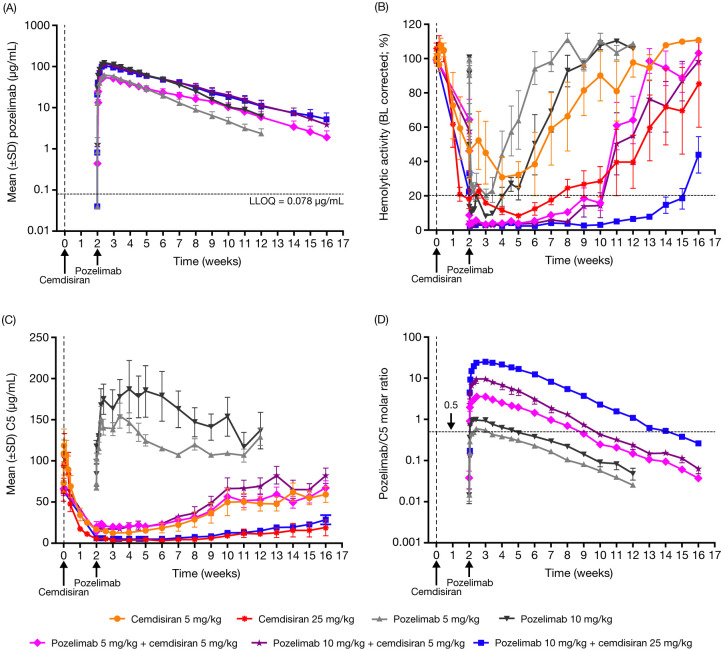
Paroxysmal nocturnal hemoglobinuria (PNH) is a rare disease caused by uncontrolled complement activation; effective and approved treatments include terminal complement inhibition. This study assessed whether combination cemdisiran (an investigational N-acetylgalactosamine-conjugated RNAi therapeutic that suppresses liver production of complement component C5) and pozelimab (an investigational fully human monoclonal antibody against C5) results in more effective and durable complement activity inhibition than the individual agents alone in non-human primates. Cynomolgus monkeys received a single subcutaneous injection of cemdisiran (5 or 25 mg/kg), pozelimab (5 or 10 mg/kg), or combination cemdisiran and pozelimab (5+5 mg/kg, 5+10 mg/kg, or 25+10 mg/kg, respectively). When given in combination, pozelimab was administered 2 weeks after cemdisiran dosing. Pharmacokinetics and ex vivo pharmacodynamic properties were assessed. The half-life of pozelimab alone was 12.9-13.3 days; this increased to 19.6-21.1 days for pozelimab administered in combination with cemdisiran. In ex vivo classical pathway hemolysis assays (CH50), pozelimab + cemdisiran combinations achieved durable and more complete suppression of complement activity (8-13 weeks) vs monotherapy of either agent. Cemdisiran monotherapy demonstrated dose-dependent suppression of total C5 concentrations, with the higher dose (25 mg/kg) achieving >90% maximum suppression. Total C5 concentrations after administration of pozelimab + cemdisiran combinations were similar compared with administration of cemdisiran alone. The combination of pozelimab + cemdisiran mediates complement activity inhibition more efficiently than either pozelimab or cemdisiran administered alone. The pharmacokinetic/pharmacodynamic profile of combination pozelimab + cemdisiran in non-human primates appears suitable for further clinical investigation as a potential long-acting treatment for PNH and other complement-mediated diseases.
阵发性夜间血红蛋白尿症 (PNH) 是一种由补体失控激活引起的罕见疾病;有效的、已批准的治疗方法包括终末补体抑制。本研究评估了在非人类灵长类动物中,cemdisiran(一种研究性 N-乙酰半乳糖胺修饰的 RNAi 治疗药物,可抑制肝脏补体成分 C5 的产生)和 pozelimab(一种研究性的针对 C5 的全人源单克隆抗体)联合治疗是否比单独使用这两种药物更能有效和持久地抑制补体活性。食蟹猴接受单次皮下注射 cemdisiran(5 或 25mg/kg)、pozelimab(5 或 10mg/kg)或 cemdisiran 和 pozelimab 联合治疗(分别为 5+5mg/kg、5+10mg/kg 和 25+10mg/kg)。当联合使用时,在给予 cemdisiran 后 2 周给予 pozelimab。评估了药代动力学和离体药效学特性。单独使用 pozelimab 的半衰期为 12.9-13.3 天;当与 cemdisiran 联合使用时,半衰期增加至 19.6-21.1 天。在离体经典途径溶血试验 (CH50) 中,pozelimab+cemdisiran 联合治疗可实现持久且更完全的补体活性抑制(8-13 周),而单药治疗则不然。cemdisiran 单药治疗表现出剂量依赖性的总 C5 浓度抑制,高剂量(25mg/kg)可实现>90%的最大抑制。pozelimab+cemdisiran 联合治疗后的总 C5 浓度与单独使用 cemdisiran 后的浓度相似。与单独使用 pozelimab 或 cemdisiran 相比,联合使用 pozelimab+cemdisiran 更有效地介导补体活性抑制。在非人类灵长类动物中,pozelimab+cemdisiran 的药代动力学/药效学特征似乎适合进一步的临床研究,作为 PNH 和其他补体介导疾病的潜在长效治疗方法。