Health Technology Assessment Resource Centre, Indian Council of medical Research-National Institute of Epidemiology, Chennai, India.
Health Technology Assessment in India Secretariat, Department of Health Research, Government of India, New Delhi, India.
PLoS One. 2022 Jun 16;17(6):e0264563. doi: 10.1371/journal.pone.0264563. eCollection 2022.
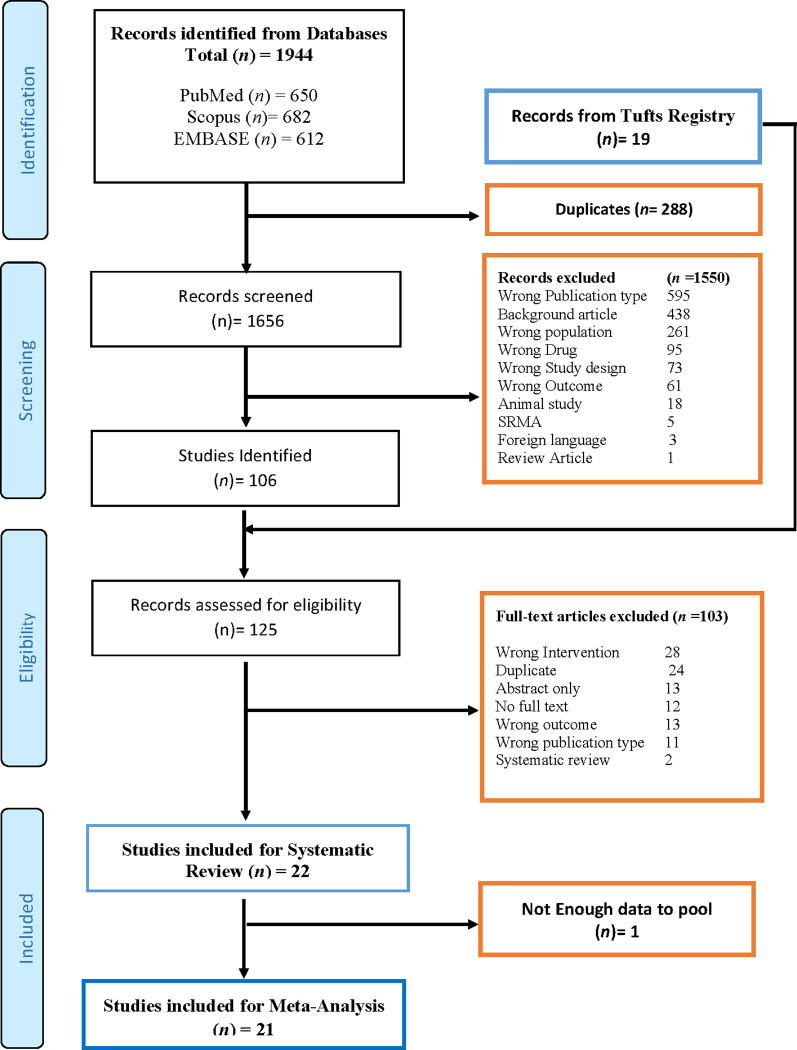
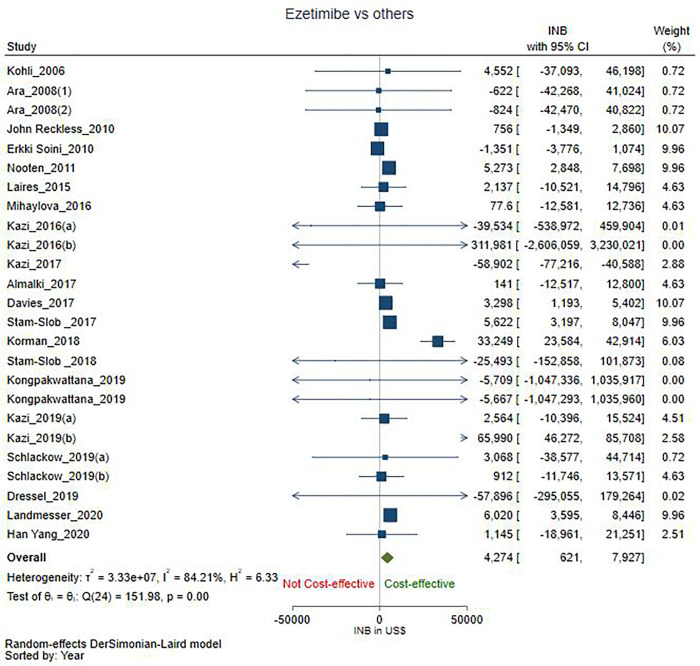
In addition to statin therapy, Ezetimibe, a non-statin lipid-modifying agent, is increasingly used to reduce low-density lipoprotein cholesterol and atherosclerotic cardiovascular disease risk. Literature suggests the clinical effectiveness of Ezetimibe plus statin (EPS) therapy; however, primary evidence on its economic effectiveness is inconsistent. Hence, we pooled incremental net benefit to synthesise the cost-effectiveness of EPS therapy. We identified economic evaluation studies reporting outcomes of EPS therapy compared with other lipid-lowering therapeutic agents or placebo by searching PubMed, Embase, Scopus, and Tufts Cost-Effective Analysis registry. Using random-effects meta-analysis, we pooled Incremental Net Benefit (INB) in the US $ with a 95% confidence interval (CI). We used the modified economic evaluations bias checklist and GRADE quality assessment for quality appraisal. The pooled INB from twenty-one eligible studies showed that EPS therapy was significantly cost-effective compared to other lipid-lowering therapeutic agents or placebo. The pooled INB (95% CI) was $4,274 (621 to 7,927), but there was considerable heterogeneity (I2 = 84.21). On subgroup analysis EPS therapy is significantly cost-effective in high-income countries [$4,356 (621 to 8,092)], for primary prevention [$4,814 (2,523 to 7,106)], and for payers' perspective [$3,255 (571 to 5,939)], and from lifetime horizon [$4,571 (746 to 8,395)]. EPS therapy is cost-effective compared to other lipid-lowering therapeutic agents or placebo in high-income countries and for primary prevention. However, there is a dearth of evidence from lower-middle-income countries and the societal perspective.
除了他汀类药物治疗外,依折麦布作为一种非他汀类降脂药物,也越来越多地用于降低低密度脂蛋白胆固醇和减少动脉粥样硬化性心血管疾病风险。文献表明,依折麦布联合他汀类药物(Ezetimibe plus statin,EPS)治疗具有临床疗效;然而,关于其经济有效性的主要证据并不一致。因此,我们汇总增量净收益来综合评估 EPS 治疗的成本效益。我们通过检索 PubMed、Embase、Scopus 和 Tufts Cost-Effective Analysis 登记处,确定了评估 EPS 治疗与其他降脂治疗药物或安慰剂比较的经济学评价研究。我们使用随机效应荟萃分析,汇总了美国增量净收益(Incremental Net Benefit,INB)及其 95%置信区间(95% Confidence Interval,CI)。我们使用改良经济学评价偏倚检查表和 GRADE 质量评估对质量进行评估。21 项合格研究的汇总增量净收益结果表明,与其他降脂治疗药物或安慰剂相比,EPS 治疗具有显著的成本效益。汇总的增量净收益(95%CI)为 4274 美元(621 美元至 7927 美元),但存在很大的异质性(I2=84.21%)。亚组分析表明,在高收入国家[4356 美元(621 美元至 8092 美元)]、一级预防[4814 美元(2523 美元至 7106 美元)]和支付者视角[3255 美元(571 美元至 5939 美元)],以及从终身角度来看[4571 美元(746 美元至 8395 美元)],EPS 治疗均具有显著的成本效益。在高收入国家和一级预防中,与其他降脂治疗药物或安慰剂相比,EPS 治疗具有成本效益。然而,从中等偏下收入国家和社会视角来看,证据匮乏。