Centre for the Study of Regional Development, School of Social Sciences, Jawaharlal Nehru University, New Delhi, India.
Centre of Social Medicine and Community Health, School of Social Sciences, Jawaharlal Nehru University, New Delhi, India.
PLoS One. 2022 Jun 16;17(6):e0269844. doi: 10.1371/journal.pone.0269844. eCollection 2022.
Fever is one of the common clinical symptoms found among children suffering from various illnesses. India carries a substantial burden of febrile illness among under-five children which heighten the risk of malnutrition, mortality and morbidity. This study aims to determine the factors associated with delay in treatment-seeking for fever among under-five children in India.
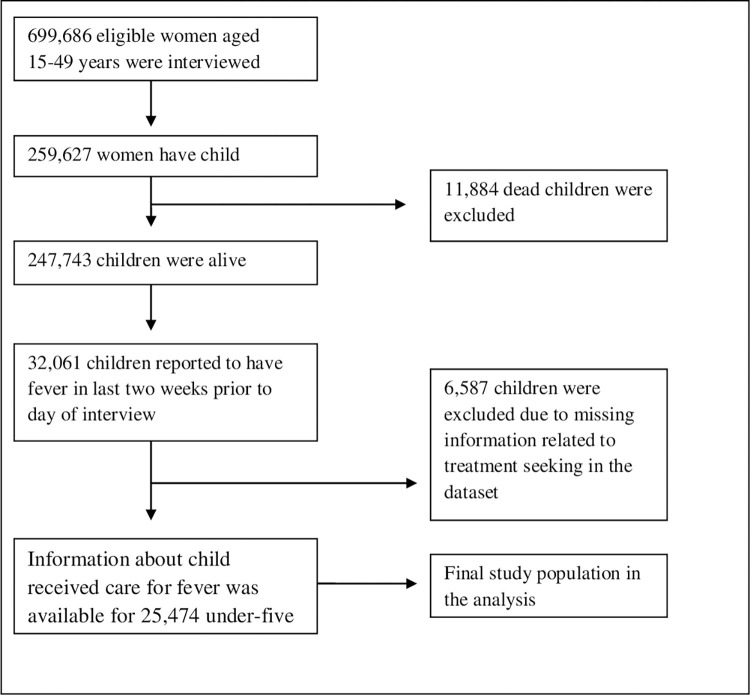
A cross-sectional study was carried out using the large-scale nationally representative data from the National Family Health Survey (NFHS-4), conducted in 2015-2016. The data were collected by using four survey questionnaires i.e., Household Questionnaire, Woman's Questionnaire, Man's Questionnaire, and Biomarker Questionnaire. Delay in treatment-seeking was defined as taking a child for treatment after 24 hours of fever onset. Bivariate and multivariate logistic regression models were performed to assess the factors associated with delay in treatment-seeking behaviour for fever in under-five children.
In India, 31.12% (n = 7229) of the caregivers sought treatment for children after 24 hours of the onset of fever. Findings show no significant differences in delay in treatment-seeking behaviour by age groups and sex of children. Multivariate analysis revealed that the odds of delay in treatment-seeking behaviour of fever were higher among children from the poorest wealth quintile (AOR: 2.06; 95% CI: 1.85, 2.31), belonging to the scheduled tribe (AOR: 1.35; 95% CI: 1.24, 1.48), children who resided in rural areas (AOR: 1.14; 95% CI: 1.07, 1.22), children from the northeast region (AOR: 1.29; 95% CI: 1.14, 1.46), and children of caregivers who perceived distance to health facilities as a 'big problem' (AOR: 1.16; 95% CI: 1.09, 1.23).
The study shows a high prevalence of delay in seeking treatment for fever among caregivers of under-five children in India. Delay in seeking treatment is associated with socio-demographic and socio-economic factors. Therefore, there is a need for intensified health promotion programs to sensitize caregivers on the importance of early health-seeking behaviour.
发热是儿童各种疾病的常见临床症状之一。印度五岁以下儿童发热负担沉重,这增加了儿童营养不良、死亡和发病的风险。本研究旨在确定与印度五岁以下儿童发热治疗延迟相关的因素。
本研究采用 2015-2016 年进行的全国范围具有代表性的国家家庭健康调查(NFHS-4)的大型横断面研究数据。数据收集使用了四个调查问卷,即家庭问卷、妇女问卷、男子问卷和生物标志物问卷。发热治疗延迟的定义为在发热发作后 24 小时内带孩子就医。采用二变量和多变量逻辑回归模型评估与五岁以下儿童发热治疗延迟行为相关的因素。
在印度,31.12%(n=7229)的照顾者在发热发作后 24 小时内带孩子就医。研究结果显示,年龄组和儿童性别对发热治疗延迟行为无显著差异。多变量分析显示,来自最贫困五分之一家庭(AOR:2.06;95%CI:1.85,2.31)、属于在册部落(AOR:1.35;95%CI:1.24,1.48)、居住在农村地区(AOR:1.14;95%CI:1.07,1.22)、来自东北部地区(AOR:1.29;95%CI:1.14,1.46)的儿童,以及认为距离医疗机构为“大问题”的照顾者(AOR:1.16;95%CI:1.09,1.23)的儿童,发热治疗延迟的可能性更高。
本研究显示,印度五岁以下儿童发热治疗延迟的现象较为普遍。治疗延迟与社会人口和社会经济因素有关。因此,需要加强健康促进计划,提高照顾者对早期寻求健康行为重要性的认识。