Department of Paediatrics, Ruxmaniben Deepchand Gardi Medical College, Ujjain, Madhya Pradesh, 456010, India.
Department of Women and Children's Health, International Maternal and Child Health Unit, Uppsala University, Uppsala, Sweden.
BMC Infect Dis. 2020 Feb 21;20(1):162. doi: 10.1186/s12879-020-4890-6.
Fever is a cause for concern for both parents and the treating pediatrician and a common reason for antibiotic overuse. However, the proportion of children hospitalized for fever with serious bacterial infection (SBI) is uncertain. We aimed to evaluate the epidemiological, clinical, hematological, and biochemical risks for SBI among the children admitted with fever.
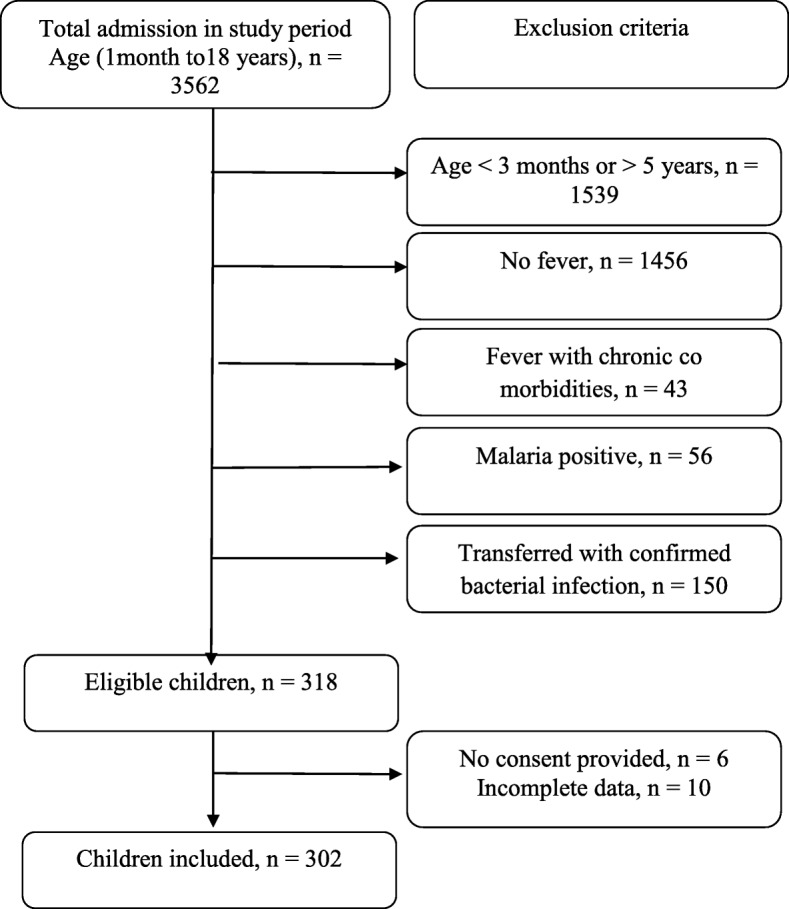
This prospective study was conducted in a rural teaching hospital in India on consecutive children, aged 3 months-12 years, presenting with fever 100 °F (37.7 °C) or higher. The presence of SBI was confirmed with one of the following criteria: (a) a positive blood culture; (b) roentgenographically confirmed pneumonia with high titres of C-reactive protein; (c) a culture-confirmed urinary tract infection; (d) enteric fever diagnosed clinically in addition to either a positive blood culture or high Widal titers; and (e) meningitis diagnosed clinically in addition to either a positive blood culture or cerebrospinal fluid culture. A predefined questionnaire was filled.
A total of 302 children were included in the study, out of which 47% (95% CI 41.4-52.7%) presented with SBI. The factors associated with confirmed SBI in bivariate analysis were history of previous hospitalization, history of chronic illness, history of medication in the previous 1 week, a partially immunized child, history of common cold, moderate-grade fever, toxic look, significant lymphadenopathy, absence of BCG scar, delayed development, irritability, breathlessness, respiratory distress, poor feeding, significant weight loss, suspected urinary tract infection, hyponatremia, hypokalemia, and abnormal leucocyte count. The final generalized logistic regression model revealed partially immunized child (RR 4.26), breathlessness (RR 1.80), weight loss (RR 2.28), and suspected urinary tract infection (RR 1.95) as risk factors for the increased risk of SBI.
The study identified multiple risk factors for SBI. Pediatricians can be made aware of these risk factors. Further studies are warranted to identify age-specific risk factors for SBI because most clinicians depend on clinical signs and symptoms to identify SBI.
发热令患儿家长和儿科医生均感担忧,也是抗生素过度使用的常见原因。然而,因发热住院的患儿中严重细菌感染(SBI)的比例尚不确定。我们旨在评估发热患儿中 SBI 的流行病学、临床、血液学和生化危险因素。
这是一项在印度农村教学医院进行的前瞻性研究,连续纳入年龄 3 个月至 12 岁、发热≥100°F(37.7°C)的患儿。通过以下标准之一确定 SBI 的存在:(a)血培养阳性;(b)高 C 反应蛋白水平 X 线证实肺炎;(c)培养证实的尿路感染;(d)临床诊断为伤寒,同时血培养阳性或肥达试验滴度升高;(e)临床诊断为脑膜炎,同时血培养阳性或脑脊液培养阳性。填写了一份预设的调查问卷。
本研究共纳入 302 例患儿,其中 47%(95%CI 41.4-52.7%)存在 SBI。单变量分析中与确诊 SBI 相关的因素包括既往住院史、慢性病史、既往 1 周内用药史、部分免疫儿童、普通感冒史、中重度发热、中毒面容、显著淋巴结肿大、无卡介苗瘢痕、发育延迟、烦躁不安、呼吸困难、呼吸窘迫、喂养不良、显著体重减轻、疑似尿路感染、低钠血症、低钾血症和异常白细胞计数。最终的广义逻辑回归模型显示,部分免疫儿童(RR 4.26)、呼吸困难(RR 1.80)、体重减轻(RR 2.28)和疑似尿路感染(RR 1.95)是 SBI 风险增加的危险因素。
本研究确定了 SBI 的多个危险因素。儿科医生可以了解这些危险因素。需要进一步研究以确定 SBI 的特定年龄危险因素,因为大多数临床医生依赖临床症状和体征来识别 SBI。