Division of Infectious Diseases, Department of Medicine, University of Texas Medical Branch, Galveston, Texas, United States of America.
Graduate School of Biomedical Sciences, University of Texas Medical Branch, Galveston, Texas, United States of America.
PLoS Negl Trop Dis. 2022 Jun 16;16(6):e0010499. doi: 10.1371/journal.pntd.0010499. eCollection 2022 Jun.
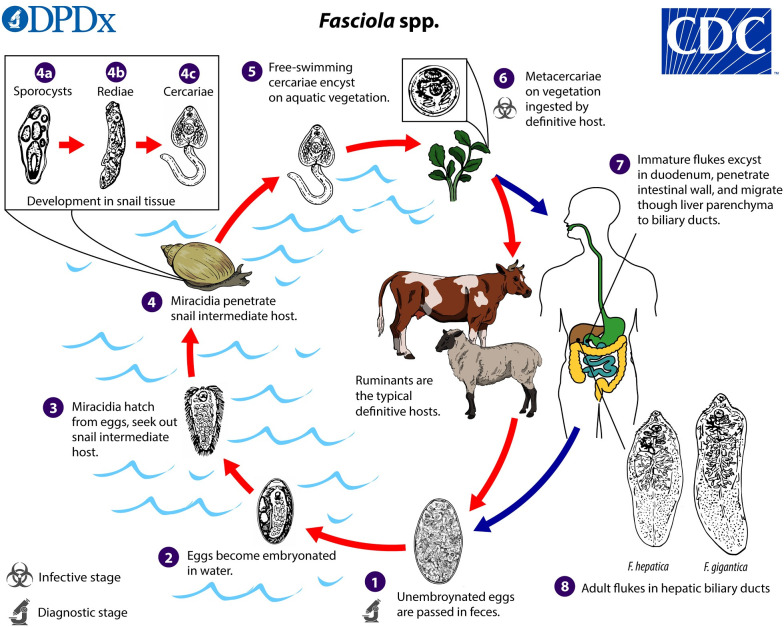
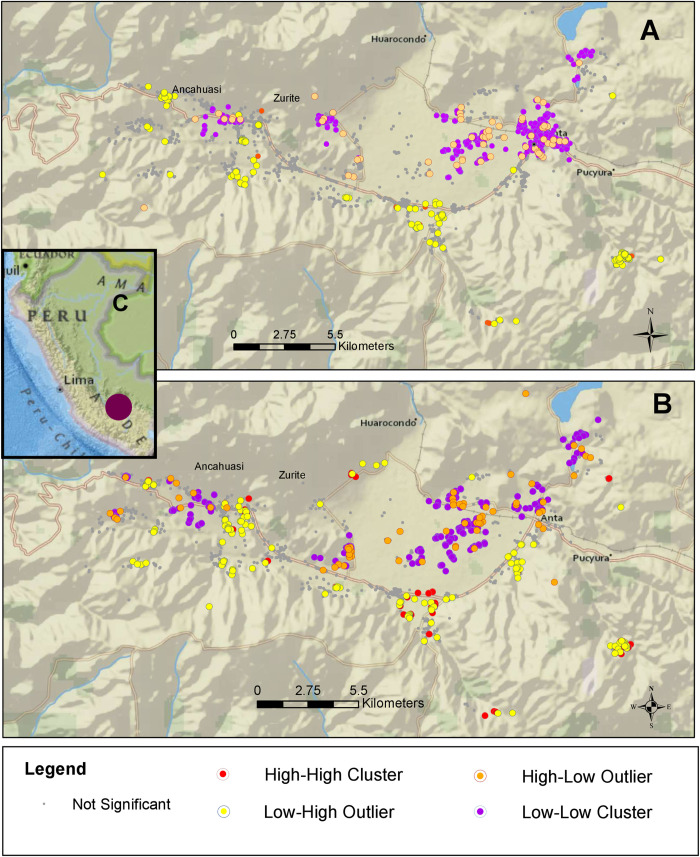
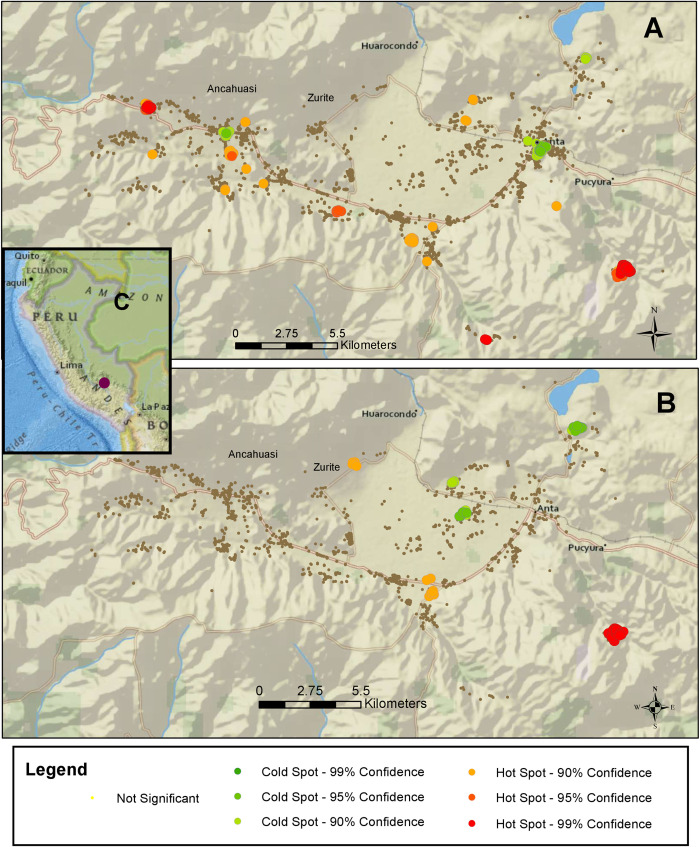
Fasciola hepatica is a neglected parasitic infection with significant human health and livestock industry impact. The Andean Altiplano harbors an estimated 50% of the Fasciola's world infection burden. There is scarce data regarding the spatial associations between different Fasciola hosts. In this project, we aimed to determine the geospatial relationships between Fasciola eggs passed in feces of different livestock species and the risk of infection among each household as a unit. We used data from a cross-sectional study evaluating children and livestock feces for Fasciola infection around households in three districts of Anta province, in the Cusco region of Peru. Each sample was geographically tagged and evaluated for fascioliasis using microscopy methods. A total of 2070 households were included, the median age was 9.1 years (6.7-11.8), 49.5% were female, and 7.2% of the households had at least one infected child. A total of 2420 livestock feces samples were evaluated. The infection rate in livestock samples was 30.9%. The highest infection rate was found in sheep with 40.8%, followed by cattle (33.8%), and swine (26.4%). The median distance between a household with an infected child to a positive animal sample was 44.6 meters (IQR 14.7-112.8) and the distance between a household with no infected children to a positive animal sample was 62.2 meters (IQR 18.3-158.6) (p = 0.025). The multivariable logistic regression adjusted by presence of poor sanitation, unsafe water consumption, altitude, and presence of multiple infected children per household demonstrated an association between household infection and any cattle feces at a 50 meters radius (Uninfected: OR 1.42 (95%CI 1.07-1.89), p = 0.017. Infected: OR 1.89 (95%CI 1.31-2.73), p = 0.001), positive cattle feces at a 100 meters radius (OR 1.35 (95% CI 1.08-1.69), p = 0.008), and negative cattle feces at a 200 meters radius (OR 1.08 (95% CI 1.01-1.15), p = 0.022). We identified potential hot and cold spots for fascioliasis in the Anta province. An association between environmental contamination with feces from different livestock species and infected children in rural households was found in our study. Local health authorities may apply this strategy to estimate the risk of infection in human populations and apply targeted interventions.
肝片形吸虫是一种被忽视的寄生虫感染,对人类健康和畜牧业有重大影响。安第斯高原估计承载了全球 50%的肝片形吸虫感染负担。关于不同肝片形吸虫宿主之间的空间关联,数据十分匮乏。在本项目中,我们旨在确定不同家畜粪便中肝片形吸虫卵的地理空间关系,并以家庭为单位确定每个家庭的感染风险。我们使用了一项横断面研究的数据,该研究评估了秘鲁库斯科地区安塔省三个区的家庭周围儿童和家畜粪便中的肝片形吸虫感染情况。每个样本都进行了地理标记,并使用显微镜方法评估了肝片形吸虫病。共纳入 2070 户家庭,中位数年龄为 9.1 岁(6.7-11.8),49.5%为女性,7.2%的家庭至少有一名感染儿童。共评估了 2420 份家畜粪便样本。家畜样本的感染率为 30.9%。感染率最高的是绵羊,为 40.8%,其次是牛(33.8%)和猪(26.4%)。有感染儿童的家庭与阳性动物样本之间的中位数距离为 44.6 米(IQR 14.7-112.8),无感染儿童的家庭与阳性动物样本之间的中位数距离为 62.2 米(IQR 18.3-158.6)(p=0.025)。经调整存在卫生条件差、不安全饮用水、海拔高度和家庭内多个感染儿童数量后,多变量逻辑回归显示家庭感染与半径 50 米内任何牛粪便之间存在关联(未感染者:OR 1.42(95%CI 1.07-1.89),p=0.017;感染者:OR 1.89(95%CI 1.31-2.73),p=0.001),半径 100 米内的阳性牛粪便(OR 1.35(95%CI 1.08-1.69),p=0.008),以及半径 200 米内的阴性牛粪便(OR 1.08(95%CI 1.01-1.15),p=0.022)。我们在安塔省确定了肝片形吸虫病的潜在热点和冷点。我们的研究发现,农村家庭中,不同家畜粪便对环境的污染与感染儿童之间存在关联。当地卫生当局可以利用这一策略来估计人群的感染风险,并采取有针对性的干预措施。