Yu Lianyu, Yang Sha, Liu Zeyu, Qiu Xiaopei, Tang Xiaoqi, Zhao Shuang, Xu Hanqing, Gao Mingxuan, Bao Jing, Zhang Ligai, Luo Dan, Chang Kai, Chen Ming
Department of Clinical Laboratory Medicine, Southwest Hospital, Army Medical University, 30 Gaotanyan, Shapingba District, Chongqing, 400038, China.
Key Laboratory of Hepatobiliary and Pancreatic Surgery, Institute of Hepatobiliary Surgery, Southwest Hospital, Army Medical University, 30 Gaotanyan, Shapingba District, Chongqing, 400038, China.
Mater Today Bio. 2022 May 6;15:100276. doi: 10.1016/j.mtbio.2022.100276. eCollection 2022 Jun.
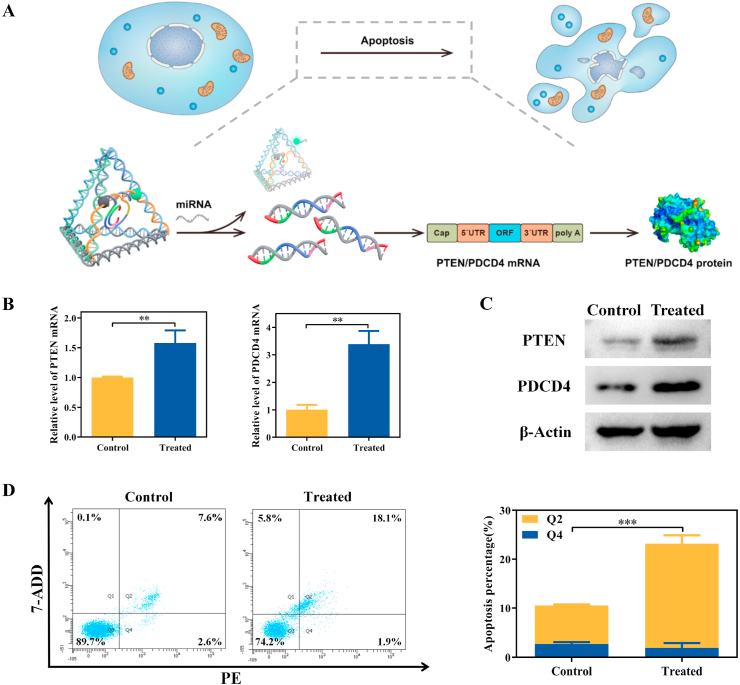
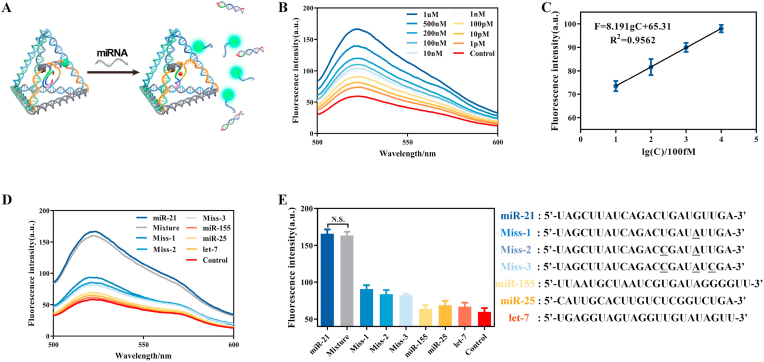
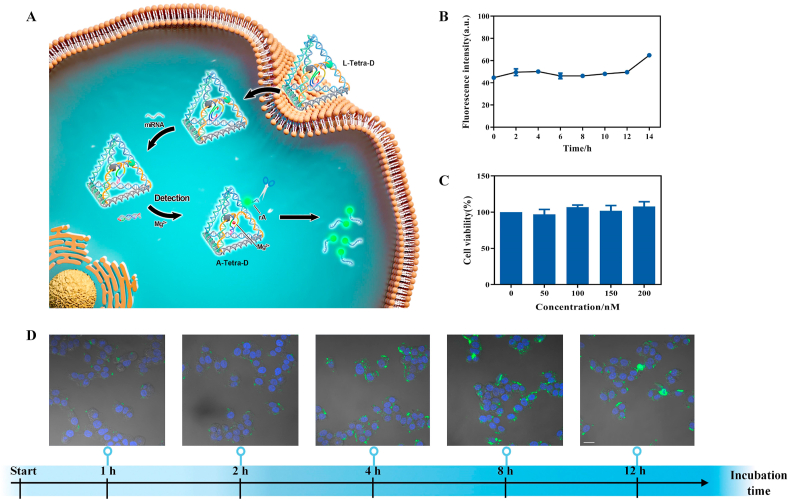
The synchronous detection and regulation of microRNAs (miRNAs) are essential for the early tumor diagnosis and treatment but remains a challenge. An integrative DNA tetrahedral nanomachine was self-assembled for sensitive detection and negative feedback regulation of intracellular miRNAs. This nanomachine comprised a DNA tetrahedron nanostructure as the framework, and a miRNA inhibitor-controlled allosteric DNAzyme as the core. The DNA tetrahedron brought the DNAzyme and the substrate in spatial proximity and facilitated the cellular uptake of DNAzyme. In allosteric regulation of DNAzyme, the locked tetrahedral DNAzyme (L-tetra-D) and active tetrahedral DNAzyme (A-Tetra-D) were controlled by miRNA inhibitor. The combination of miRNA inhibitor and target could trigger the conformational change from L-tetra-D to A-Tetra-D. A-Tetra-D cleaved the substrate and released fluorescence for intracellular miRNA biosensing. The DNA tetrahedral nanomachine showed excellent sensitivity (with detection limit down to 0.77 pM), specificity (with one-base mismatch discrimination), biocompatibility and stability. Simultaneously, miRNA stimulus-unlocked inhibitor introduced by our nanomachine exhibited the synchronous regulation of target cells, of which regulatory performance has been verified by the upregulated levels of downstream genes/proteins and the increased cellular apoptosis. Our study demonstrated that the DNA tetrahedral nanomachine is a promising biosense-and-treat tool for the synchronous detection and regulation of intracellular miRNA, and is expected to be applied in the early diagnosis and tailored management of cancers.
微小RNA(miRNA)的同步检测与调控对肿瘤早期诊断和治疗至关重要,但仍具挑战性。我们自组装了一种集成DNA四面体纳米机器,用于细胞内miRNA的灵敏检测和负反馈调控。该纳米机器以DNA四面体纳米结构为框架,以miRNA抑制剂控制的变构DNA酶为核心。DNA四面体使DNA酶与底物在空间上接近,并促进DNA酶的细胞摄取。在DNA酶的变构调控中,锁定的四面体DNA酶(L-tetra-D)和活性四面体DNA酶(A-Tetra-D)由miRNA抑制剂控制。miRNA抑制剂与靶标的结合可触发从L-tetra-D到A-Tetra-D的构象变化。A-Tetra-D切割底物并释放荧光用于细胞内miRNA生物传感。该DNA四面体纳米机器表现出优异的灵敏度(检测限低至0.77 pM)、特异性(可区分单碱基错配)、生物相容性和稳定性。同时,我们的纳米机器引入的miRNA刺激解锁抑制剂对靶细胞具有同步调控作用,其调控性能已通过下游基因/蛋白质水平的上调和细胞凋亡的增加得到验证。我们的研究表明,DNA四面体纳米机器是一种用于同步检测和调控细胞内miRNA的有前景的生物传感与治疗工具,有望应用于癌症的早期诊断和精准管理。