Mamo Firew Tafesse, Shang Bo, Selvaraj Jonathan Nimal, Zheng Yongquan, Liu Yang
School of Food Science and Engineering, Foshan University/South China Food Safety Research Center, Foshan, Guangdong, P R. China.
Key Laboratory of Agro-products Quality and Safety Control in Storage and Transport Process, Ministry of Agriculture and Rural Affairs, Institute of Food Science and Technology, Chinese Academy of Agricultural Sciences, Beijing, P. R. China.
Mycology. 2021 Oct 6;13(2):143-152. doi: 10.1080/21501203.2021.1978573. eCollection 2022.
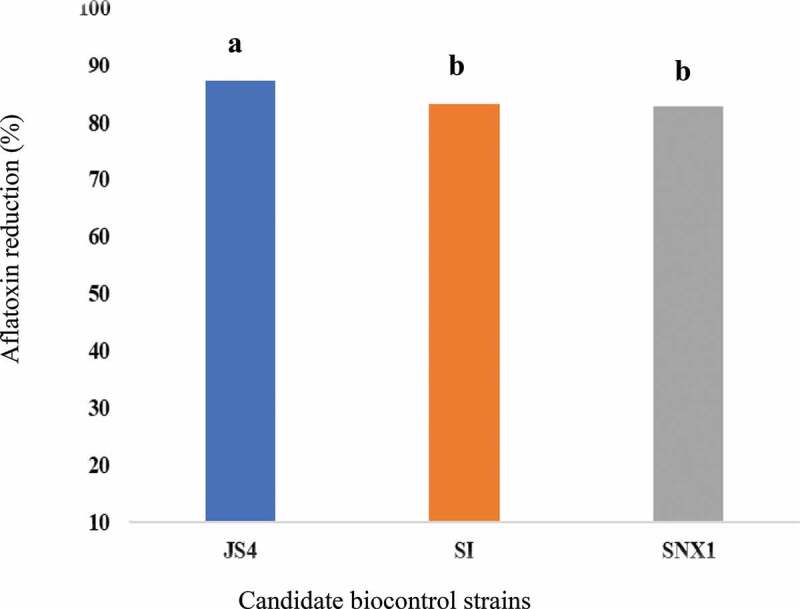
Application of atoxigenic strains of to soils is the most successful aflatoxin biological control approach. The objective of this study was to evaluate the efficacies of native non-aflatoxin producing (atoxigenic) strains as a biocontrol agent in peanut field in China. The competitive atoxigenic strains (JS4, SI1and SXN) isolated from different crops, in China were used for field evaluation. The strains applied during the growing season (June - October, 2016) in the field at rate of 25 kg inoculum/hectare. The colonization of these biocontrol agents has been investigated and the population of communities in soil were determined. The incidences of toxin producing (toxigenic) strains and aflatoxin contamination in peanuts were also determined. Treated plots produced significant reductions in the incidence of toxigenic isolates of in soil. However, the total fungal densities were not significantly different (p > 0.05) after treatments. Large percentage of aflatoxin reductions, ranging from 82.8% (SXN) up to 87.2% (JS4) were recorded in treated plots. Generally, the results suggest that the strategy can be used to control aflatoxin contamination and continuous evaluation should be done.
将产毒不产毒株应用于土壤是最成功的黄曲霉毒素生物防治方法。本研究的目的是评估中国花生田本土不产黄曲霉毒素(产毒不产毒)菌株作为生物防治剂的效果。从中国不同作物中分离出的具有竞争力的产毒不产毒菌株(JS4、SI1和SXN)用于田间评估。这些菌株于2016年6月至10月生长季节以25千克接种物/公顷的用量施用于田间。对这些生物防治剂的定殖情况进行了研究,并测定了土壤中群落的数量。还测定了花生中产毒(产毒)菌株的发生率和黄曲霉毒素污染情况。处理过的地块土壤中产毒分离株的发生率显著降低。然而,处理后总真菌密度没有显著差异(p>0.05)。处理过的地块记录到黄曲霉毒素大幅减少,减少幅度从82.8%(SXN)到87.2%(JS4)不等。总体而言,结果表明该策略可用于控制黄曲霉毒素污染,应持续进行评估。