Zhang Chushu, Selvaraj Jonathan Nimal, Yang Qingli, Liu Yang
Institute of Food Science and Technology, Chinese Academy of Agricultural Sciences/Key Laboratory of Agro-Products Processing, Ministry of Agriculture, Beijing 100193, China.
Shandong Peanut Research Institute, Qingdao 266100, China.
Toxins (Basel). 2017 Jan 20;9(1):40. doi: 10.3390/toxins9010040.
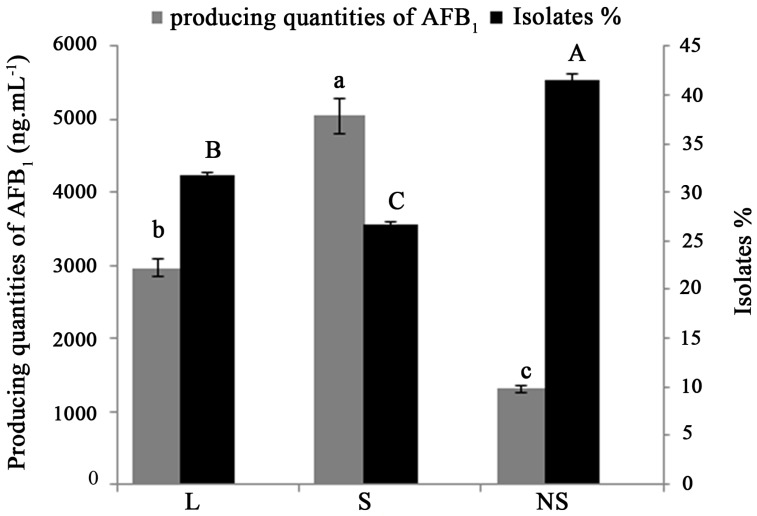
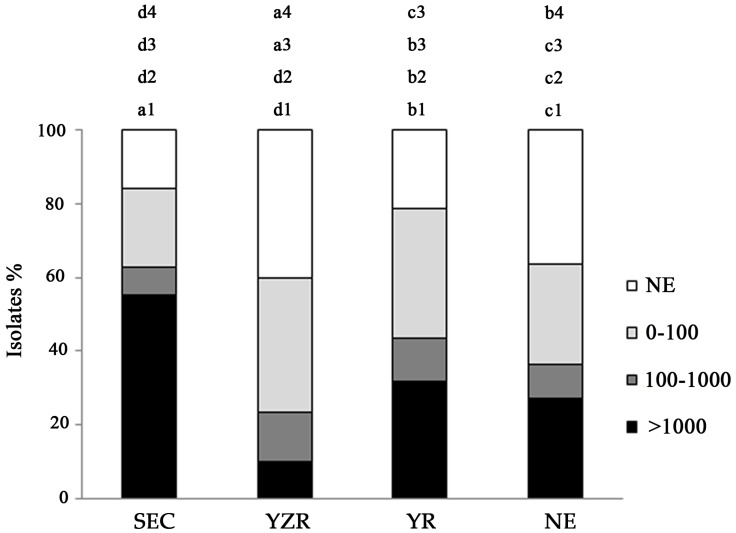
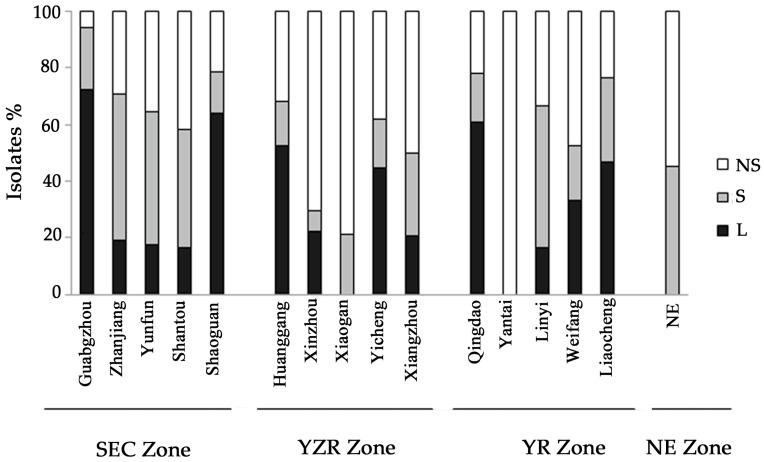
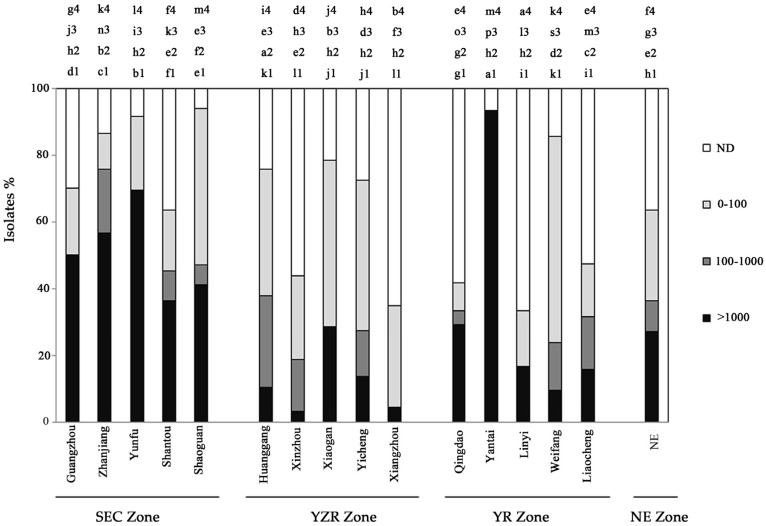
Peanut pods are easily infected by aflatoxin-producing sp.ecies from field soil. To assess the aflatoxin-producing sp. in different peanut field soils, 344 aflatoxin-producing strains were isolated from 600 soil samples of four agroecological zones in China (the Southeast coastal zone (SEC), the Yangtze River zone (YZR), the Yellow River zone (YR) and the Northeast zone (NE)). Nearly 94.2% (324/344) of strains were and 5.8% (20/344) of strains were . YZR had the highest population density of sp. and positive rate of aflatoxin production in isolated strains (1039.3 cfu·g, 80.7%), the second was SEC (191.5 cfu·g, 48.7%), the third was YR (26.5 cfu·g, 22.7%), and the last was NE (2.4 cfu·g, 6.6%). The highest risk of AFB₁ contamination on peanut was in YZR which had the largest number of AFB₁ producing isolates in 1g soil, followed by SEC and YR, and the lowest was NE. The potential risk of AFB₁ contamination in peanuts can increase with increasing population density and a positive rate of aflatoxin-producing sp. in field soils, suggesting that reducing aflatoxigenic sp. in field soils could prevent AFB₁ contamination in peanuts.
花生荚果很容易受到田间土壤中产生黄曲霉毒素的物种的感染。为了评估不同花生田土壤中产生黄曲霉毒素的物种,从中国四个农业生态区(东南沿海区(SEC)、长江区(YZR)、黄河区(YR)和东北区(NE))的600个土壤样本中分离出344株产生黄曲霉毒素的菌株。近94.2%(324/344)的菌株为[此处原文缺失具体菌株类型信息],5.8%(20/344)的菌株为[此处原文缺失具体菌株类型信息]。长江区产生[此处原文缺失具体菌株类型信息]的物种的种群密度和分离菌株中黄曲霉毒素产生阳性率最高(1039.3 cfu·g,80.7%),其次是东南沿海区(191.5 cfu·g,48.7%),第三是黄河区(26.5 cfu·g,22.7%),最后是东北区(2.4 cfu·g,6.6%)。花生上黄曲霉毒素B₁污染的最高风险在长江区,该区每克土壤中产生黄曲霉毒素B₁的分离株数量最多,其次是东南沿海区和黄河区,最低的是东北区。花生中黄曲霉毒素B₁污染的潜在风险可能会随着田间土壤中产生黄曲霉毒素的物种的种群密度和阳性率的增加而增加,这表明减少田间土壤中产生黄曲霉毒素的物种可以预防花生中的黄曲霉毒素B₁污染。