
接受全身性抗真菌三唑类药物治疗侵袭性真菌感染患者的多中心登记研究。
Multicenter Registry of Patients Receiving Systemic Mold-Active Triazoles for the Management of Invasive Fungal Infections.
作者信息
Ostrosky-Zeichner L, Nguyen M H, Bubalo J, Alexander B D, Miceli M H, Pappas P G, Jiang J, Song Y, Thompson G R
机构信息
McGovern Medical School, Houston, TX, USA.
University of Pittsburgh Medical Center, Pittsburgh, PA, USA.
出版信息
Infect Dis Ther. 2022 Aug;11(4):1609-1629. doi: 10.1007/s40121-022-00661-5. Epub 2022 Jun 18.
INTRODUCTION
'Real-world' data for mold-active triazoles (MATs) in the treatment of invasive fungal infections (IFIs) are lacking. This study evaluated usage of MATs in a disease registry for the management of IFIs.
METHODS
Data were collected for this multicenter, observational, prospective study from 55 US centers, between March 2017 and April 2020. Eligible patients received isavuconazole, posaconazole, or voriconazole as MAT monotherapy (one MAT) or multiple/sequenced MAT therapy (more than one MAT) for prophylaxis or treatment. Patients were enrolled within 60 days of MAT initiation. The primary objective was to characterize patients receiving a MAT and their patterns of therapy. The full analysis set (FAS) included eligible patients for the relevant enrollment protocol, and the safety analysis set (SAF) included patients who received ≥ 1 MAT dose.
RESULTS
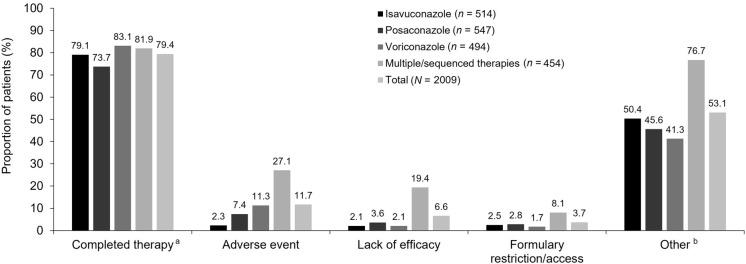
Overall, 2009 patients were enrolled in the SAF. The FAS comprised 1993 patients (510 isavuconazole; 540 posaconazole; 491 voriconazole; 452 multiple/sequenced MAT therapies); 816 and 1177 received treatment and prophylaxis at study index/enrollment, respectively. Around half (57.8%) of patients were male, and median age was 59 years. Among patients with IFIs during the study, the most common pathogens were Aspergillus fumigatus in the isavuconazole (18.2% [10/55]) and voriconazole (25.5% [12/47]) groups and Candida glabrata in the posaconazole group (20.9% [9/43]); the lungs were the most common infection site (58.2% [166/285]). Most patients were maintained on MAT monotherapy (77.3% [1541/1993]), and 79.4% (1520/1915) completed their MAT therapies. A complete/partial clinical response was reported in 59.1% (591/1001) of patients with a clinical response assessment. Breakthrough IFIs were reported in 7.1% (73/1030) of prophylaxis patients. Adverse drug reactions (ADRs) were reported in 14.7% (296/2009) of patients (3.9% [20/514] isavuconazole; 11.3% [62/547] posaconazole; 14.2% [70/494] voriconazole).
CONCLUSIONS
In this 'real-world' study, most patients remained on their initial therapy and completed their MAT therapy. Over half of patients receiving MATs for IFIs had a successful response, and most receiving prophylaxis did not develop breakthrough IFIs. ADRs were uncommon.
引言
侵袭性真菌感染(IFI)治疗中,缺乏活性霉菌三唑类药物(MAT)的“真实世界”数据。本研究评估了MAT在IFI管理疾病登记中的使用情况。
方法
2017年3月至2020年4月期间,从美国55个中心收集了本多中心、观察性、前瞻性研究的数据。符合条件的患者接受了艾沙康唑、泊沙康唑或伏立康唑作为MAT单药治疗(一种MAT)或多种/序贯MAT治疗(一种以上MAT)用于预防或治疗。患者在MAT开始使用的60天内入组。主要目的是描述接受MAT治疗的患者及其治疗模式。全分析集(FAS)包括符合相关入组方案的合格患者,安全性分析集(SAF)包括接受≥1剂MAT的患者。
结果
总体而言,2009例患者被纳入SAF。FAS包括1993例患者(510例使用艾沙康唑;540例使用泊沙康唑;491例使用伏立康唑;452例接受多种/序贯MAT治疗);816例和1177例患者分别在研究指数/入组时接受治疗和预防。约一半(57.8%)的患者为男性,中位年龄为59岁。在研究期间患有IFI的患者中,在使用艾沙康唑(18.2%[10/55])和伏立康唑(25.5%[12/47])治疗的组中,最常见的病原体是烟曲霉,在使用泊沙康唑治疗的组中最常见的病原体是光滑念珠菌(20.9%[9/43]);肺部是最常见的感染部位(58.2%[166/285])。大多数患者接受MAT单药治疗(77.3%[1541/1993]),79.4%(1520/1915)的患者完成了MAT治疗。在有临床反应评估的患者中,59.1%(591/1001)报告了完全/部分临床反应。7.1%(73/1030)的预防患者报告了突破性IFI。14.7%(296/2009)的患者报告了药物不良反应(ADR)(艾沙康唑3.9%[20/514];泊沙康唑11.3%[62/547];伏立康唑14.2%[70/494])。
结论
在这项“真实世界”研究中,大多数患者维持初始治疗并完成了MAT治疗。超过一半接受MAT治疗IFI的患者反应成功,大多数接受预防治疗的患者未发生突破性IFI。ADR并不常见。

 Zotero 插件