Sánchez-Prieto Manuel, Sánchez-Borrego Rafael, Lubián-López Daniel Maria, Pérez-López Faustino R
Department of Obstetrics and Gynecology, Instituto Universitario Dexeus, Barcelona, Spain.
DIATROS, Clínica de Atención a la Mujer, Barcelona, Spain.
Gynecol Oncol Rep. 2022 Jun 11;42:101018. doi: 10.1016/j.gore.2022.101018. eCollection 2022 Aug.
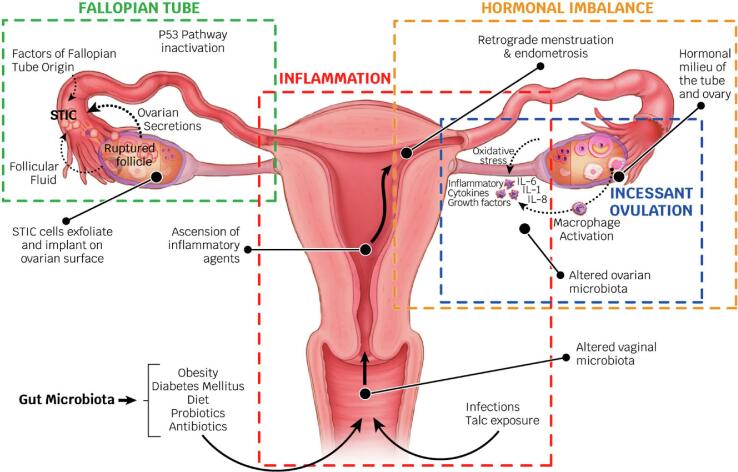
Ovarian cancer is one of the most common gynecologic cancers and has the highest mortality rate. The risk/protective factors of ovarian cancer suggest that its etiology is multifactorial. Several factors are involved in age-related increases in carcinogenesis, including the accumulation of senescent cells, inflammaging (a chronic inflammatory state that persists in the elderly), and immunosenescence (aging of the immune system) changes associated with poor immune surveillance. At sites of inflammation, exposure to high levels of inflammatory mediators, such as reactive oxygen species, cytokines, prostaglandins, and growth factors, contributes to increased cell division and genetic and epigenetic changes. These exposure-induced changes promote excessive cell proliferation, increased survival, malignant transformation, and cancer development. Furthermore, the proinflammatory tumor microenvironment contributes to ovarian cancer metastasis and chemoresistance. This narrative review of the literature was carried out to delineate the possible role of inflammaging in the etiopathogenesis of ovarian cancer development. We discuss the current carcinogenic hypotheses, sites of origin, and etiological factors of ovarian cancer. Treatment of inflammation may represent an attractive strategy for both the prevention and therapy of ovarian cancer.
卵巢癌是最常见的妇科癌症之一,死亡率最高。卵巢癌的风险/保护因素表明其病因是多因素的。与年龄相关的致癌作用增加涉及几个因素,包括衰老细胞的积累、炎症衰老(老年人持续存在的慢性炎症状态)以及与免疫监视不良相关的免疫衰老(免疫系统衰老)变化。在炎症部位,暴露于高水平的炎症介质,如活性氧、细胞因子、前列腺素和生长因子,会导致细胞分裂增加以及基因和表观遗传变化。这些暴露诱导的变化促进了过度的细胞增殖、存活率增加、恶性转化和癌症发展。此外,促炎肿瘤微环境有助于卵巢癌转移和化疗耐药性。本叙述性文献综述旨在阐明炎症衰老在卵巢癌发生发展的病因学中的可能作用。我们讨论了卵巢癌目前的致癌假说、起源部位和病因因素。炎症治疗可能是卵巢癌预防和治疗的一个有吸引力的策略。