Meng Chunliu, Wang Fang, Chen Minghong, Shi Hongyun, Zhao Lujun, Wang Ping
Department of Radiation Oncology, Tianjin Medical University Cancer Institute and Hospital, National Clinical Research Center for Cancer, Tianjin Key Laboratory of Cancer Prevention and Therapy, Tianjin's Clinical Research Center for Cancer, Tianjin, China.
Department of Radiation Oncology, Affiliated Hospital of Hebei University, Baoding, China.
Front Oncol. 2022 Jun 1;12:858634. doi: 10.3389/fonc.2022.858634. eCollection 2022.
This retrospective study investigated prognostic factors in advanced lung adenocarcinoma (LUAD) with one to five bone-only metastasis (BOM) and developed a nomogram model to estimate patient survival.
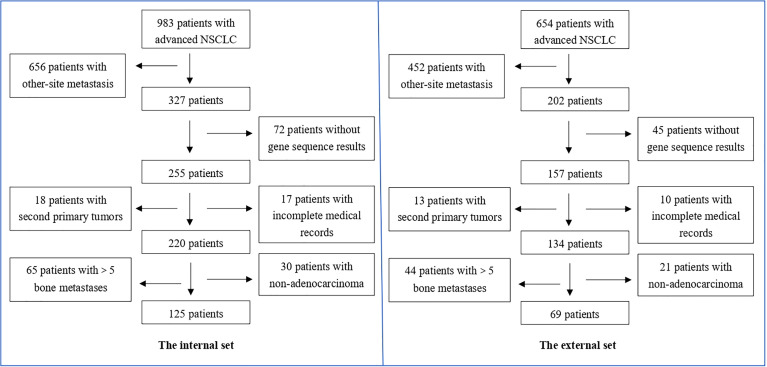
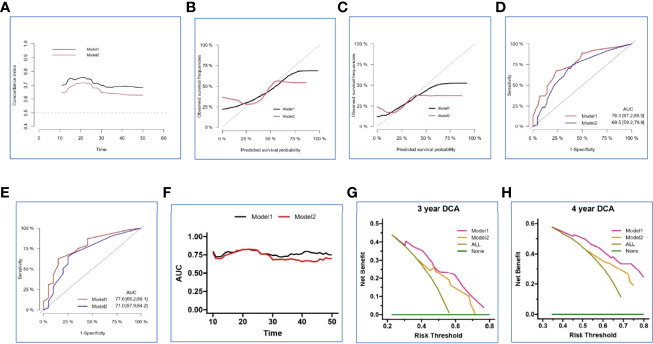
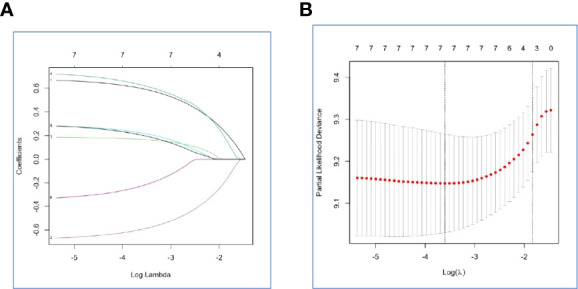
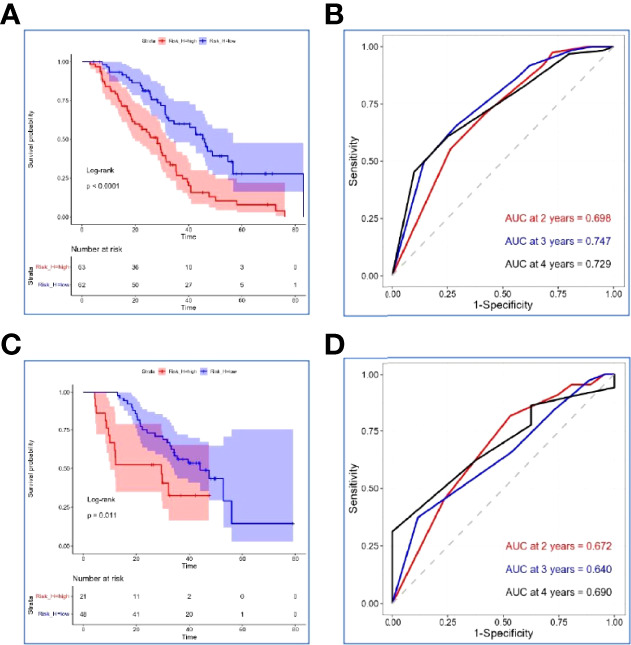
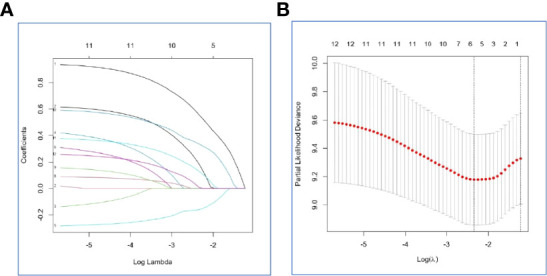
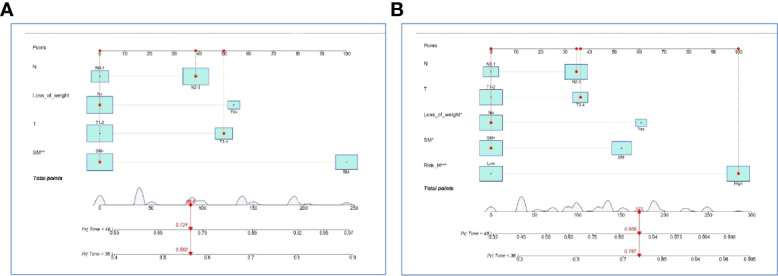
We investigated patients with advanced LUAD with one to five bone-only metastasis at the initial diagnosis and diagnosed between 2013 and 2019 in two hospitals. A formula named Risk-H was constructed using hematological variables screened by LASSO-Cox regression analysis in the internal set and verified by the external set. Two nomogram models were developed by clinical variables selected by LASSO-Cox regression analysis with or without Risk-H in the internal set. The concordance index (C-index), calibration curves, time-dependent receiver operating characteristic (ROC) analysis, area under the curve (AUC), and decision curve analysis (DCA) were formulated to verify nomogram models. The primary endpoint was overall survival.
We finally included 125 and 69 patients, respectively, in the internal and external sets for analysis. The following were significant hematology prognostic factors and were included in the Risk-H formula: alkaline phosphatase and albumin, leukocyte. Four clinical factors, including loss of weight, sensitive mutation status, T and N stage, with or without Risk-H were used to establish nomogram models. C-index, calibration curves, ROC analysis, AUC, and DCA showed the addition of hematological data improved the predictive accuracy of survival.
Pretreatment peripheral blood indexes may be a meaningful serum biomarker for prognosis in LUAD. The addition of Risk-H to the nomogram model could serve as a more economical, powerful, and practical method to predict survival for LUAD patients with one to five BOM.
本回顾性研究调查了伴有1至5处单纯骨转移(BOM)的晚期肺腺癌(LUAD)的预后因素,并建立了列线图模型以估计患者生存率。
我们调查了2013年至2019年间在两家医院初诊时伴有1至5处单纯骨转移的晚期LUAD患者。使用通过LASSO-Cox回归分析在内集筛选并经外集验证的血液学变量构建了一个名为Risk-H的公式。通过在内部数据集中使用或不使用Risk-H经LASSO-Cox回归分析选择的临床变量建立了两个列线图模型。制定一致性指数(C指数)、校准曲线、时间依赖性受试者工作特征(ROC)分析、曲线下面积(AUC)和决策曲线分析(DCA)以验证列线图模型。主要终点是总生存期。
我们最终分别在内集和外集中纳入了125例和69例患者进行分析。以下是显著的血液学预后因素,并被纳入Risk-H公式:碱性磷酸酶、白蛋白、白细胞。包括体重减轻、敏感突变状态、T和N分期这四个临床因素,使用或不使用Risk-H来建立列线图模型。C指数、校准曲线、ROC分析、AUC和DCA表明,添加血液学数据提高了生存预测准确性。
治疗前外周血指标可能是LUAD预后有意义的血清生物标志物。在列线图模型中加入Risk-H可以作为一种更经济、强大且实用的方法来预测伴有1至5处BOM的LUAD患者的生存率。