Department of Thyroid Surgery, Affiliated Yantai Yuhuangding Hospital of Qingdao University Medical College, Yantai, China.
Department of Clinical Nutrition, Affiliated Yantai Yuhuangding Hospital of Qingdao University Medical College, Yantai, China.
Front Immunol. 2022 May 26;13:879824. doi: 10.3389/fimmu.2022.879824. eCollection 2022.
Although the pathogenetic mechanisms of Hashimoto's thyroiditis (HT) and Graves' disease (GD) have been elucidated, the molecular mechanisms by which the abnormal immune function of cellular subpopulations trigger an autoimmune attack on thyroid tissue largely remains unexplained.
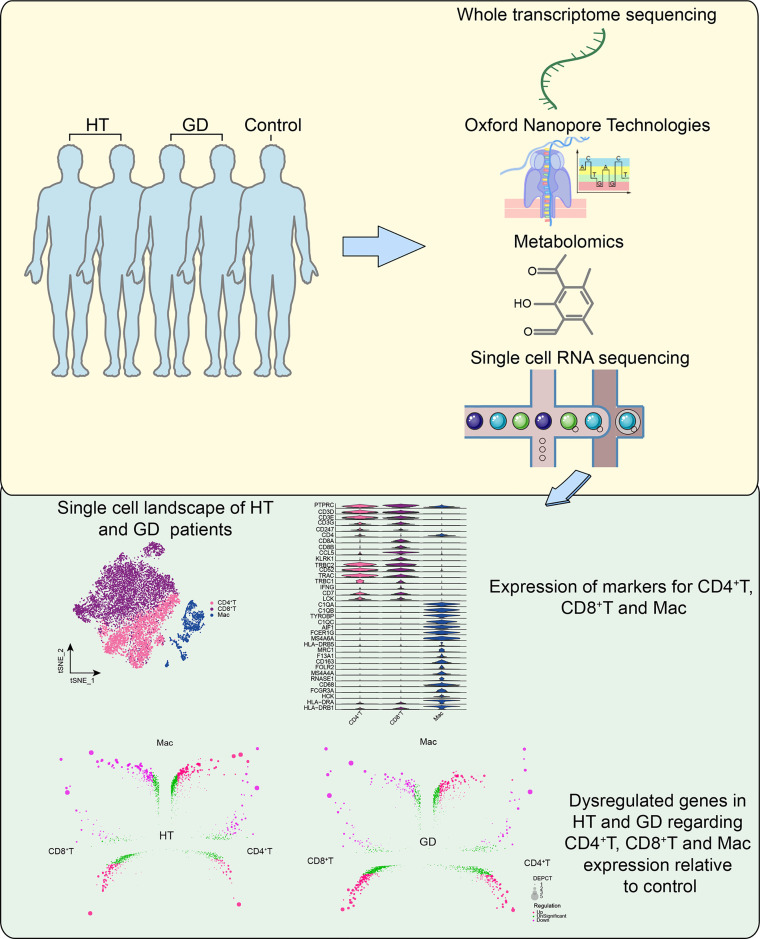
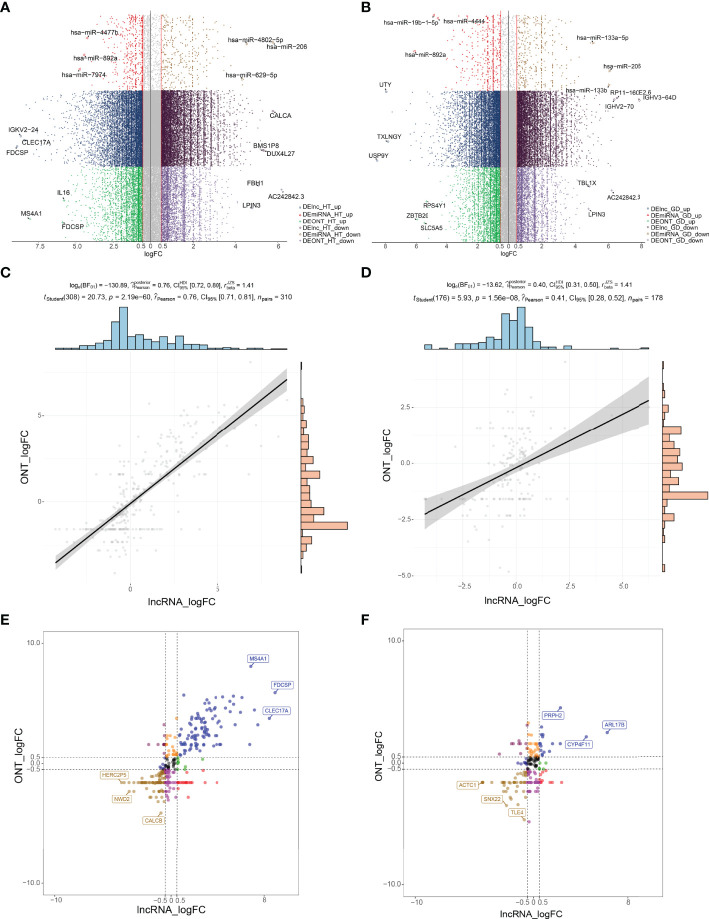
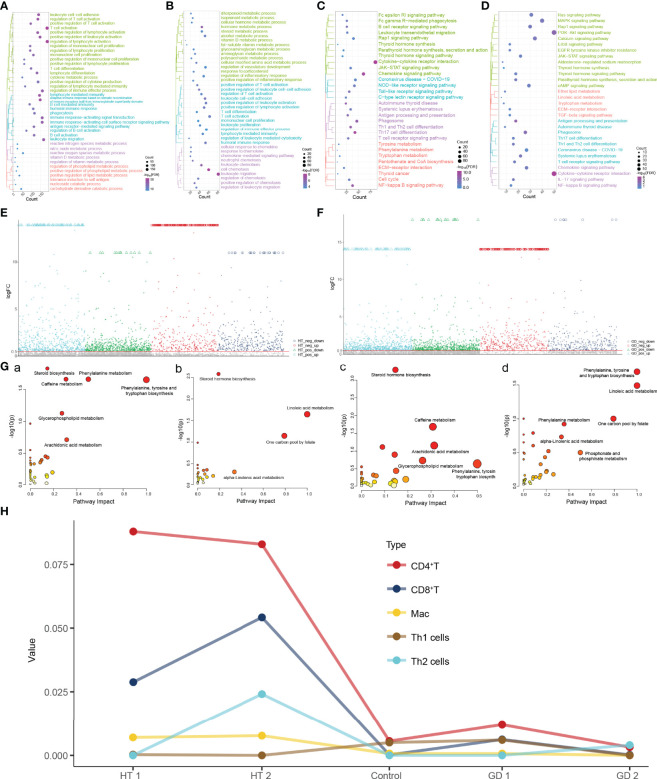
The study included 2 HT patients, 2 GD patients, and 1 control donor. The thyroid samples were extracted for single-cell RNA sequencing, whole transcriptome, full-length transcriptome (Oxford Nanopore Technologies), and metabolome sequencing. Identification of immune cells with dysregulated gene expression and abnormal metabolic signaling was performed in the microenvironment, both at the bulk and single-cell levels. Based on functional enrichment analysis, the biological processes and pathways involved in abnormal immune cells were further explored. Finally, according to cell communication analysis, the global regulatory network of immune cells was constructed.
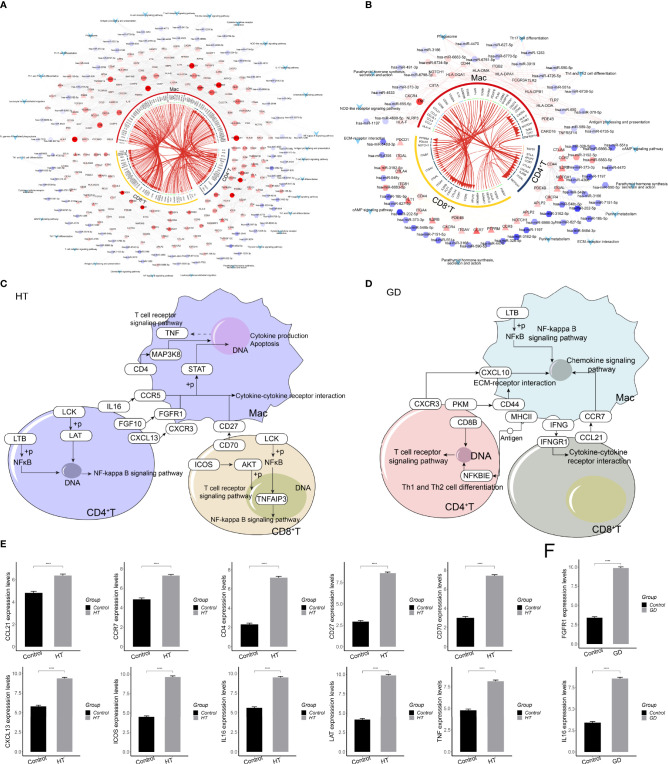
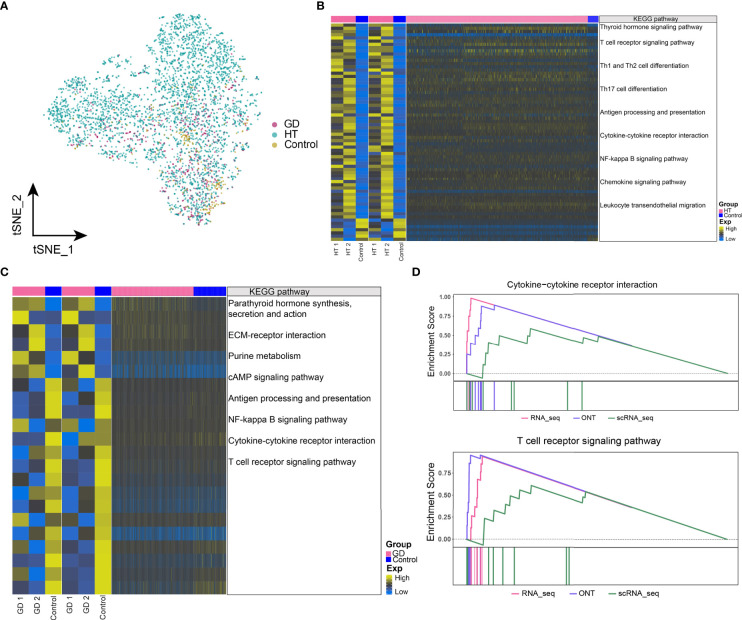
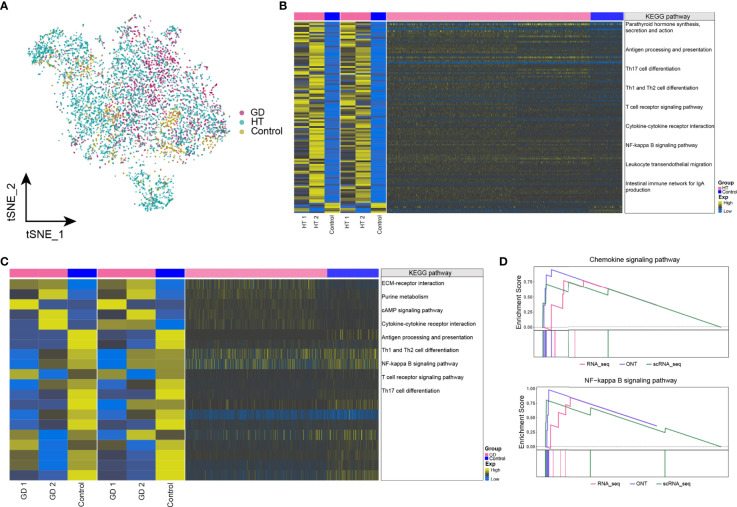
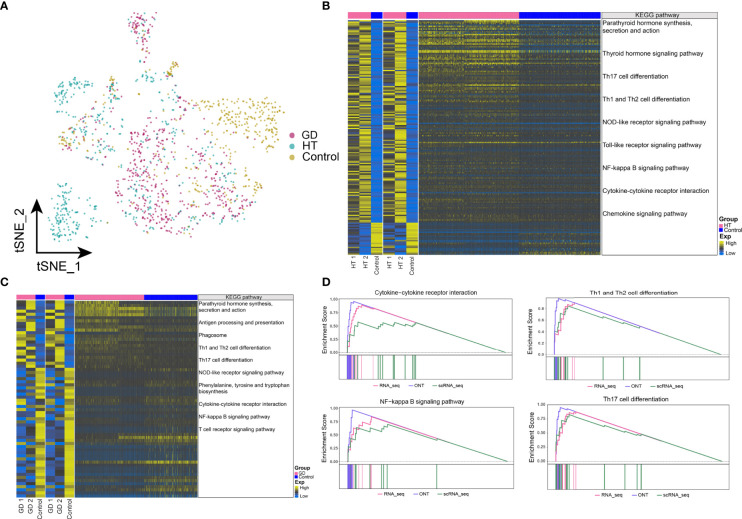
CD4 T cells, CD8 T cells, and macrophages were abnormally increased in patients with HT and GD. The differentially expressed genes of these cells were significantly involved in signaling pathways, including Th1 and Th2 cell differentiation, Th17 cell differentiation, cytokine-cytokine receptor interaction, and NF-kappa B signaling pathway. Moreover, in HT, CD4 T cells interact with macrophages the IL16-CCR5/FGF10-FGFR1/CXCL13-CXCR3 axis, and macrophages interact with CD8 T cells the CD70-CD27 axis, thereby activating the T-cell receptor signaling pathway and NF-kappa B signaling pathway. In GD, CD4 T cells interact with macrophages the CXCR3-CXCL10/PKM-CD44/MHCII-NFKBIE axis, and macrophages interact with CD8 T cells the IFNG-IFNGR1/CCR7-CCL21 axis, thereby activating T-cell receptor signaling pathway, Th1 and Th2 cell differentiation, and chemokine signaling pathway.
In HT and GD, immune dysregulated cells interact and activate relevant immune pathways and further aggravate the immune response. This may trigger the immune cells to target the thyroid tissue and influence the development of the disease.
尽管桥本甲状腺炎(HT)和格雷夫斯病(GD)的发病机制已得到阐明,但细胞亚群异常免疫功能触发针对甲状腺组织的自身免疫攻击的分子机制在很大程度上仍未得到解释。
本研究纳入了 2 例 HT 患者、2 例 GD 患者和 1 例对照供者。提取甲状腺样本进行单细胞 RNA 测序、全转录组、全长转录组(Oxford Nanopore Technologies)和代谢组测序。在细胞微环境中,分别在细胞群和单细胞水平上,对具有失调基因表达和异常代谢信号的免疫细胞进行鉴定。基于功能富集分析,进一步探讨了异常免疫细胞所涉及的生物学过程和通路。最后,根据细胞通讯分析,构建了免疫细胞的全局调控网络。
HT 和 GD 患者的 CD4 T 细胞、CD8 T 细胞和巨噬细胞异常增加。这些细胞的差异表达基因显著参与了信号通路,包括 Th1 和 Th2 细胞分化、Th17 细胞分化、细胞因子-细胞因子受体相互作用和 NF-κB 信号通路。此外,在 HT 中,CD4 T 细胞与巨噬细胞通过 IL16-CCR5/FGF10-FGFR1/CXCL13-CXCR3 轴相互作用,巨噬细胞与 CD8 T 细胞通过 CD70-CD27 轴相互作用,从而激活 T 细胞受体信号通路和 NF-κB 信号通路。在 GD 中,CD4 T 细胞与巨噬细胞通过 CXCR3-CXCL10/PKM-CD44/MHCII-NFKBIE 轴相互作用,巨噬细胞与 CD8 T 细胞通过 IFNG-IFNGR1/CCR7-CCL21 轴相互作用,从而激活 T 细胞受体信号通路、Th1 和 Th2 细胞分化以及趋化因子信号通路。
在 HT 和 GD 中,免疫失调细胞相互作用并激活相关免疫通路,从而进一步加剧免疫反应。这可能触发免疫细胞靶向甲状腺组织并影响疾病的发展。