Nolasco Santi, Manti Sara, Leonardi Salvatore, Vancheri Carlo, Spicuzza Lucia
Department of Clinical and Experimental Medicine, University of Catania, Catania, Italy.
Pediatric Pulmonology Unit, Department of Clinical and Experimental Medicine, University of Catania, Catania, Italy.
Front Med (Lausanne). 2022 Jun 3;9:920549. doi: 10.3389/fmed.2022.920549. eCollection 2022.
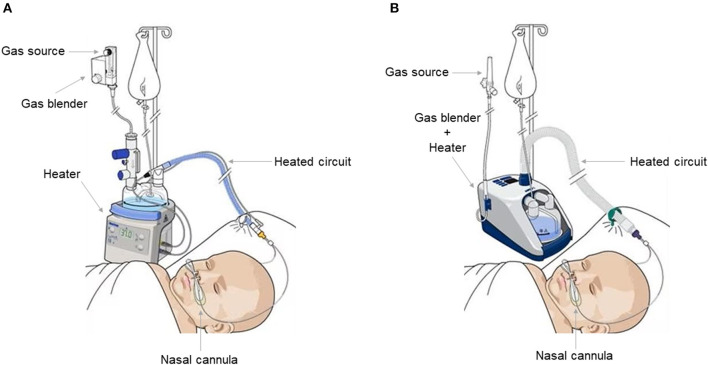
High-flow nasal cannula (HFNC) oxygen therapy has rapidly become a popular modality of respiratory support in pediatric care. This is undoubtedly due to its ease of use and safety, which allows it to be used in a wide variety of settings, ranging from pediatric intensive care to patients' homes. HFNC devices make it possible to regulate gas flow and temperature, as well as allowing some nebulized drugs to be administered, features very useful in children, in which the balance between therapeutic effectiveness and adherence to treatment is pivotal. Although the physiological effects of HFNC are still under investigation, their mechanisms of action include delivery of fixed concentration of oxygen, generation of positive end-expiratory pressure, reduction of the work of breathing and clearance of the nasopharyngeal dead space, while providing optimal gas conditioning. Nevertheless, current evidence supports the use of HFNC mainly in moderate-to-severe bronchiolitis, whereas for asthma exacerbations and breath sleeping disorders there is a lack of randomized controlled trials comparing HFNC to continuous positive airway pressure (CPAP) and non-invasive ventilation (NIV), which are essentials for the identification of response and non-response predictors. In this regard, the development of clinical guidelines for HFNC, including flow settings, indications, and contraindications is urgently needed.
高流量鼻导管(HFNC)氧疗已迅速成为儿科护理中一种流行的呼吸支持方式。这无疑归因于其使用简便和安全性,使其能够在从儿科重症监护到患者家中等广泛的环境中使用。HFNC设备能够调节气流和温度,还允许使用一些雾化药物,这些特性对儿童非常有用,因为在儿童中治疗效果和治疗依从性之间的平衡至关重要。尽管HFNC的生理效应仍在研究中,但其作用机制包括输送固定浓度的氧气、产生呼气末正压、减少呼吸功以及清除鼻咽部死腔,同时提供最佳的气体调节。然而,目前的证据支持HFNC主要用于中重度细支气管炎,而对于哮喘急性发作和睡眠呼吸障碍,缺乏将HFNC与持续气道正压通气(CPAP)和无创通气(NIV)进行比较的随机对照试验,而这些试验对于识别反应和无反应预测因素至关重要。在这方面,迫切需要制定包括流量设置、适应症和禁忌症在内的HFNC临床指南。