Horvat Christopher M, Suresh Srinivasan, James Nathan, Aneja Rajesh K, Au Alicia K, Berry Scott, Blumer Arthur, Bricker Kelly, Clark Robert S B, Dolinich Heidilyn, Hahner Sheila, Jockel Christina, Kalivoda Jordan, Loar India, Marasco Denee, Marcinick Adrienne, Marroquin Oscar, O'brien Jonathan, Pelletier Jonathan, Ramgopal Sriram, Venkataraman Shekhar, Angus Derek C, Butler Gabriella
UPMC Children's Hospital of Pittsburgh, Pittsburgh, PA, USA.
Division of Health Informatics, Department of Pediatrics, University of Pittsburgh School of Medicine, Pittsburgh, PA, USA.
Trials. 2024 Jul 16;25(1):484. doi: 10.1186/s13063-024-08327-y.
High flow nasal cannula (HFNC) has been increasingly adopted in the past 2 decades as a mode of respiratory support for children hospitalized with bronchiolitis. The growing use of HFNC despite a paucity of high-quality data regarding the therapy's efficacy has led to concerns about overutilization. We developed an electronic health record (EHR) embedded, quality improvement (QI) oriented clinical trial to determine whether standardized management of HFNC weaning guided by clinical decision support (CDS) results in a reduction in the duration of HFNC compared to usual care for children with bronchiolitis.
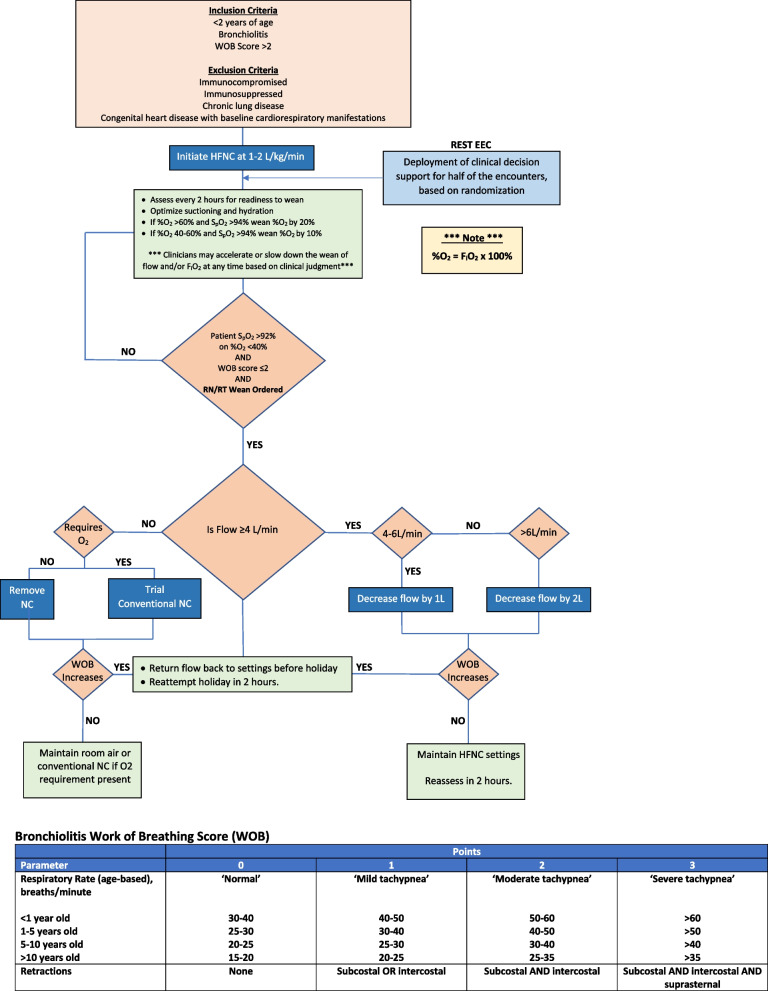
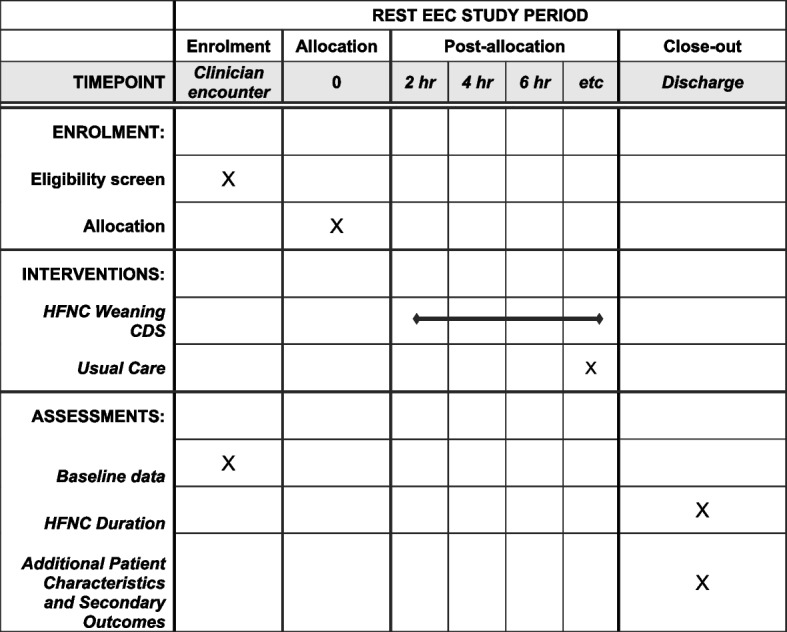
The design and summary of the statistical analysis plan for the REspiratory SupporT for Efficient and cost-Effective Care (REST EEC; "rest easy") trial are presented. The investigators hypothesize that CDS-coupled, standardized HFNC weaning will reduce the duration of HFNC, the trial's primary endpoint, for children with bronchiolitis compared to usual care. Data supporting trial design and eventual analyses are collected from the EHR and other real world data sources using existing informatics infrastructure and QI data sources. The trial workflow, including randomization and deployment of the intervention, is embedded within the EHR of a large children's hospital using existing vendor features. Trial simulations indicate that by assuming a true hazard ratio effect size of 1.27, equivalent to a 6-h reduction in the median duration of HFNC, and enrolling a maximum of 350 children, there will be a > 0.75 probability of declaring superiority (interim analysis posterior probability of intervention effect > 0.99 or final analysis posterior probability of intervention effect > 0.9) and a > 0.85 probability of declaring superiority or the CDS intervention showing promise (final analysis posterior probability of intervention effect > 0.8). Iterative plan-do-study-act cycles are used to monitor the trial and provide targeted education to the workforce.
Through incorporation of the trial into usual care workflows, relying on QI tools and resources to support trial conduct, and relying on Bayesian inference to determine whether the intervention is superior to usual care, REST EEC is a learning health system intervention that blends health system operations with active evidence generation to optimize the use of HFNC and associated patient outcomes.
ClinicalTrials.gov NCT05909566. Registered on June 18, 2023.
在过去20年里,高流量鼻导管(HFNC)越来越多地被用作毛细支气管炎住院儿童的呼吸支持模式。尽管关于该疗法疗效的高质量数据匮乏,但HFNC的使用却日益增加,这引发了对其过度使用的担忧。我们开展了一项嵌入电子健康记录(EHR)、以质量改进(QI)为导向的临床试验,以确定与毛细支气管炎患儿的常规护理相比,在临床决策支持(CDS)指导下的HFNC撤机标准化管理是否能缩短HFNC的使用时长。
介绍了高效且具成本效益护理的呼吸支持(REST EEC;“安心呼吸”)试验的设计及统计分析计划摘要。研究人员假设,与常规护理相比,结合CDS的标准化HFNC撤机将缩短毛细支气管炎患儿HFNC(试验的主要终点)使用时长。利用现有的信息学基础设施和QI数据源,从EHR及其他真实世界数据源收集支持试验设计和最终分析的数据。试验工作流程,包括随机分组和干预措施的实施,利用现有供应商功能嵌入一家大型儿童医院的EHR中。试验模拟表明,假设真实风险比效应大小为1.27,相当于HFNC中位使用时长减少6小时,且最多招募350名儿童,那么宣布干预措施具有优越性的概率将大于0.75(中期分析干预效应的后验概率>0.99或最终分析干预效应的后验概率>0.9),宣布干预措施具有优越性或CDS干预措施显示出前景的概率将大于0.85(最终分析干预效应的后验概率>0.8)。采用迭代的计划-执行-研究-改进循环来监测试验,并为工作人员提供针对性培训。
通过将试验纳入常规护理工作流程,依靠QI工具和资源支持试验开展,并依靠贝叶斯推断来确定干预措施是否优于常规护理,REST EEC是一种学习型健康系统干预措施,它将健康系统运作与积极的证据生成相结合,以优化HFNC的使用及相关患者结局。
ClinicalTrials.gov NCT05909566。于2023年6月18日注册。