Ma Hongbo, Liu Shengming, Li Shanrui, Xia Yong
Department of Rehabilitation Medicine, West China Hospital, Sichuan University, Chengdu, China.
West China School of Pharmacy, Sichuan University, Chengdu, China.
Front Pharmacol. 2022 Jun 3;13:918771. doi: 10.3389/fphar.2022.918771. eCollection 2022.
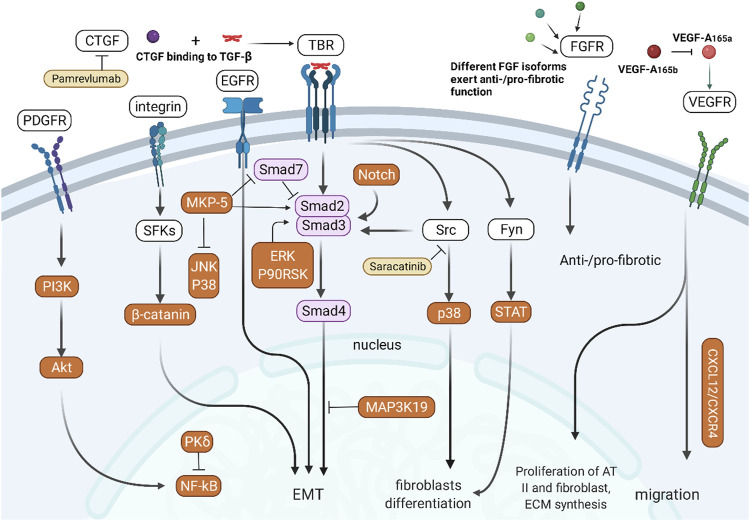
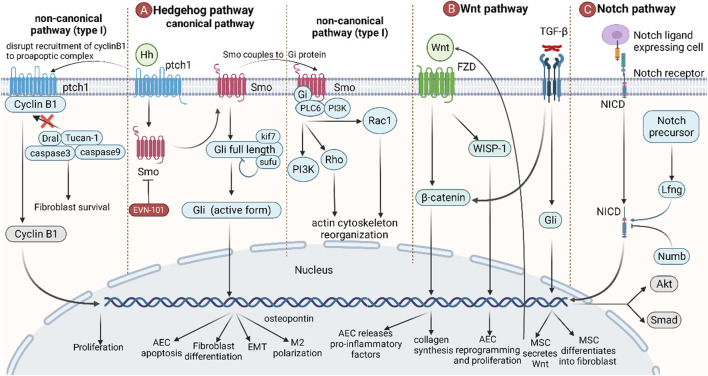
Idiopathic pulmonary fibrosis (IPF) is a chronic interstitial lung disease of unknown origin that usually results in death from secondary respiratory failure within 2-5 years of diagnosis. Recent studies have identified key roles of cytokine and growth factor pathways in the pathogenesis of IPF. Although there have been numerous clinical trials of drugs investigating their efficacy in the treatment of IPF, only Pirfenidone and Nintedanib have been approved by the FDA. However, they have some major limitations, such as insufficient efficacy, undesired side effects and poor pharmacokinetic properties. To give more insights into the discovery of potential targets for the treatment of IPF, this review provides an overview of cytokines, growth factors and their signaling pathways in IPF, which have important implications for fully exploiting the therapeutic potential of targeting cytokine and growth factor pathways. Advances in the field of cytokine and growth factor pathways will help slow disease progression, prolong life, and improve the quality of life for IPF patients in the future.
特发性肺纤维化(IPF)是一种病因不明的慢性间质性肺疾病,通常在诊断后2至5年内因继发性呼吸衰竭而死亡。最近的研究已经确定了细胞因子和生长因子信号通路在IPF发病机制中的关键作用。尽管已经有许多药物的临床试验研究了它们在治疗IPF方面的疗效,但只有吡非尼酮和尼达尼布获得了美国食品药品监督管理局(FDA)的批准。然而,它们存在一些主要局限性,如疗效不足、不良副作用和药代动力学性质不佳。为了更深入地了解IPF潜在治疗靶点的发现,本综述概述了IPF中的细胞因子、生长因子及其信号通路,这对于充分挖掘靶向细胞因子和生长因子信号通路的治疗潜力具有重要意义。细胞因子和生长因子信号通路领域的进展将有助于在未来减缓疾病进展、延长生命并改善IPF患者的生活质量。