Faculty of Public Health, Lebanese University, Beirut, 961, Lebanon.
PHENOL research group (Public HEalth Nutrition prOgram-Lebanon), Faculty of Public Health, Lebanese University, Beirut, 961, Lebanon.
F1000Res. 2022 Jan 24;11:84. doi: 10.12688/f1000research.75703.2. eCollection 2022.
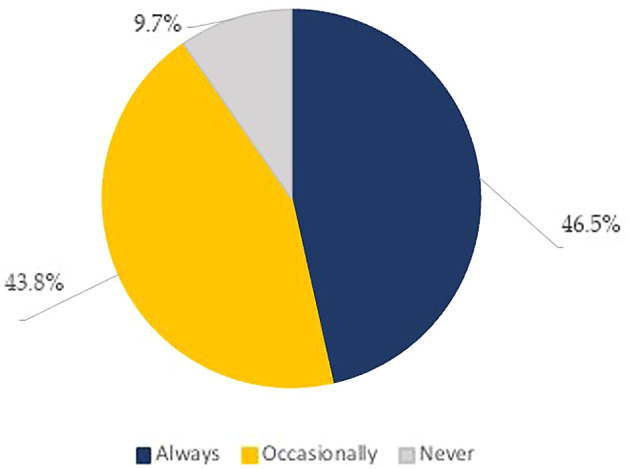
: Food labeling is a fundamental educational tool for advocating for public awareness. It emphasizes knowledge of the nutrient content of food and thus directs the choice towards the healthiest food products. This cross-sectional survey aimed to assess the knowledge, attitudes, and practices (KAP) regarding nutrition label use in Lebanon through a valid questionnaire. Overall, 768 participants (mean age: 30.8 ±12, males: 60.2%) were recruited randomly between February and May 2020. We used word of mouth and social media to recruit our sample population. : Social media was the most accessed tool to attain nutrition information by responders (39.8%). More than half the participants expressed positive attitudes to check information related to sugars (66.4%), vitamins (64.9%), total fats (61.7%), proteins (59.1%), and calories (58.7%) on the food label. Expiry date, price, and brand name were the top three considerations while reading food labels. About half (46.5%) reported to "always" look at the food label. Responders reported reading labels related primarily to sugars (44.3%), calories (38.8%), and total fats (36.8%). The optimal total KAP score was 46; our findings revealed a mean KAP score of 14.46 ±7 (31.4%). When categorizing the KAP scores, 15% had high scores, and 85% scored low. Spearman's coefficients showed positive correlations between knowledge-attitude, knowledge-practice, and attitude-practice scores, with p<0.001. The regression analysis revealed that gender, age, BMI, residency area, educational level, university degree, health and diet statuses, and activity level were significant predictors of the KAP score. Being on a diet had the highest odds (OR=3.107, CI=1.904-5.072, p<0.001). The low awareness of food labels leads Lebanese people to choose unhealthy food options. A planned educational program is recommended to ease the interpretation of these labels.
食品标签是倡导公众意识的基本教育工具。它强调了对食品营养成分的了解,从而引导人们选择最健康的食品。本横断面调查旨在通过有效的问卷评估黎巴嫩人对营养标签使用的知识、态度和实践(KAP)。总体而言,2020 年 2 月至 5 月期间,我们随机招募了 768 名参与者(平均年龄:30.8±12,男性:60.2%)。我们通过口碑和社交媒体来招募我们的样本人群。
社交媒体是受访者获取营养信息的最常用工具(39.8%)。超过一半的参与者表示,他们愿意查看食品标签上与糖(66.4%)、维生素(64.9%)、总脂肪(61.7%)、蛋白质(59.1%)和卡路里(58.7%)相关的信息。在阅读食品标签时,保质期、价格和品牌名称是前三个考虑因素。大约一半(46.5%)的人表示“总是”会看食品标签。受访者表示,主要关注与糖(44.3%)、卡路里(38.8%)和总脂肪(36.8%)相关的标签。最佳总 KAP 得分为 46;我们的研究结果显示,平均 KAP 得分为 14.46±7(31.4%)。当对 KAP 得分进行分类时,15%的人得分较高,85%的人得分较低。Spearman 系数显示知识-态度、知识-实践和态度-实践得分之间存在正相关,p<0.001。回归分析显示,性别、年龄、BMI、居住地区、教育程度、大学学历、健康和饮食状况以及活动水平是 KAP 得分的显著预测因素。正在节食的人具有最高的可能性(OR=3.107,CI=1.904-5.072,p<0.001)。
黎巴嫩人对食品标签的低认识导致他们选择不健康的食品。建议开展一项有计划的教育计划,以帮助人们更容易地理解这些标签。