Department of Integrative Oncology, China-Japan Friendship Hospital, Beijing 100029, China.
World J Gastroenterol. 2022 May 28;28(20):2163-2175. doi: 10.3748/wjg.v28.i20.2163.
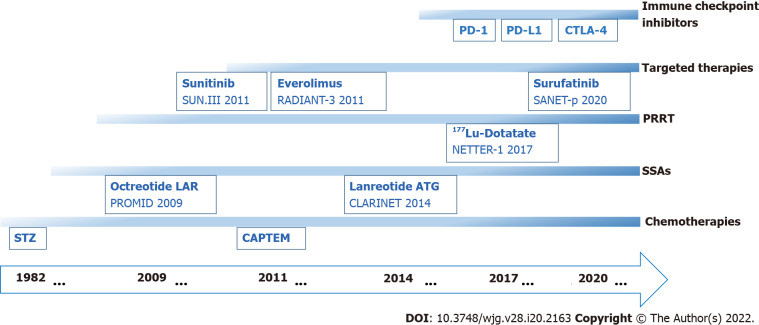
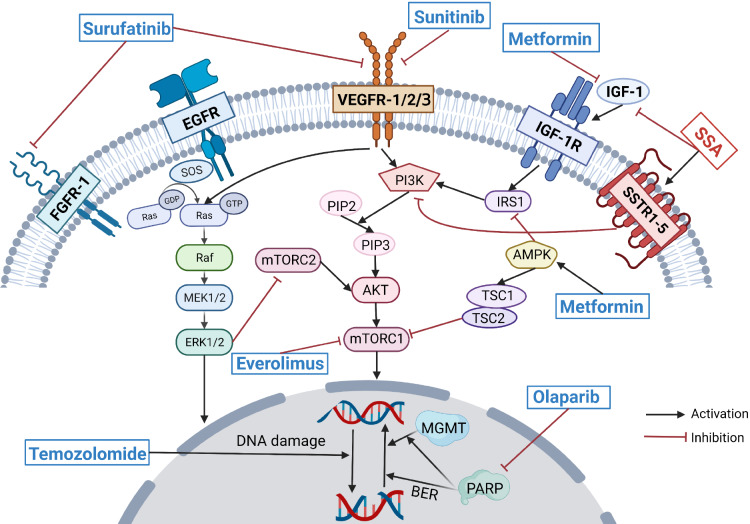
Pancreatic neuroendocrine neoplasms (PanNENs) are rare neoplasms with strong heterogeneity that have experienced an increasing incidence rate in recent years. For patients with locally advanced or distant metastatic PanNENs, systemic treatment options vary due to the different differentiations, grades and stages. The available options for systemic therapy include somatostatin analogs, mole-cularly targeted agents, cytotoxic chemotherapeutic agents, immune checkpoint inhibitors, and peptide receptor radionuclide therapy. In addition, the development of novel molecularly targeted agents is currently in progress. The sequence of selection between different chemotherapy regimens has been of great interest, and resistance to chemotherapeutic agents is the major limitation in their clinical application. Novel agents and high-level clinical evidence continue to emerge in the field of antiangiogenic agents. Peptide receptor radionuclide therapy is increasingly employed for the treatment of advanced neuroendocrine tumors, and greater therapeutic efficacy may be achieved by emerging radio-labeled peptides. Since immune checkpoint inhibitor monotherapies for PanNENs appear to have limited antitumor activity, dual immune checkpoint inhibitor therapies or combinations of antiangiogenic therapies and immune checkpoint inhibitors have been applied in the clinic to improve clinical efficacy. Combining the use of a variety of agents with different mechanisms of action provides new possibilities for clinical treatments. In the future, the study of systemic therapies will continue to focus on the screening of the optimal benefit population and the selection of the best treatment sequence strategy with the aim of truly achieving individualized precise treatment of PanNENs.
胰腺神经内分泌肿瘤(PanNENs)是一种具有高度异质性的罕见肿瘤,近年来其发病率呈上升趋势。对于局部晚期或远处转移的 PanNENs 患者,由于分化程度、分级和分期不同,系统治疗选择也不同。系统治疗的可选方案包括生长抑素类似物、分子靶向药物、细胞毒性化疗药物、免疫检查点抑制剂和肽受体放射性核素治疗。此外,新型分子靶向药物的开发目前正在进行中。不同化疗方案之间的选择顺序一直是人们关注的焦点,而化疗药物的耐药性是其临床应用的主要限制。新型药物和高级别的临床证据不断出现在抗血管生成药物领域。肽受体放射性核素治疗越来越多地用于治疗晚期神经内分泌肿瘤,通过新兴的放射性标记肽可能实现更大的治疗效果。由于 PanNENs 的免疫检查点抑制剂单药治疗似乎抗肿瘤活性有限,因此临床上已经应用了双重免疫检查点抑制剂治疗或抗血管生成治疗联合免疫检查点抑制剂的治疗,以提高临床疗效。联合使用具有不同作用机制的多种药物为临床治疗提供了新的可能性。未来,系统治疗的研究将继续侧重于筛选最佳获益人群和选择最佳治疗顺序策略,旨在真正实现 PanNENs 的个体化精准治疗。