Tang Jinzhi, Zeng Zhihao, Liang Haikuan, Wang Zhihao, Nong Wei, Yang Zhen, Qi Chenze, Qiao Zhengping, Li Yan, Wang Chengxin
State Key Laboratory of Optoelectronic Materials and Technologies, School of Materials Science and Engineering, Sun Yat-sen (Zhongshan) University, Guangzhou 510275, People's Republic of China.
Zhejiang Key Laboratory of Alternative Technologies for Fine Chemicals Process, College of Chemistry and Chemical Engineering, Shaoxing University, Shaoxing 312000, People's Republic of China.
ACS Omega. 2022 Jun 2;7(23):19794-19803. doi: 10.1021/acsomega.2c01562. eCollection 2022 Jun 14.
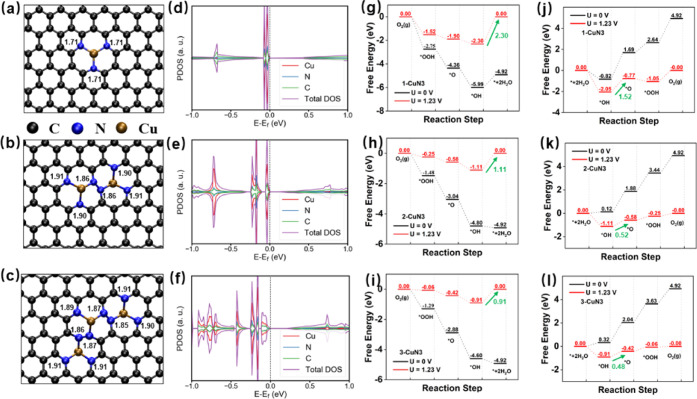
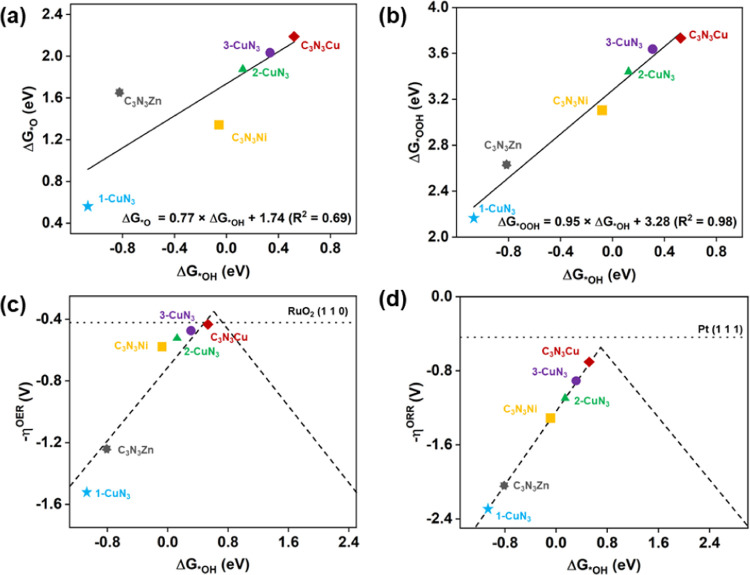
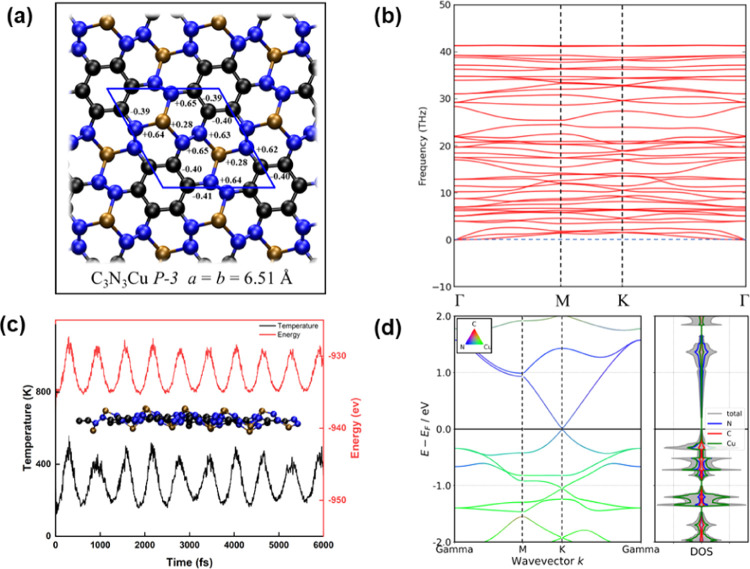
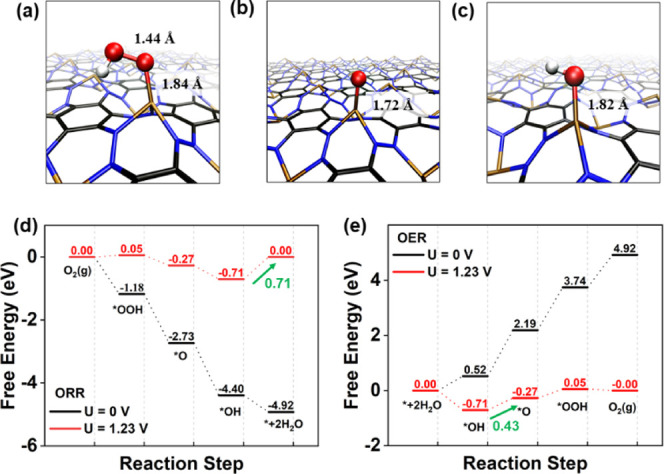
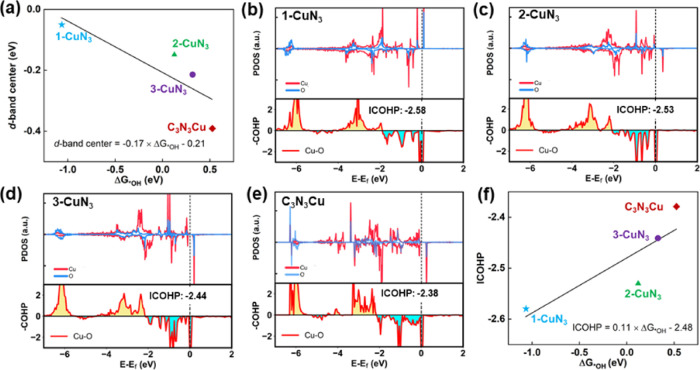
Atomically dispersed M-N-C has been considered an effective catalyst for various electrochemical reactions such as oxygen reduction reaction (ORR) and oxygen evolution reaction (OER), which faces the challenge of increasing metal load while simultaneously maintaining catalytic performance. Herein, we put forward a strategy for boosting catalytic performances of a single Cu atom coordinated with three N atoms (CuN) for both ORR and OER by increasing the density of connected CuN moieties. Our calculations first show that a single CuN moiety exhibiting no catalytic performance for ORR and OER can be activated by increasing the density of metal centers, which weakens the binding affinity to *OH due to the lowered d-band center of the metal atoms. These findings stimulate the further theoretical design of a two-dimensional compound of CNCu with a high concentration of homogeneously distributed CuN moieties serving as bifunctional active sites, which demonstrates efficient catalytic performance for both ORR and OER as reflected by the overpotentials of 0.71 and 0.43 V, respectively. This work opens a new avenue for designing effective single-atom catalysts with potential applications as energy storage and conversion devices possessing high density of metal centers independent of the doping strategy and defect engineering, which deserves experimental investigation in the future.
原子分散的M-N-C已被认为是用于各种电化学反应(如氧还原反应(ORR)和析氧反应(OER))的有效催化剂,这面临着在提高金属负载量的同时保持催化性能的挑战。在此,我们提出了一种策略,通过增加连接的CuN部分的密度来提高单个与三个N原子配位的Cu原子(CuN)对ORR和OER的催化性能。我们的计算首先表明,对于ORR和OER没有催化性能的单个CuN部分可以通过增加金属中心的密度来激活,这由于金属原子的d带中心降低而减弱了与*OH的结合亲和力。这些发现激发了对具有高浓度均匀分布的CuN部分作为双功能活性位点的二维化合物CNCu的进一步理论设计,其分别由0.71和0.43 V的过电位反映出对ORR和OER均具有高效的催化性能。这项工作为设计有效的单原子催化剂开辟了一条新途径,这些催化剂具有作为具有高密度金属中心的能量存储和转换装置的潜在应用,而与掺杂策略和缺陷工程无关,这值得未来进行实验研究。