Division of Social Pharmacy, Department of Healthcare and Regulatory Sciences, School of Pharmacy, SHOWA University, Tokyo, Japan.
Division of Infection Control Sciences, Department of Clinical Pharmacy, School of Pharmacy, SHOWA University, Tokyo, Japan.
Ann Nutr Metab. 2022;78(4):207-212. doi: 10.1159/000525367. Epub 2022 Jun 21.
International standards for enteral feeding involving the use of feeding tubes with junctions have been introduced. If these junctions are not properly cleaned, they can become contaminated, leading to microbial infections. We aimed to compare the ease and effectiveness of cleaning of four methods using the number of bacteria.
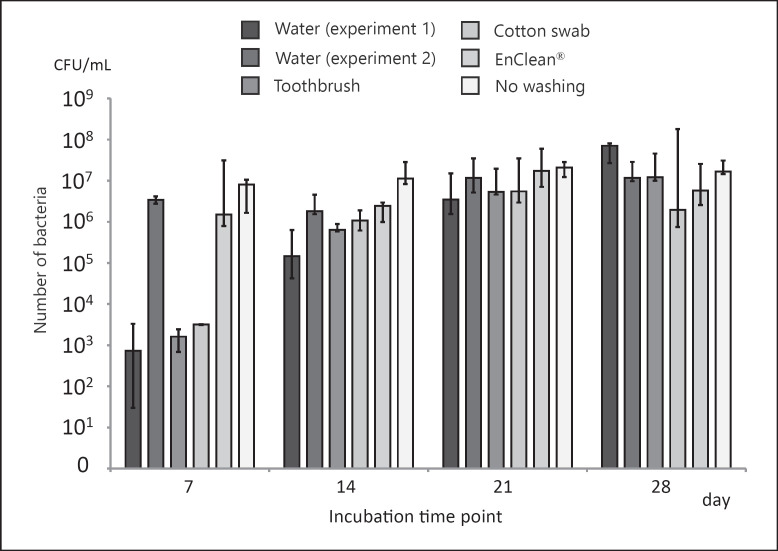
We compared enteral nutrition tube junctions cleaned using four methods such as water, toothbrush, cotton swab, and EnClean® brush with an uncleaned control. Once daily for 7 days, the tubes were injected with nutrients, cleaned, and incubated at 37°C. Samples for bacterial culture were collected before injections on days 7, 14, 21, and 28. The culture samples were incubated at 37°C for 48 h, and the number of colonies was counted.
The number of residual bacteria on day 28 did not differ between the four cleaning methods and the control group. Moreover, no significant difference was observed in bacterial counts among the four wash methods. The number of washes did not differ among cleaning methods.
The bacterial count in the ISO-standardized tube junction increased, and none of the cleaning methods decreased the counts.
国际标准规定,使用带有接头的肠内喂养管时,应进行接头清洁。如果这些接头没有得到适当的清洁,就会受到污染,从而导致微生物感染。我们旨在通过细菌数量比较四种方法(水、牙刷、棉签和 EnClean®刷子)的清洁效果和便捷性。
我们将使用水、牙刷、棉签和 EnClean®刷子四种方法清洁肠内营养管接头,并与未清洁的对照组进行比较。每天一次,连续 7 天,在每次注射营养物之前,将管注入、清洁并在 37°C 下孵育。在第 7、14、21 和 28 天收集细菌培养样本。将培养样本在 37°C 下孵育 48 小时,然后计算菌落数量。
在第 28 天,四种清洁方法与对照组之间残留细菌数量没有差异。此外,四种清洗方法之间的细菌计数也没有显著差异。清洁方法之间的清洗次数没有差异。
ISO 标准化管接头中的细菌计数增加,没有一种清洁方法可以减少计数。