Department of Psychology, University of British Columbia, Vancouver, British Columbia, Canada
Rehabilitation Research Program, Vancouver Coastal Health Research Institute, Vancouver, British Columbia, Canada.
BMJ Open. 2022 Jun 21;12(6):e062527. doi: 10.1136/bmjopen-2022-062527.
Mental health problems frequently interfere with recovery from mild traumatic brain injury (mTBI) but are under-recognised and undertreated. Consistent implementation of clinical practice guidelines for proactive detection and treatment of mental health complications after mTBI will require evidence-based knowledge translation strategies. This study aims to determine if a guideline implementation tool can reduce the risk of mental health complications following mTBI. If effective, our guideline implementation tool could be readily scaled up and/or adapted to other healthcare settings.
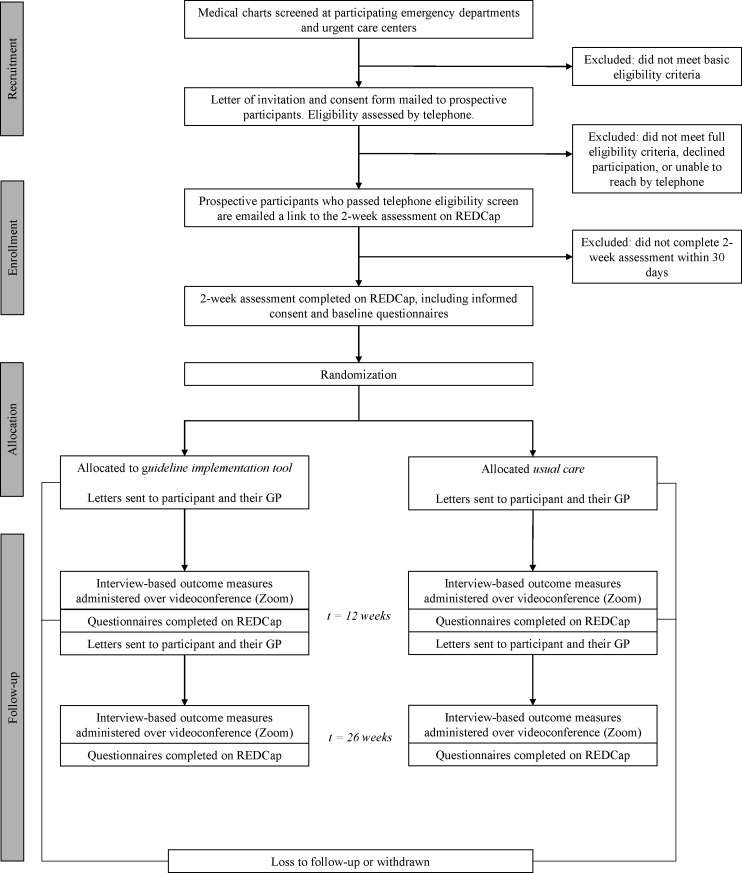
We will conduct a triple-blind cluster randomised trial to evaluate a clinical practice guideline implementation tool designed to support proactive management of mental health complications after mTBI in primary care. We will recruit 535 adults (aged 18-69 years) with mTBI from six emergency departments and two urgent care centres in the Greater Vancouver Area, Canada. Upon enrolment at 2 weeks post-injury, they will complete mental health symptom screening tools and designate a general practitioner (GP) or primary care clinic where they plan to seek follow-up care. Primary care clinics will be randomised into one of two arms. In the guideline implementation tool arm, GPs will receive actionable mental health screening test results tailored to their patient and their patients will receive written education about mental health problems after mTBI and treatment options. In the usual care control arm, GPs and their patients will receive generic information about mTBI. Patient participants will complete outcome measures remotely at 2, 12 and 26 weeks post-injury. The primary outcome is rate of new or worsened mood, anxiety or trauma-related disorder on the Mini International Neuropsychiatric Interview at 26 weeks.
Study procedures were approved by the University of British Columbia's research ethics board (H20-00562). The primary report for the trial results will be published in a peer-reviewed journal. Our knowledge user team members (patients, GPs, policymakers) will co-create a plan for public dissemination.
ClinicalTrials.gov Registry (NCT04704037).
心理健康问题经常会干扰轻度创伤性脑损伤(mTBI)的康复,但这些问题往往未被识别和治疗。为了积极检测和治疗 mTBI 后的心理健康并发症,需要一致实施临床实践指南,这就需要基于证据的知识转化策略。本研究旨在确定指南实施工具是否可以降低 mTBI 后发生心理健康并发症的风险。如果有效,我们的指南实施工具可以很容易地推广和/或适应其他医疗保健环境。
我们将进行一项三盲集群随机试验,以评估一种旨在支持初级保健中 mTBI 后积极管理心理健康并发症的临床实践指南实施工具。我们将从加拿大大温哥华地区的六个急诊室和两个紧急护理中心招募 535 名年龄在 18-69 岁之间的 mTBI 成年人。在受伤后 2 周登记时,他们将完成心理健康症状筛查工具,并指定他们计划寻求后续护理的全科医生(GP)或初级保健诊所。初级保健诊所将随机分为两个组中的一个。在指南实施工具组中,GP 将收到针对其患者的可操作的心理健康筛查测试结果,并且他们的患者将收到有关 mTBI 后心理健康问题和治疗选择的书面教育。在常规护理对照组中,GP 和他们的患者将收到关于 mTBI 的一般信息。患者参与者将在受伤后 2、12 和 26 周远程完成结果测量。主要结局是在 26 周时使用 Mini International Neuropsychiatric Interview 评估新的或恶化的情绪、焦虑或创伤相关障碍的发生率。
该研究程序已获得不列颠哥伦比亚大学研究伦理委员会的批准(H20-00562)。试验结果的主要报告将发表在同行评议的期刊上。我们的知识用户团队成员(患者、GP、决策者)将共同制定公开传播计划。
ClinicalTrials.gov 注册表(NCT04704037)。