Silverberg Noah D, Panenka William J, Lizotte Pierre-Paul, Bayley Mark T, Dance Derry, Li Linda C
Department of Psychology, The University of British Columbia, Vancouver, British Columbia, Canada
Division of Physical Medicine and Rehabilitation, The University of British Columbia, Vancouver, British Columbia, Canada.
BMJ Open. 2020 Oct 20;10(10):e035527. doi: 10.1136/bmjopen-2019-035527.
New clinical practice guidelines for the management of mild traumatic brain injury (mTBI) emphasise that family physicians should proactively screen and initiate treatment for depression/anxiety, insomnia and headaches. This study aimed to evaluate the feasibility of delivering an implementation intervention to family physicians.
Pilot cluster randomised controlled trial.
Specialty outpatient clinic (recruitment) and primary care (implementation).
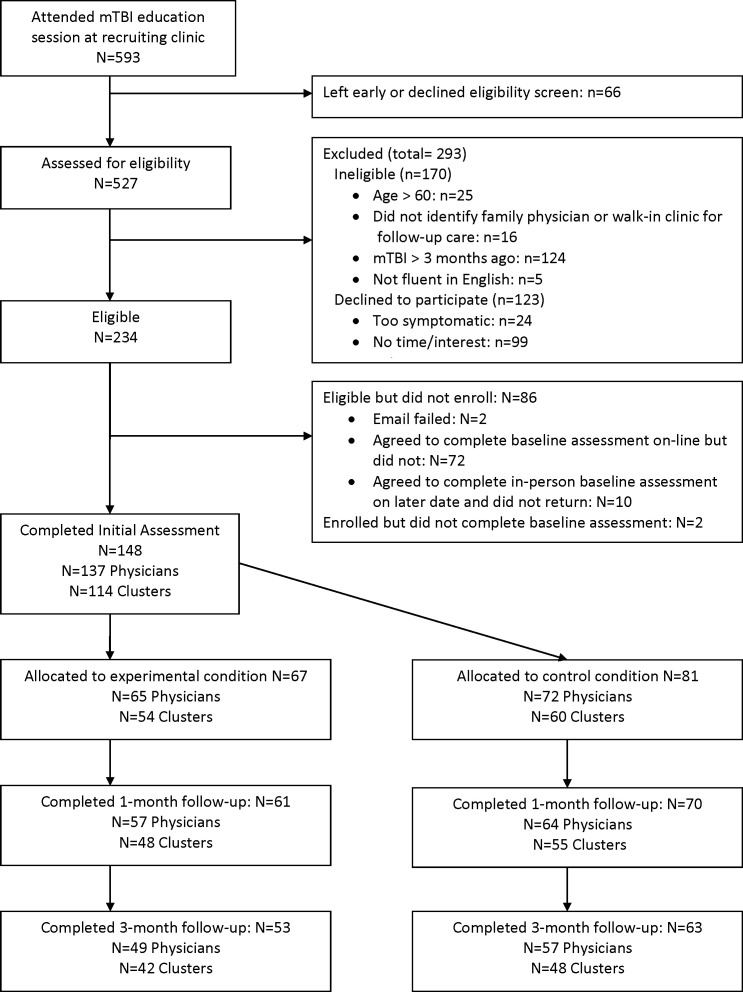
114 primary care clinics were randomised. These clinics were associated with 137 unique family physicians caring for 148 adult patients who sustained an mTBI within the previous 3 months and were seeking care for persistent symptoms.
Patients completed self-report screening measures for depression/anxiety, insomnia and headaches. A tailored letter that incorporates the patient's screening test results and associated treatment algorithms was sent to their family physician (or walk-in clinic). Physicians at clinics assigned to the control condition received a generic letter, without the screening test results.
Feasibility outcomes included the frequency of primary care follow-up, retention rates and reliability of patient recall of their physicians' actions (primary mechanistic outcome). The primary efficacy outcome was the Rivermead Post-Concussion Symptom Questionnaire (RPQ).
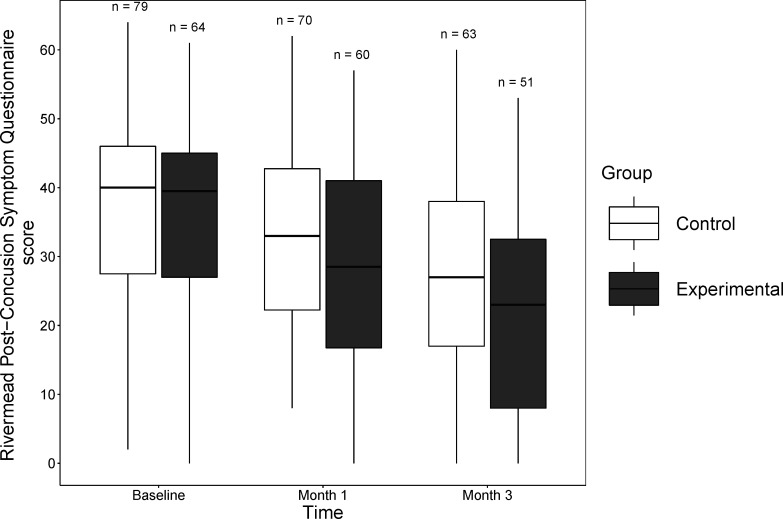
Most patients (97.8%; 128 of 131) followed up at the primary care clinic they planned to. Retention rates were 88% (131 of 148) and 78% (116 of 148) at the 1-month and 3-month assessments, respectively. Agreement between patient recall of their physicians' actions and medical chart audits was moderate (intraclass correlation coefficient=0.48-0.65). Patients in the experimental group reported fewer symptoms on the RPQ compared with those in the control group, whose physician received a general letter (B=-4.0, 95% CI: -7.3 to -0.7).
A larger trial will need to address minor feasibility challenges to evaluate the effectiveness of this guideline implementation tool for improving mTBI clinical outcomes and confirm the mechanism(s) of intervention benefit.
NCT03221218.
轻度创伤性脑损伤(mTBI)管理的新临床实践指南强调,家庭医生应积极筛查并启动针对抑郁/焦虑、失眠和头痛的治疗。本研究旨在评估对家庭医生实施干预措施的可行性。
试点整群随机对照试验。
专科门诊(招募)和初级保健机构(实施)。
114家初级保健诊所被随机分组。这些诊所与137名不同的家庭医生相关联,这些医生负责照顾148名在过去3个月内遭受mTBI且因持续症状寻求治疗的成年患者。
患者完成抑郁/焦虑、失眠和头痛的自我报告筛查量表。一封包含患者筛查测试结果及相关治疗算法的定制信件被发送给他们的家庭医生(或随诊诊所)。分配到对照组的诊所的医生收到一封普通信件,不包含筛查测试结果。
可行性结局包括初级保健随访的频率、留存率以及患者对医生行为回忆的可靠性(主要机制性结局)。主要疗效结局是Rivermead脑震荡后症状问卷(RPQ)。
大多数患者(97.8%;131例中的128例)在他们计划前往的初级保健诊所进行了随访。在1个月和3个月评估时的留存率分别为88%(148例中的131例)和78%(148例中的116例)。患者对医生行为的回忆与病历审核之间的一致性为中等(组内相关系数=0.48 - 0.65)。与医生收到普通信件的对照组患者相比,实验组患者在RPQ上报告的症状更少(B=-4.0,95%CI:-7.3至-0.7)。
一项更大规模的试验需要解决一些小的可行性挑战,以评估这种指南实施工具对改善mTBI临床结局的有效性,并确认干预获益的机制。
NCT03221218。