Department of Civil Engineering, Faculty of Engineering, Universiti Malaya (UM), 50603, Kuala Lumpur, Malaysia.
Department of Civil Engineering, College of Engineering, Universiti Tenaga Nasional (UNITEN), 43000, Kajang, Selangor Darul Ehsan, Malaysia.
Sci Rep. 2022 Jun 21;12(1):10457. doi: 10.1038/s41598-022-13532-3.
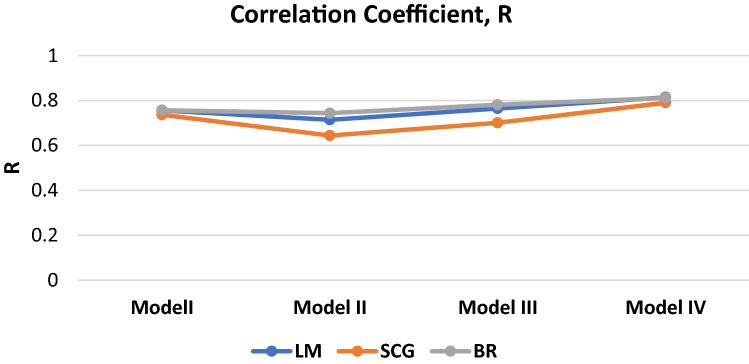
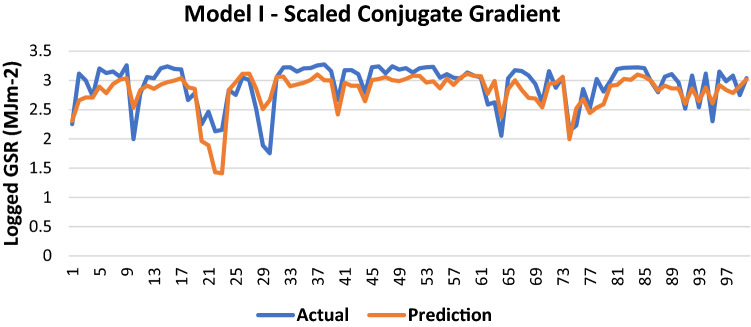
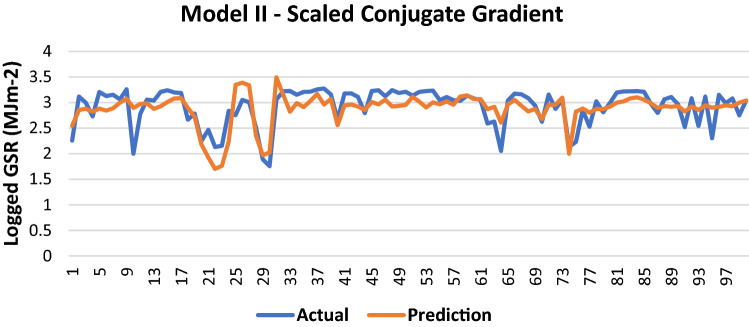
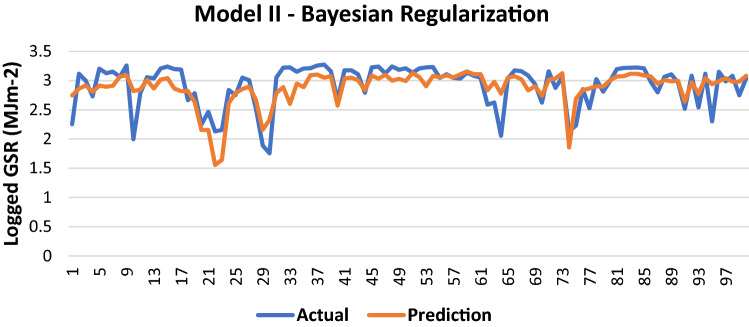
Solar energy serves as a great alternative to fossil fuels as they are clean and renewable energy. Accurate solar radiation (SR) prediction can substantially lower down the impact cost pertaining to the development of solar energy. Lately, many SR forecasting system has been developed such as support vector machine, autoregressive moving average and artificial neural network (ANN). This paper presents a comprehensive study on the meteorological data and types of backpropagation (BP) algorithms used to train and develop the best SR predicting ANN model. The meteorological data, which includes temperature, relative humidity and wind speed are collected from a meteorological station from Kuala Terrenganu, Malaysia. Three different BP algorithms are employed into training the model i.e., Levenberg-Marquardt, Scaled Conjugate Gradient and Bayesian Regularization (BR). This paper presents a comparison study to select the best combination of meteorological data and BP algorithm which can develop the ANN model with the best predictive ability. The findings from this study shows that temperature and relative humidity both have high correlation with SR whereas wind temperature has little influence over SR. The results also showed that BR algorithm trained ANN models with maximum R of 0.8113 and minimum RMSE of 0.2581, outperform other algorithm trained models, as indicated by the performance score of the respective models.
太阳能是化石燃料的绝佳替代品,因为它是清洁和可再生能源。准确的太阳辐射 (SR) 预测可以大大降低与太阳能开发相关的影响成本。最近,已经开发出许多太阳辐射预测系统,例如支持向量机、自回归移动平均和人工神经网络 (ANN)。本文对气象数据和反向传播 (BP) 算法类型进行了全面研究,这些算法用于训练和开发最佳的太阳辐射预测 ANN 模型。气象数据包括温度、相对湿度和风速,是从马来西亚瓜拉特兰努的一个气象站收集的。本文采用了三种不同的 BP 算法来训练模型,即 Levenberg-Marquardt、Scaled Conjugate Gradient 和 Bayesian Regularization (BR)。本文进行了对比研究,以选择最佳的气象数据和 BP 算法组合,从而开发出具有最佳预测能力的 ANN 模型。研究结果表明,温度和相对湿度都与 SR 高度相关,而风速对 SR 的影响较小。结果还表明,BR 算法训练的 ANN 模型的 R 值最大为 0.8113,RMSE 最小为 0.2581,优于其他算法训练的模型,这反映了各个模型的性能得分。