
使用经黑猩猩优化算法调整的多种机器学习模型增强太阳能光伏发电预测
Enhancing solar photovoltaic energy production prediction using diverse machine learning models tuned with the chimp optimization algorithm.
作者信息
Al-Dahidi Sameer, Alrbai Mohammad, Alahmer Hussein, Rinchi Bilal, Alahmer Ali
机构信息
Department of Mechanical and Maintenance Engineering, School of Applied Technical Sciences, German Jordanian University, Amman, 11180, Jordan.
Department of Mechanical Engineering, School of Engineering, University of Jordan, Amman, 11942, Jordan.
出版信息
Sci Rep. 2024 Aug 10;14(1):18583. doi: 10.1038/s41598-024-69544-8.
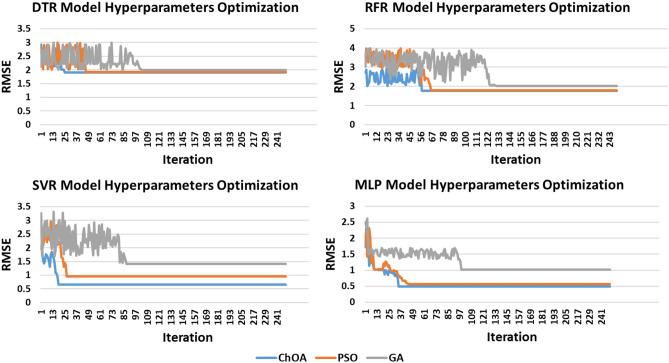
Solar photovoltaic (PV) systems, integral for sustainable energy, face challenges in forecasting due to the unpredictable nature of environmental factors influencing energy output. This study explores five distinct machine learning (ML) models which are built and compared to predict energy production based on four independent weather variables: wind speed, relative humidity, ambient temperature, and solar irradiation. The evaluated models include multiple linear regression (MLR), decision tree regression (DTR), random forest regression (RFR), support vector regression (SVR), and multi-layer perceptron (MLP). These models were hyperparameter tuned using chimp optimization algorithm (ChOA) for a performance appraisal. The models are subsequently validated on the data from a 264 kWp PV system, installed at the Applied Science University (ASU) in Amman, Jordan. Of all 5 models, MLP shows best root mean square error (RMSE), with the corresponding value of 0.503, followed by mean absolute error (MAE) of 0.397 and a coefficient of determination (R) value of 0.99 in predicting energy from the observed environmental parameters. Finally, the process highlights the fact that fine-tuning of ML models for improved prediction accuracy in energy production domain still involves the use of advanced optimization techniques like ChOA, compared with other widely used optimization algorithms from the literature.
太阳能光伏(PV)系统是可持续能源不可或缺的一部分,但由于影响能源输出的环境因素具有不可预测性,其在预测方面面临挑战。本研究探索了五种不同的机器学习(ML)模型,这些模型基于风速、相对湿度、环境温度和太阳辐射这四个独立的气象变量构建并进行比较,以预测能源产量。评估的模型包括多元线性回归(MLR)、决策树回归(DTR)、随机森林回归(RFR)、支持向量回归(SVR)和多层感知器(MLP)。这些模型使用黑猩猩优化算法(ChOA)进行超参数调整,以进行性能评估。随后,这些模型在约旦安曼应用科学大学(ASU)安装的一个264千瓦峰值功率的光伏系统的数据上进行验证。在所有五个模型中,MLP显示出最佳的均方根误差(RMSE),相应值为0.503,其次是平均绝对误差(MAE)为0.397,以及在根据观测到的环境参数预测能源时的决定系数(R)值为0.99。最后,该过程突出了这样一个事实,即与文献中其他广泛使用的优化算法相比,在能源生产领域为提高预测精度而对ML模型进行微调仍然需要使用像ChOA这样的先进优化技术。




 Zotero 插件