Malaria Branch, Division of Parasitic Diseases and Malaria, Center for Global Health, Centers for Disease Control and Prevention (CDC), 1600 Clifton Rd, Atlanta, GA, 30329, USA.
University of Malawi College of Medicine, Malaria Alert Centre, Blantyre, Malawi.
Malar J. 2022 Jun 21;21(1):195. doi: 10.1186/s12936-022-04216-4.
Malaria in pregnancy doubles the risk of low birthweight; up to 11% of all neonatal deaths in sub-Saharan Africa are associated with malaria in pregnancy. To prevent these and other adverse health consequences, the World Health Organization recommends administering intermittent preventive treatment in pregnancy (IPTp) with sulfadoxine-pyrimethamine for all pregnant women at each antenatal care (ANC) visit, starting as early as possible in the second trimester. The target is for countries to administer a minimum of three doses (IPTp3+) to at least 85% of pregnant women.
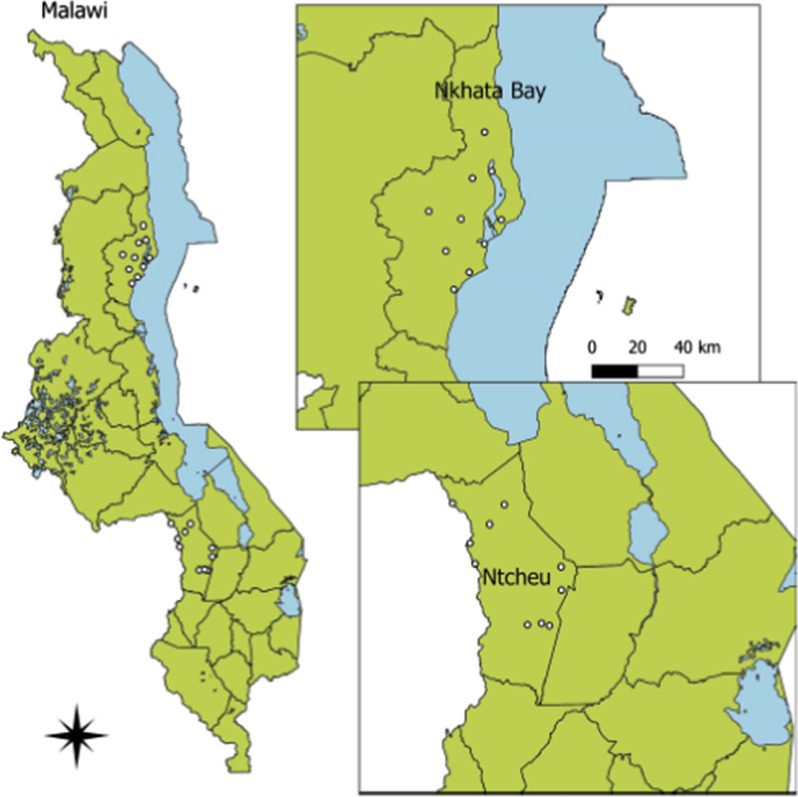
A cluster randomized, controlled trial was conducted to assess the effect of delivery of IPTp by community health workers on the coverage of IPTp3 + and ANC visits in Malawi. Community delivery of IPTp was implemented within two districts in Malawi over a 21-month period, from November 2018 to July 2020. In control sites, IPTp was delivered at health facilities. Representative samples of women who delivered in the prior 12 months were surveyed at baseline (n = 370, December 2017) and endline (n = 687, August 2020). A difference in differences analysis was conducted to assess the change in coverage of IPTp and ANC over time, accounting for clustering at the health facility level.
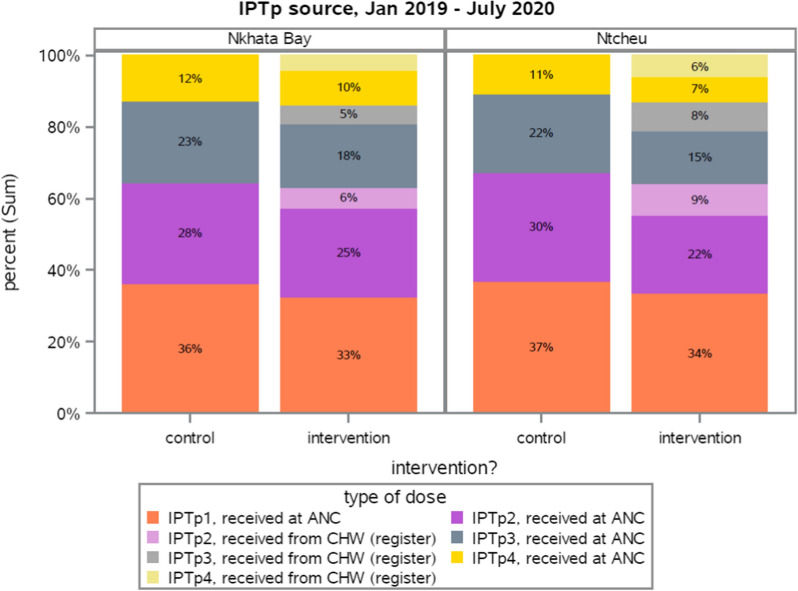
Overall IPTp coverage increased over the study period. At baseline, women received a mean of 2.3 IPTp doses (range 0-5 doses) across both arms, and at endline, women received a mean of 2.8 doses (range 0-9 doses). Despite overall increases, the change in IPTp3 + coverage was not significantly different between intervention and control groups (6.9%, 95% CI: -5.9%, 19.6%). ANC4 + coverage increased significantly in the intervention group compared with the control group, with a difference-in-differences of 25.3% points (95% CI: 1.3%, 49.3%).
In order to reduce the burden of malaria in pregnancy, new strategies are needed to improve uptake of effective interventions such as IPTp. While community health workers' delivery of IPTp did not increase uptake in this study, they may be effective in other settings or circumstances. Further research can help identify the health systems characteristics that are conducive to community delivery of IPTp and the operational requirements for effective implementation.
ClinicalTrials.gov Identifier: NCT03376217. Registered December 6, 2017, https://clinicaltrials.gov/ct2/show/NCT03376217 .
妊娠疟疾使低出生体重的风险增加一倍;撒哈拉以南非洲地区多达 11%的新生儿死亡与妊娠疟疾有关。为了预防这些和其他不良健康后果,世界卫生组织建议在每个产前保健(ANC)就诊时,为所有孕妇每两个月用磺胺多辛-乙胺嘧啶进行间歇性预防治疗(IPTp),从妊娠中期尽早开始。目标是使各国至少为 85%的孕妇提供至少三剂(IPTp3+)。
一项针对社区卫生工作者提供 IPTp 对马拉维妊娠期间接受 IPTp 覆盖和 ANC 就诊影响的集群随机对照试验。2018 年 11 月至 2020 年 7 月,在马拉维的两个区实施了社区提供 IPTp,为期 21 个月。在对照点,在卫生设施提供 IPTp。在基线(n=370,2017 年 12 月)和终点(n=687,2020 年 8 月)时,对在前 12 个月分娩的妇女进行了代表性抽样调查。采用差异中的差异分析来评估随时间推移,在考虑到卫生机构水平聚类的情况下,IPTp 和 ANC 覆盖范围的变化。
研究期间,总体上 IPTp 的覆盖率有所增加。在基线时,无论在哪一组,妇女平均接受了 2.3 剂 IPTp(范围 0-5 剂),而在终点时,妇女平均接受了 2.8 剂(范围 0-9 剂)。尽管总体上有所增加,但干预组和对照组之间 IPTp3+覆盖率的变化没有显著差异(6.9%,95%CI:-5.9%,19.6%)。与对照组相比,干预组 ANC4+覆盖率显著增加,差异为 25.3 个百分点(95%CI:1.3%,49.3%)。
为了降低妊娠疟疾的负担,需要采取新的策略来提高如 IPTp 等有效干预措施的利用率。虽然本研究中社区卫生工作者提供的 IPTp 并未增加其利用率,但他们可能在其他环境或情况下有效。进一步的研究可以帮助确定有利于社区提供 IPTp 的卫生系统特征和有效实施的操作要求。
ClinicalTrials.gov 标识符:NCT03376217。2017 年 12 月 6 日注册,https://clinicaltrials.gov/ct2/show/NCT03376217。