Mwendera Chikondi A, de Jager Christiaan, Longwe Herbert, Phiri Kamija, Hongoro Charles, Mutero Clifford M
School of Health Systems and Public Health, Institute for Sustainable Malaria Control (UP ISMC), University of Pretoria, Private Bag X363, Pretoria, 0001, South Africa.
Mailman School of Public Health, ICAP at Columbia University, Pretoria, South Africa.
Malar J. 2017 Feb 20;16(1):84. doi: 10.1186/s12936-017-1736-9.
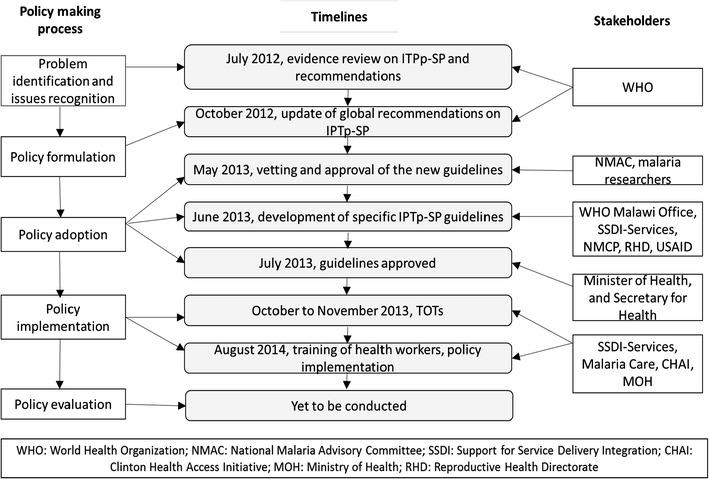
The growing resistance of Plasmodium falciparum to sulfadoxine-pyrimethamine (SP) treatment for uncomplicated malaria led to a recommendation by the World Health Organization for the use of artemisinin-based combination therapy. Inevitably, concerns were also raised surrounding the use of SP for intermittent prevention treatment of malaria during pregnancy (IPTp) amidst the lack of alternative drugs. Malawi was the first country to adopt intermittent prevention treatment with SP in 1993, and updated in 2013. This case study examines the policy updating process and the contribution of research and key stakeholders to this process. The findings support the development of a malaria research-to-policy framework in Malawi.
Documents and evidence published from 1993 to 2012 were systematically reviewed in addition to key informant interviews.
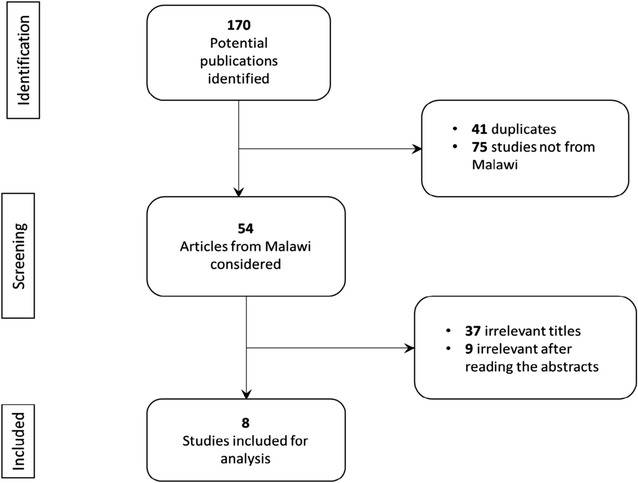
The online search identified 170 potential publications, of which eight from Malawi met the inclusion criteria. Two published studies from Malawi were instrumental in the WHO policy recommendation which in turn led to the updating of national policies. The updated policy indicates that more than two SP doses, as informed by research, overcome the challenges of the first policy of two SP doses only because of ineffectiveness by P. falciparum resistance and the global lack of replacement drugs to SP for IPTp.
International WHO recommendations facilitated a smooth policy change driven by motivated local leadership with technical and financial support from development partners. Policy development and implementation should include key stakeholders and use local malaria research in a research-to-policy framework.
恶性疟原虫对用于治疗非复杂性疟疾的磺胺多辛-乙胺嘧啶(SP)产生的耐药性不断增加,导致世界卫生组织建议使用以青蒿素为基础的联合疗法。不可避免地,在缺乏替代药物的情况下,围绕在孕期使用SP进行疟疾间歇性预防治疗(IPTp)也引发了担忧。马拉维是1993年首个采用SP进行间歇性预防治疗的国家,并于2013年进行了更新。本案例研究考察了政策更新过程以及研究和关键利益相关者对这一过程的贡献。研究结果支持在马拉维建立一个疟疾研究到政策的框架。
除关键信息人访谈外,还对1993年至2012年发表的文献和证据进行了系统回顾。
在线搜索确定了170篇潜在出版物,其中来自马拉维的8篇符合纳入标准。马拉维发表的两项研究对世卫组织的政策建议起到了推动作用,进而促使国家政策得到更新。更新后的政策表明,如研究所显示的,超过两剂SP能够克服仅使用两剂SP的首个政策所面临的挑战,这是由于恶性疟原虫耐药性导致的无效性以及全球缺乏用于IPTp的SP替代药物。
世卫组织的国际建议在当地积极领导以及发展伙伴的技术和资金支持下,推动了政策的顺利变革。政策制定和实施应纳入关键利益相关者,并在研究到政策的框架中利用当地的疟疾研究成果。