Department of Nephrology, Hypertension and Clinical Pharmacology, University of Bern, CH-3010, Bern, Switzerland.
National Center of Competence in Research, Kidney.CH, CH-1011, Lausanne, Switzerland.
Pflugers Arch. 2022 Aug;474(8):829-840. doi: 10.1007/s00424-022-02715-6. Epub 2022 Jun 22.
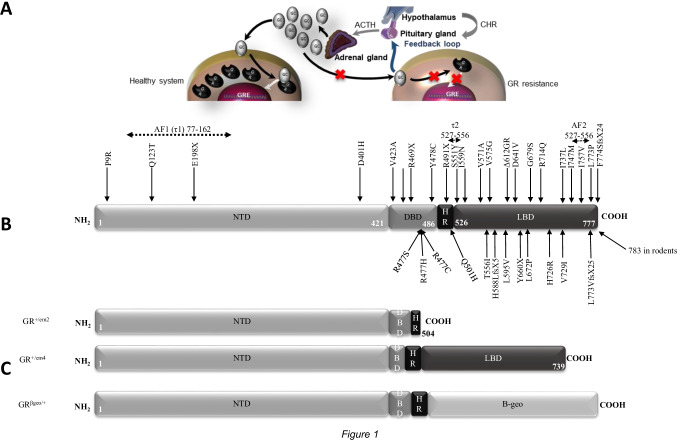
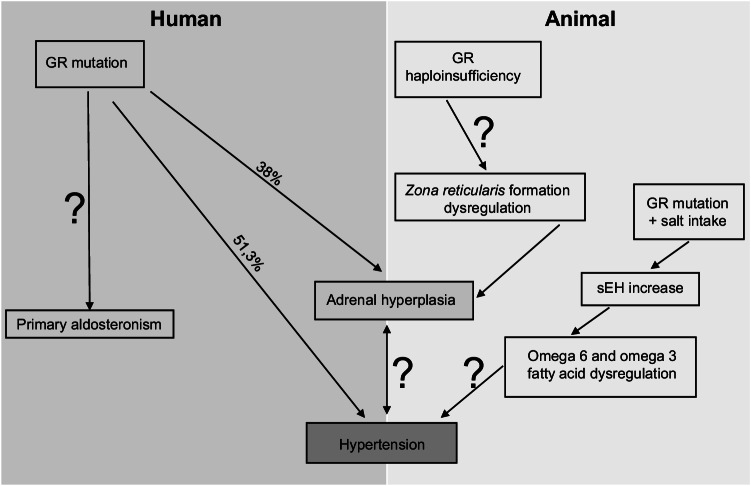
Hypertension is one of the leading causes of premature death in humans and exhibits a complex aetiology including environmental and genetic factors. Mutations within the glucocorticoid receptor (GR) can cause glucocorticoid resistance, which is characterized by several clinical features like hypercortisolism, hypokalaemia, adrenal hyperplasia and hypertension. Altered glucocorticoid receptor signalling further affects sodium and potassium homeostasis as well as blood pressure regulation and cell proliferation and differentiation that influence organ development and function. In salt-sensitive hypertension, excessive renal salt transport and sympathetic nervous system stimulation may occur simultaneously, and, thus, both the mineralocorticoid receptor (MR) and the GR-signalling may be implicated or even act interdependently. This review focuses on identified GR mutations in human primary generalized glucocorticoid resistance (PGGR) patients and their related clinical phenotype with specific emphasis on adrenal gland hyperplasia and hypertension. We compare these findings to mouse and rat mutants harbouring genetically engineered mutations to further dissect the cause and/or the consequence of clinical features which are common or different.
高血压是导致人类早逝的主要原因之一,其病因复杂,包括环境和遗传因素。糖皮质激素受体 (GR) 内的突变可导致糖皮质激素抵抗,其特征是出现多种临床特征,如皮质醇过多症、低钾血症、肾上腺增生和高血压。糖皮质激素受体信号的改变进一步影响钠和钾的平衡以及血压调节和细胞增殖和分化,从而影响器官发育和功能。在盐敏感性高血压中,可能同时发生肾脏盐转运过度和交感神经系统刺激,因此,可能涉及到盐皮质激素受体 (MR) 和 GR 信号,甚至它们可能相互依存。这篇综述重点介绍了人类原发性全身性糖皮质激素抵抗 (PGGR) 患者中已鉴定的 GR 突变及其相关临床表型,特别强调了肾上腺增生和高血压。我们将这些发现与携带基因工程突变的小鼠和大鼠突变体进行比较,以进一步剖析常见或不同的临床特征的原因和/或后果。