Department of Medicine, Division of Nephrology, and Department of Cellular and Molecular Pharmacology, University of California San Francisco, San Francisco, CA, USA.
Institut für Zelluläre und Molekulare Physiologie, Friedrich-Alexander-Universität Erlangen-Nürnberg, Erlangen, Germany, Erlangen, Germany.
Pflugers Arch. 2022 Aug;474(8):869-884. doi: 10.1007/s00424-022-02732-5. Epub 2022 Jul 27.
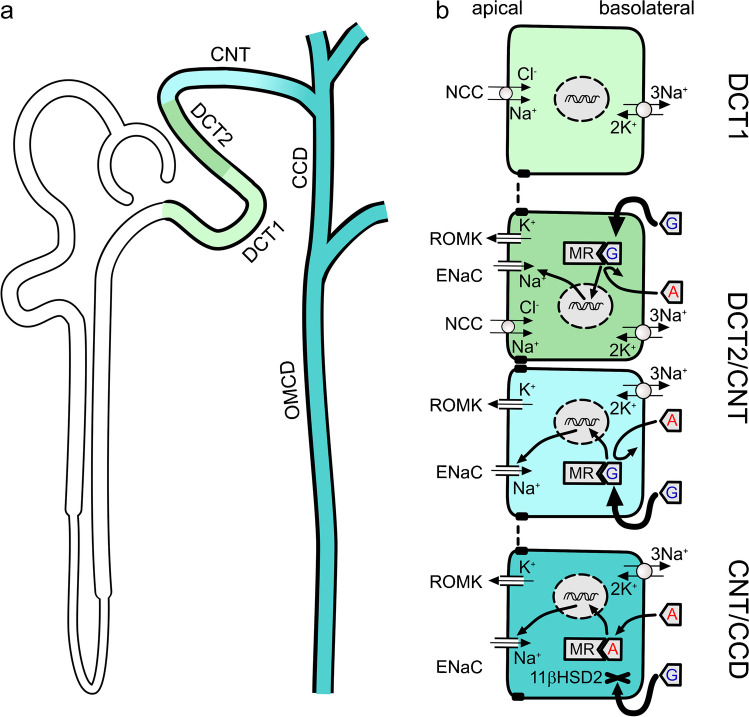
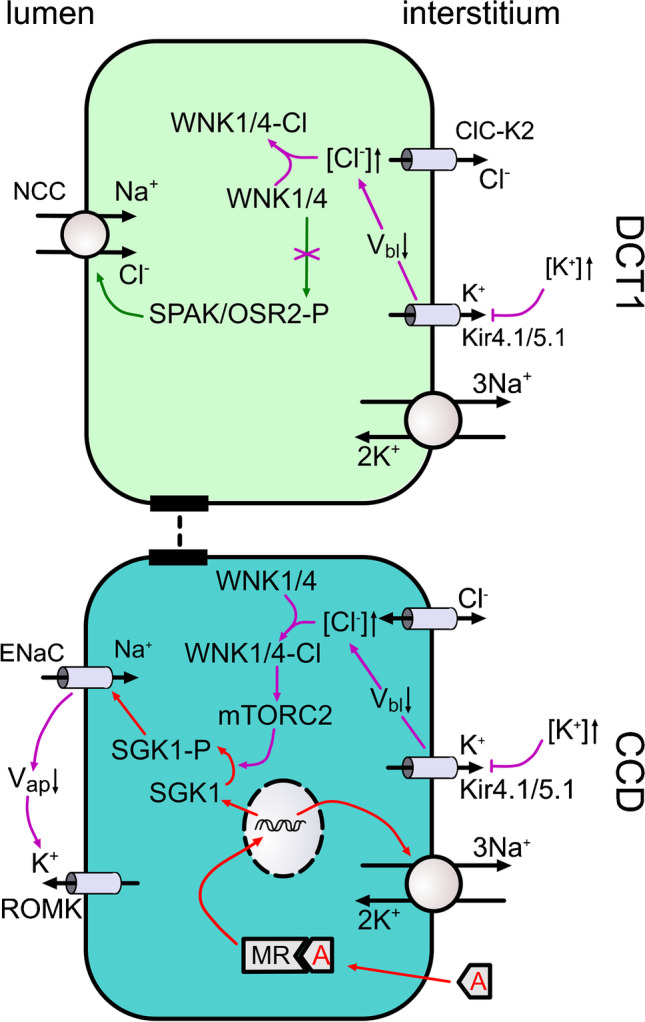
Regulated Na transport in the distal nephron is of fundamental importance to fluid and electrolyte homeostasis. Further upstream, Na is the principal driver of secondary active transport of numerous organic and inorganic solutes. In the distal nephron, Na continues to play a central role in controlling the body levels and concentrations of a more select group of ions, including K, Ca, Mg, Cl, and HCO, as well as water. Also, of paramount importance are transport mechanisms aimed at controlling the total level of Na itself in the body, as well as its concentrations in intracellular and extracellular compartments. Over the last several decades, the transporters involved in moving Na in the distal nephron, and directly or indirectly coupling its movement to that of other ions have been identified, and their interrelationships brought into focus. Just as importantly, the signaling systems and their components-kinases, ubiquitin ligases, phosphatases, transcription factors, and others-have also been identified and many of their actions elucidated. This review will touch on selected aspects of ion transport regulation, and its impact on fluid and electrolyte homeostasis. A particular focus will be on emerging evidence for site-specific regulation of the epithelial sodium channel (ENaC) and its role in both Na and K homeostasis. In this context, the critical regulatory roles of aldosterone, the mineralocorticoid receptor (MR), and the kinases SGK1 and mTORC2 will be highlighted. This includes a discussion of the newly established concept that local K concentrations are involved in the reciprocal regulation of Na-Cl cotransporter (NCC) and ENaC activity to adjust renal K secretion to dietary intake.
在远端肾单位中,调节钠的转运对于液体和电解质的平衡至关重要。再往前,钠是许多有机和无机溶质继发性主动转运的主要驱动力。在远端肾单位中,钠继续在控制包括 K、Ca、Mg、Cl 和 HCO 在内的一组更精选离子以及水的体内水平和浓度方面发挥核心作用。同样重要的是,旨在控制体内钠的总水平及其在细胞内和细胞外隔室中的浓度的转运机制。在过去几十年中,参与将 Na 转运到远端肾单位的转运体,以及直接或间接将其运动与其他离子的运动偶联的转运体已经被确定,并且它们的相互关系也得到了关注。同样重要的是,信号系统及其组件——激酶、泛素连接酶、磷酸酶、转录因子等——也已经被确定,并且它们的许多作用也已经被阐明。这篇综述将涉及离子转运调节的某些方面及其对液体和电解质平衡的影响。特别关注的是上皮钠通道(ENaC)的特异性调节及其在 Na 和 K 平衡中的作用的新出现的证据。在这种情况下,醛固酮、盐皮质激素受体(MR)和激酶 SGK1 和 mTORC2 的关键调节作用将被强调。这包括讨论新建立的概念,即局部 K 浓度参与调节 Na-Cl 共转运蛋白(NCC)和 ENaC 活性,以调整肾脏对饮食摄入的 K 分泌。