School of Public Health (Shenzhen), Shenzhen Campus of Sun Yat-sen University, Shenzhen, China.
Department of Epidemiology, School of Public Health and Tropical Medicine, Tulane University, New Orleans, LA, United States.
Front Endocrinol (Lausanne). 2022 Jun 6;13:868094. doi: 10.3389/fendo.2022.868094. eCollection 2022.
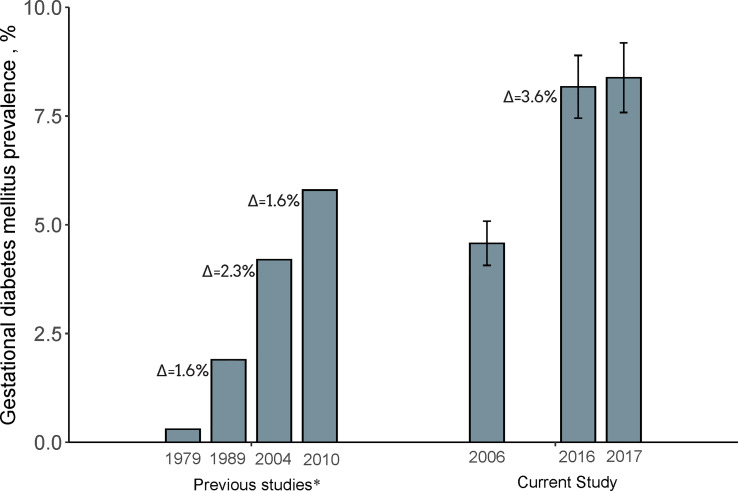
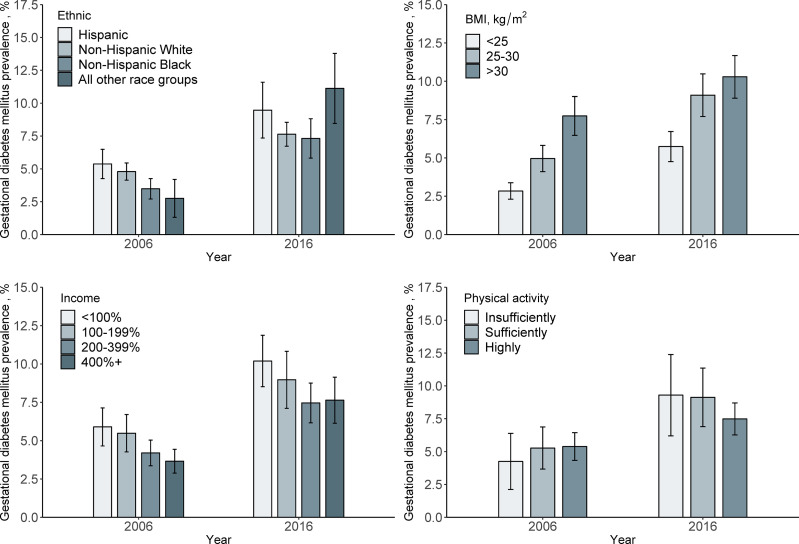
The prevalence of gestational diabetes mellitus (GDM) has increased with the increasing rate of obesity. However, national data on the prevalence and secular trends of GDM during the past decade in the United States are lacking. This study included 37,357 women aged more than 18 years and who had ever been pregnant from the National Health Interview Survey (NHIS). We examined GDM prevalence in 2006, 2016, and 2017, with age-standardized to the US population in 2000. We found that the prevalence of GDM per 100 people increased from 4.6 (95% CI, 4.1-5.1) in 2006 to 8.2 (95% CI, 7.5-8.9) in 2016 (test for difference; P <0.001), with a relatively increased rate of 78%. Non-Hispanic white women tended to have a lower increase (2.8%) than non-Hispanic black women (3.8%), Hispanic women (4.1%), and women of other race/ethnicity (8.4%). The prevalence of GDM in non-Hispanic white women was higher than that in non-Hispanic black women in 2006 (4.8% vs 3.5%, P = 0.006); such differences became non-significant in 2016 (P = 0.72). Additionally, the increase of GDM from 2006 to 2016 tended to be more evident among women who were overweight (25≤ BMI ≤30 kg/m), physically inactive, and with family income below the poverty threshold than women in other BMI ranges, with more physical activity, and with higher incomes. The prevalence of GDM per 100 people in 2017 was 8.4 (7.6-9.2), and there was no significant change in the overall and subgroup prevalence compared with 2016. Collectively, in the United States, the prevalence of GDM continuously increased, nearly doubled, from 2006 to 2016, and then leveled off in 2017. The increase appeared more marked among the minority populations and subpopulations with overweight people, insufficient activity, and family incomes below the poverty threshold.
妊娠期糖尿病(GDM)的患病率随着肥胖率的上升而增加。然而,美国过去十年中 GDM 的患病率和时间趋势的全国数据尚缺乏。本研究纳入了来自全国健康访谈调查(NHIS)的 37357 名年龄超过 18 岁且曾经怀孕的妇女。我们检测了 2006 年、2016 年和 2017 年的 GDM 患病率,并按 2000 年美国人口进行了年龄标准化。我们发现,每 100 人 GDM 的患病率从 2006 年的 4.6(95%CI,4.1-5.1)增加到 2016 年的 8.2(95%CI,7.5-8.9)(差异检验;P<0.001),增长率相对为 78%。非西班牙裔白种女性的增长率(2.8%)低于非西班牙裔黑种女性(3.8%)、西班牙裔女性(4.1%)和其他种族/民族的女性(8.4%)。2006 年非西班牙裔白种女性的 GDM 患病率高于非西班牙裔黑种女性(4.8%比 3.5%,P=0.006);2016 年,这种差异无统计学意义(P=0.72)。此外,与 BMI 处于其他范围的女性相比,超重(25≤BMI≤30kg/m)、身体活动不足和家庭收入低于贫困线的女性,从 2006 年到 2016 年,GDM 的增加更为明显,这些女性的身体活动更多,收入更高。2017 年每 100 人 GDM 的患病率为 8.4(7.6-9.2),与 2016 年相比,总体患病率和亚组患病率没有明显变化。总的来说,在美国,GDM 的患病率从 2006 年到 2016 年持续上升,几乎翻了一番,然后在 2017 年趋于平稳。在少数族裔和超重、身体活动不足以及家庭收入低于贫困线的亚人群中,这种增长更为显著。