Bangash Kashif, Mumtaz Hassan, Mehmood Mehwish, Hingoro Majid Ali, Khan Zoobia Z, Sohail Ahmed, Ullah Sami, Maqbool Durishahwar, Jamal Neelum, Khan Momina Sami, Ahmad Shahzaib, Sohail Anum, Hussain Hassan Ul, Ullah Irfan
KRL Hospital Islamabad Pakistan, Pakistan.
Maroof International Hospital. Public Health Scholar, Health Services Academy, Islamabad, Pakistan.
Ann Med Surg (Lond). 2022 May 27;78:103855. doi: 10.1016/j.amsu.2022.103855. eCollection 2022 Jun.
Increasing rates of antimicrobial resistance among E. coli is a growing concern worldwide. We aimed to assess the changing antibiotic sensitivity pattern in Uropathogenic E. coli over a period of 12 years with special emphasis on ESBL-producing E. coli.
A retrospective study was done on the population of Islamabad from 1st Jan 2005 to Dec 2010 and then continued from 1st Jan 2016 to 31st May 2021. A total of 12000 samples were analyzed for isolation and identification of bacteria and antimicrobial susceptibility testing, from patients having uncomplicated urinary tract infections. Our primary was to find the antibiotics with the highest sensitivity against E. Coli in 2021, while our secondary outcome was to find the overall sensitivity pattern of E. Coli to antibiotics from 2005 to 2021.
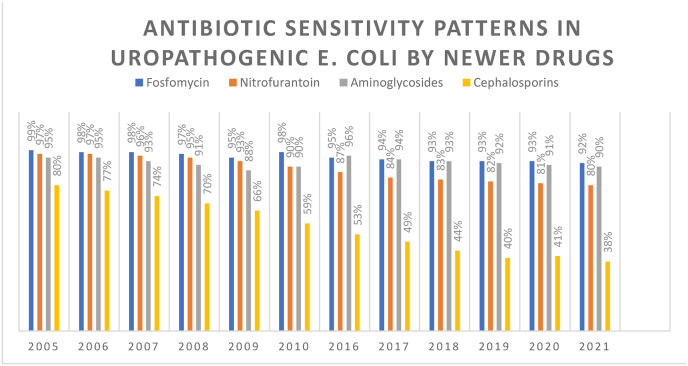
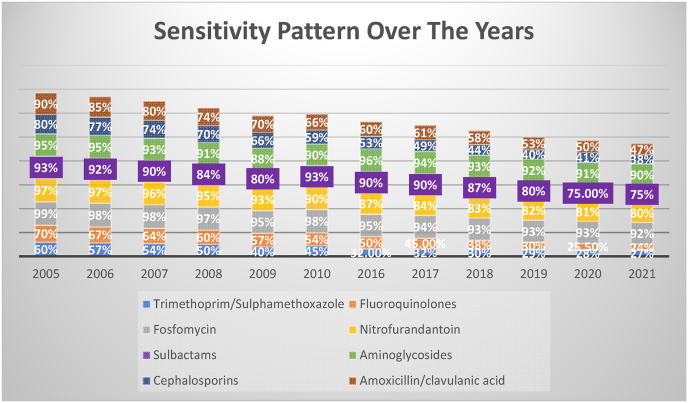
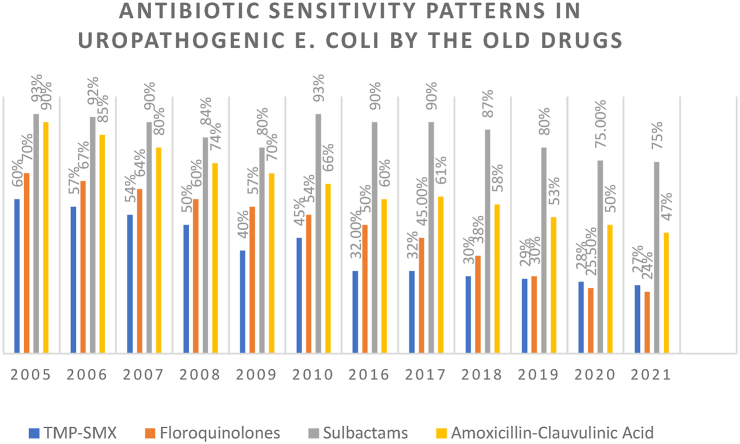
There was a decrease in susceptibility rates of E. coli to Amoxicillin-Clavulanic Acid 47%, Trimethoprim-Sulfamethoxazole (TMP-SMX) 27%, Fluoroquinolones 24% & Cephalosporins 38%. There was a significant increase in the use of Nitrofurantoin and Fosfomycin. High resistance rates to Fluoroquinolones (76%), TMP-SMX (73%), Cephalosporins (62%), and Amoxicillin (53%) were documented. However, significantly high degree of sensitivity rates to Fosfomycin (92%), Aminoglycosides (90%) & Nitrofurantoin (80%) were recorded.
Uropathogenic E. coli shows the highest sensitivity to Fosfomycin and Aminoglycosides in the year 2021, followed by Nitrofurantoin and Sulbactam. Cephalosporins, Amoxicillin/Cluvalanic acid, TMP-SMX, and Fluoroquinolones show a declining sensitivity pattern. UTIs can be prevented well by lifestyle changes, taking vitamins, trace elements, and carbohydrates.
大肠杆菌耐药率不断上升是全球日益关注的问题。我们旨在评估12年间致病性大肠杆菌抗生素敏感性模式的变化,特别关注产超广谱β-内酰胺酶(ESBL)的大肠杆菌。
对2005年1月1日至2010年12月的伊斯兰堡人群进行回顾性研究,然后从2016年1月1日持续至2021年5月31日。对12000份来自单纯性尿路感染患者的样本进行分析,以分离和鉴定细菌并进行抗菌药敏试验。我们的主要目的是找出2021年对大肠杆菌敏感性最高的抗生素,而次要结果是找出2005年至2021年大肠杆菌对各种抗生素的总体敏感性模式。
大肠杆菌对阿莫西林-克拉维酸的敏感性率下降了47%,对甲氧苄啶-磺胺甲恶唑(TMP-SMX)下降了27%,对氟喹诺酮类下降了24%,对头孢菌素下降了38%。呋喃妥因和磷霉素的使用显著增加。记录到对氟喹诺酮类(76%)、TMP-SMX(73%)、头孢菌素(62%)和阿莫西林(53%)的高耐药率。然而,记录到对磷霉素(92%)、氨基糖苷类(90%)和呋喃妥因(80%)的显著高敏感性率。
2021年,致病性大肠杆菌对磷霉素和氨基糖苷类的敏感性最高,其次是呋喃妥因和舒巴坦。头孢菌素、阿莫西林/克拉维酸、TMP-SMX和氟喹诺酮类的敏感性呈下降趋势。通过改变生活方式、摄入维生素、微量元素和碳水化合物,可以很好地预防尿路感染。