Department of Neurology, Kaohsiung Chang Gung Memorial Hospital, Kaohsiung, Taiwan.
Department of Neurology, Kaohsiung Chang Gung Memorial Hospital, Kaohsiung, Taiwan; Department of Information Management, National Sun Yat-sen University, Kaohsiung, Taiwan.
Biomed J. 2021 Dec;44(6 Suppl 1):S93-S100. doi: 10.1016/j.bj.2020.07.007. Epub 2020 Jul 27.
Neuromyelitis optica spectrum disorder (NMOSD) is a rare neuroimmunology disorder predominantly affecting the East Asia population, the reason for this preference remains unknown. Genetic factors such as polymorphisms in human leukocyte antigen (HLA) and interleukins (IL) genes have been reported. Although the familial occurrence of NMOSD is rare, it supports that genetic factors may play a role.
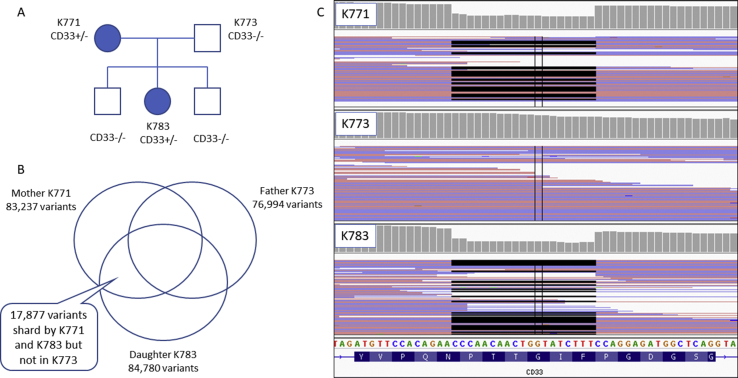
Whole exome sequencing (WES) study was performed on the affected mother and daughter, as well as the unaffected father in a Taiwanese family with NMOSD. A cohort of 19 sporadic patients with aquaporin 4 antibody (AQP4-Ab) positive NMOSD was also recruited; all fulfilled the 2015 International NMOSD Diagnosis Criteria. Sanger sequencing was performed on exon 4 of the CD33 gene on the sporadic NMOSD cohort.
WES study revealed a 19 base pair deletion in exon 4 of the CD33 gene, resulting in frameshift premature truncating protein, which segregated with the affected status. CD33 was the most likely candidate gene due to its known function in immune regulation. A total of 19 sporadic NMOSD patients were tested using Sanger sequencing, including 3 patients with other concomitant autoimmune disorders. Two additional NMOSD patients were found to have the same CD33 frameshift variant, which accounts for 19.04% of all NMOSD patients, and 15% following correction for the familial cases; compared to 2% in Taiwanese population controls.
In this study, we identified a 19 base pair deletion in the CD33 gene may be a potential risk locus for NMOSD, which is predicted to cause loss of function of CD33. The loss of CD33 inhibitory function may affect the regulation of the immune system in NMOSD patients. This finding requires further larger cohorts of NMOSD patients and functional study to corroborate.
视神经脊髓炎谱系疾病(NMOSD)是一种罕见的神经免疫疾病,主要影响东亚人群,其偏好的原因尚不清楚。已经报道了人类白细胞抗原(HLA)和白细胞介素(IL)基因多态性等遗传因素。尽管 NMOSD 的家族发生很少见,但它支持遗传因素可能起作用。
对一个患有 NMOSD 的台湾家庭中的受影响的母亲和女儿以及未受影响的父亲进行了全外显子组测序(WES)研究。还招募了一组 19 名水通道蛋白 4 抗体(AQP4-Ab)阳性 NMOSD 的散发性患者;所有患者均符合 2015 年国际 NMOSD 诊断标准。对散发性 NMOSD 队列中的 CD33 基因外显子 4 进行 Sanger 测序。
WES 研究发现 CD33 基因外显子 4 存在 19 个碱基缺失,导致移码提前终止蛋白,该蛋白与受影响的状态分离。由于 CD33 在免疫调节中的已知功能,CD33 是最可能的候选基因。总共对 19 名散发性 NMOSD 患者进行了 Sanger 测序检测,包括 3 名患有其他伴随自身免疫性疾病的患者。另外 2 名 NMOSD 患者发现具有相同的 CD33 移码变异,占所有 NMOSD 患者的 19.04%,经家族病例校正后为 15%;而在台湾人群对照中为 2%。
在这项研究中,我们发现 CD33 基因中的 19 个碱基缺失可能是 NMOSD 的一个潜在风险位点,预计会导致 CD33 功能丧失。CD33 抑制功能的丧失可能会影响 NMOSD 患者的免疫系统调节。这一发现需要进一步扩大 NMOSD 患者的队列和功能研究来证实。