
埃及和沙特阿拉伯王国新毕业牙医对辐射防护措施的知识评估:一项基于问卷的横断面研究。
Assessment of Knowledge towards Radiation Protection Measures among Newly Graduated Dentists from Egypt and the Kingdom of Saudi Arabia: A Questionnaire-Based Cross-Sectional Study.
作者信息
Basha Soha Mohamed Ali, BinShabaib Munerah Saleh, ALHarthi Shatha Subhi
机构信息
Department of Basic Dental Sciences, College of Dentistry, Princess Nourah Bint Abdulrahman University, Riyadh 11671, Saudi Arabia.
Department of Preventive Dental Sciences, College of Dentistry, Princess Nourah Bint Abdulrahman University, Riyadh 11671, Saudi Arabia.
出版信息
Dent J (Basel). 2022 Jun 1;10(6):95. doi: 10.3390/dj10060095.
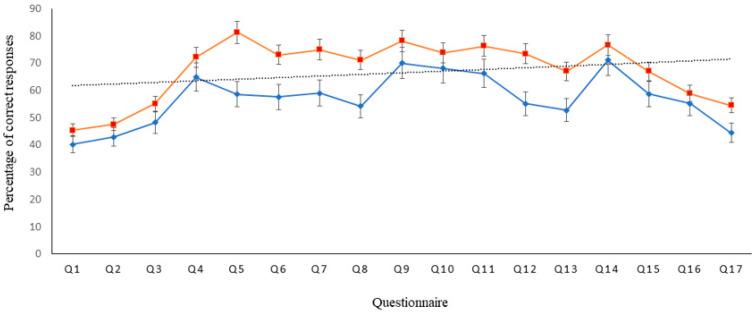
Background: It is hypothesized that knowledge towards ionizing radiation (IR) protection measures is lacking among newly graduated dentists from Egypt and Saudi Arabia. The purpose of the present questionnaire-based study was to compare the IR protection knowledge among newly graduated dentists from Egypt and the Kingdom of Saudi Arabia (KSA). Methods: The present investigation was a questionnaire-based study and had a cross-sectional observational analytical design. Newly graduated dentists were defined as individuals who had graduated from a credentialed dental institution within the past 36-months. The questionnaire was related to knowledge about radiation safety, awareness and practices. The questionnaire comprised of 17 multiple choice questions. Questionnaires in which all the 17 questions were not answered or had missing pages were excluded. Odds ratios were computed for the number of correct and incorrect responses and 95% confidence intervals were determined. Individuals that provided up to 40%, 41% to 70% and >70% correct answers were categorized as having “low competence”; “moderate competence” and “high competence” in IR knowledge. p-values less than 0.05 were considered statistically significant. Results: The mean percentage of correct answers provided by dentists from Egypt and KSA were 56.9% and 67.4%, respectively. There was no statistically significant difference in the percentages of correct responses for the 17 questions submitted by respondents from Egypt and KSA. The overall percentage of correct responses ranged between 40.2−71.2% and 45.4−81.4% for respondents from Egypt and KSA, respectively. The odds ratios and 95% confidence intervals showed no statistically significant correlation in the responses from respondents from Egypt and KSA for each of the 17 questions addressed. Conclusion: Newly graduated dentists from Egypt and KSA are moderately competent regarding IR doses and related safety measures. It is recommended that modifications in the undergraduate dental education curriculum with emphasis on IR safety and practice would help enhance the knowledge and competence of students and newly graduated dentists. Moreover, routine continuing dental education seminars/programs may help enhance the IR knowledge of dental students and dentists.
背景
据推测,埃及和沙特阿拉伯的刚毕业牙医缺乏关于电离辐射(IR)防护措施的知识。本项基于问卷的研究目的是比较埃及和沙特阿拉伯王国(KSA)刚毕业牙医的IR防护知识。方法:本调查是一项基于问卷的研究,采用横断面观察性分析设计。刚毕业的牙医定义为在过去36个月内从有资质的牙科机构毕业的个体。问卷与辐射安全知识、意识和实践相关。问卷由17道多项选择题组成。所有17道题未作答或有缺失页的问卷被排除。计算正确和错误回答数量的比值比,并确定95%置信区间。提供40%及以下、41%至70%和超过70%正确答案的个体在IR知识方面被归类为“低能力”、“中等能力”和“高能力”。p值小于0.05被认为具有统计学意义。结果:埃及和KSA的牙医提供的正确答案平均百分比分别为56.9%和67.4%。埃及和KSA的受访者提交的17道题的正确回答百分比没有统计学显著差异。埃及和KSA的受访者正确回答的总体百分比分别在40.2 - 71.2%和45.4 - 81.4%之间。对于所涉及的17道题中的每一道,埃及和KSA的受访者的回答中,比值比和95%置信区间均未显示出统计学显著相关性。结论:埃及和KSA的刚毕业牙医在IR剂量及相关安全措施方面具有中等能力。建议修改本科牙科教育课程,重点关注IR安全和实践,这将有助于提高学生和刚毕业牙医的知识和能力。此外,常规的继续牙科教育研讨会/项目可能有助于提高牙科学生和牙医的IR知识。
 Zotero 插件