Alsanea Majed, Habib Shabana, Khan Noreen Fayyaz, Alsharekh Mohammed F, Islam Muhammad, Khan Sheroz
Computing Department, Arabeast Colleges, Riyadh 13544, Saudi Arabia.
Department of Information Technology, College of Computer, Qassim University, Buraydah 52571, Saudi Arabia.
J Imaging. 2022 Jun 15;8(6):170. doi: 10.3390/jimaging8060170.
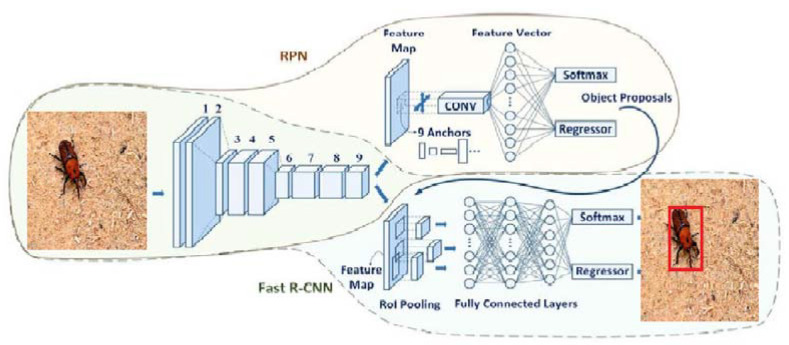
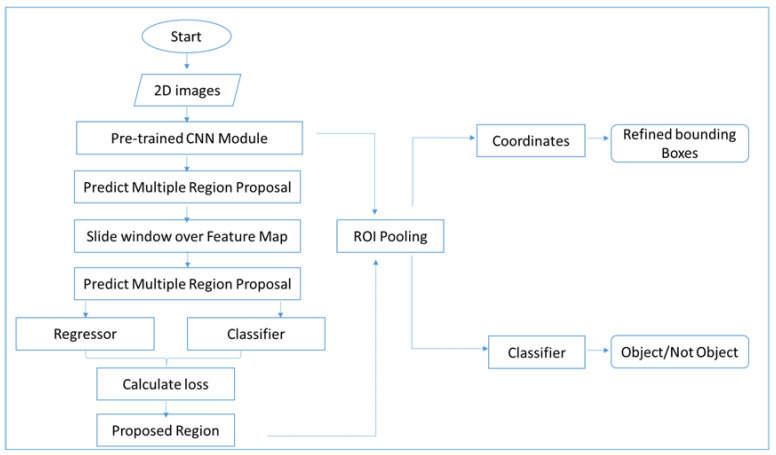
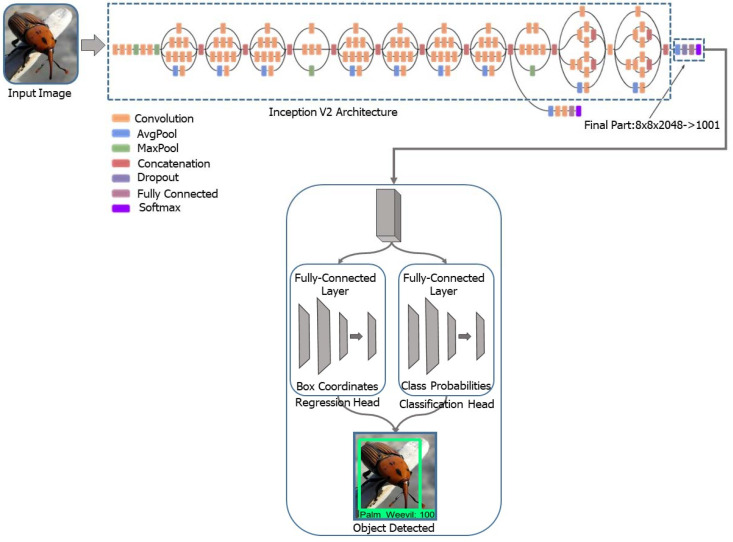
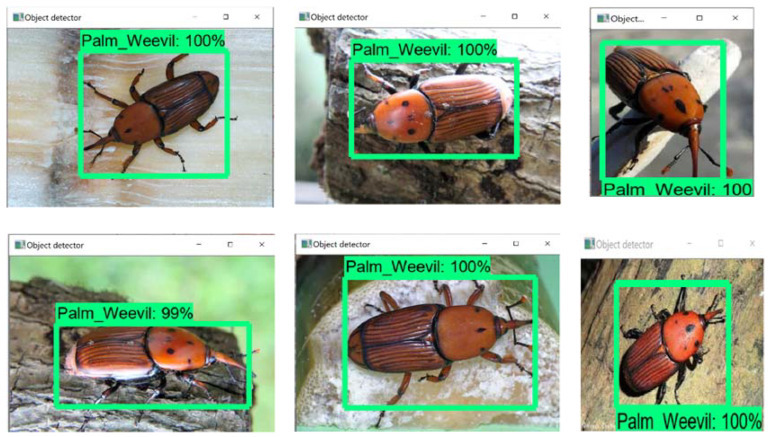
Over the last two decades, particularly in the Middle East, Red Palm Weevils (RPW, Rhynchophorus ferruginous) have proved to be the most destructive pest of palm trees across the globe. The RPW has caused considerable damage to various palm species. The early identification of the RPW is a challenging task for good date production since the identification will prevent palm trees from being affected by the RPW. This is one of the reasons why the use of advanced technology will help in the prevention of the spread of the RPW on palm trees. Many researchers have worked on finding an accurate technique for the identification, localization and classification of the RPW pest. This study aimed to develop a model that can use a deep-learning approach to identify and discriminate between the RPW and other insects living in palm tree habitats using a deep-learning technique. Researchers had not applied deep learning to the classification of red palm weevils previously. In this study, a region-based convolutional neural network (R-CNN) algorithm was used to detect the location of the RPW in an image by building bounding boxes around the image. A CNN algorithm was applied in order to extract the features to enclose with the bounding boxes-the selection target. In addition, these features were passed through the classification and regression layers to determine the presence of the RPW with a high degree of accuracy and to locate its coordinates. As a result of the developed model, the RPW can be quickly detected with a high accuracy of 100% in infested palm trees at an early stage. In the Al-Qassim region, which has thousands of farms, the model sets the path for deploying an efficient, low-cost RPW detection and classification technology for palm trees.
在过去二十年中,尤其是在中东地区,红棕象甲(RPW,锈色棕榈象)已被证明是全球棕榈树最具破坏性的害虫。红棕象甲对各种棕榈树种造成了相当大的损害。对于优质枣椰生产而言,红棕象甲的早期识别是一项具有挑战性的任务,因为这种识别将防止棕榈树受到红棕象甲的影响。这就是为什么使用先进技术有助于预防红棕象甲在棕榈树上传播的原因之一。许多研究人员致力于寻找一种准确的技术来识别、定位和分类红棕象甲害虫。本研究旨在开发一种模型,该模型可以使用深度学习方法,通过深度学习技术识别红棕象甲与生活在棕榈树栖息地的其他昆虫并加以区分。此前研究人员尚未将深度学习应用于红棕象甲的分类。在本研究中,基于区域的卷积神经网络(R-CNN)算法被用于通过在图像周围构建边界框来检测图像中红棕象甲的位置。应用卷积神经网络(CNN)算法来提取要与边界框(选择目标)一起包围的特征。此外,这些特征通过分类和回归层,以高精度确定红棕象甲的存在并定位其坐标。所开发模型的结果是,在早期受侵染的棕榈树中,可以以100%的高精度快速检测到红棕象甲。在拥有数千个农场的卡西姆地区,该模型为部署一种高效、低成本的棕榈树红棕象甲检测和分类技术铺平了道路。