Zhang Wenjing, Tang Yunfeng, Guo Yuxian, Kong Yujia, Shi Fuyan, Sheng Chao, Wang Suzhen, Wang Qinghua
Department of Health Statistics, Key Laboratory of Medicine and Health of Shandong Province, School of Public Health, Weifang Medical University, 261053, Weifang, Shandong, China.
School of Public Health, Weifang Medical University, 261053, Weifang, Shandong, China.
NPJ Precis Oncol. 2022 Jun 23;6(1):46. doi: 10.1038/s41698-022-00292-6.
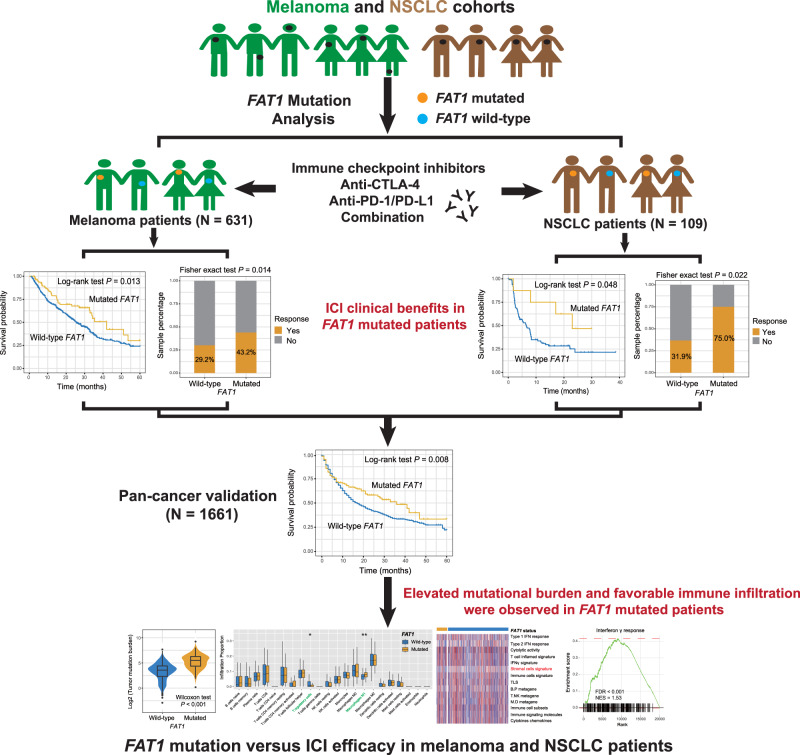
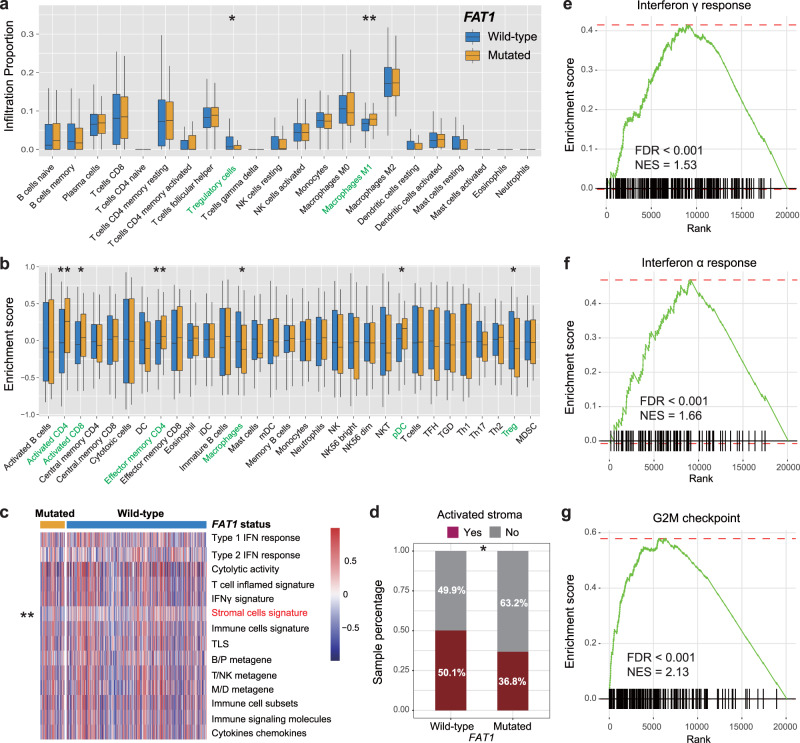
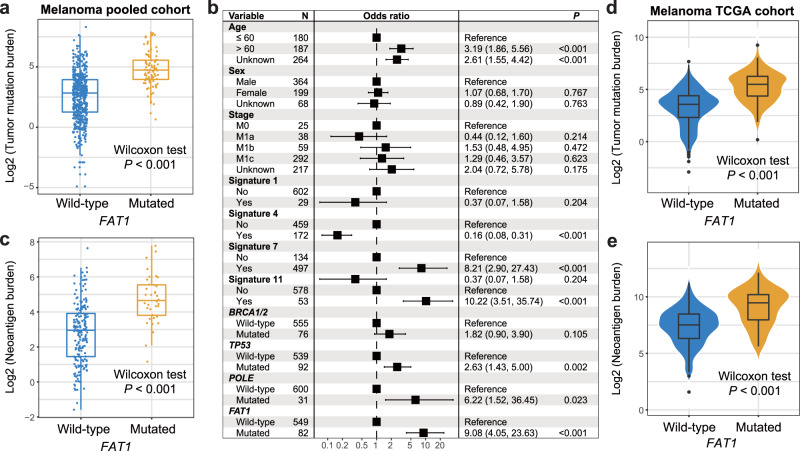
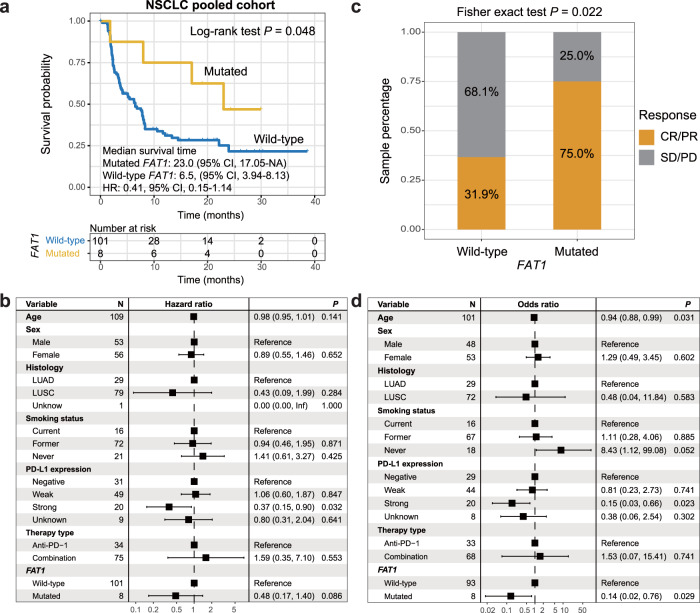
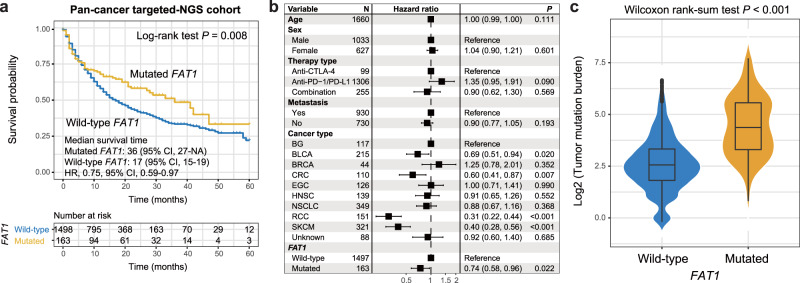
Immune checkpoint inhibitors (ICIs) are most commonly used for melanoma and non-small cell lung cancer (NSCLC) patients. FAT atypical cadherin 1 (FAT1), which frequently mutates in melanoma and NSCLC. In this study, we aim to investigate the association of FAT1 mutations with ICI response and outcome. We collected somatic mutation profiles and clinical information from ICI-treated 631 melanoma and 109 NSCLC samples, respectively. For validation, a pan-cancer cohort with 1661 patients in an immunotherapy setting was also used. Melanoma and NSCLC samples from the Cancer Genome Atlas were used to evaluate the potential immunologic mechanisms of FAT1 mutations. In melanoma, patients with FAT1 mutations had a significantly improved survival outcome than those wild-type patients (HR: 0.67, 95% CI: 0.46-0.97, P = 0.033). An elevated ICI response rate also appeared in FAT1-mutated patients (43.2% vs. 29.2%, P = 0.032). Associations of FAT1 mutations with improved prognosis and ICI response were confirmed in NSCLC patients. In the pan-cancer cohort, the association between FAT1 mutations and favorable ICI outcome was further validated (HR: 0.74, 95% CI: 0.58-0.96, P = 0.022). Genomic and immunologic analysis showed that a high mutational burden, increased infiltration of immune-response cells, decreased infiltration of immune-suppressive cells, interferon and cell cycle-related pathways were enriched in patients with FAT1 mutations. Our study revealed that FAT1 mutations were associated with better immunogenicity and ICI efficacy, which may be considered as a biomarker for selecting patients to receive immunotherapy.
免疫检查点抑制剂(ICI)最常用于黑色素瘤和非小细胞肺癌(NSCLC)患者。FAT非典型钙黏蛋白1(FAT1)在黑色素瘤和NSCLC中经常发生突变。在本研究中,我们旨在调查FAT1突变与ICI反应及预后的关联。我们分别收集了631例接受ICI治疗的黑色素瘤样本和109例NSCLC样本的体细胞突变谱及临床信息。为进行验证,还使用了一个在免疫治疗环境下包含1661例患者的泛癌队列。来自癌症基因组图谱的黑色素瘤和NSCLC样本用于评估FAT1突变的潜在免疫机制。在黑色素瘤中,与野生型患者相比,FAT1突变患者的生存结局显著改善(HR:0.67,95%CI:0.46 - 0.97,P = 0.033)。FAT1突变患者的ICI反应率也有所升高(43.2%对29.2%,P = 0.032)。在NSCLC患者中也证实了FAT1突变与预后改善和ICI反应的关联。在泛癌队列中,进一步验证了FAT1突变与良好ICI结局之间的关联(HR:0.74,95%CI:0.58 - 0.96,P = 0.022)。基因组和免疫分析表明,FAT1突变患者中高突变负荷、免疫反应细胞浸润增加、免疫抑制细胞浸润减少、干扰素和细胞周期相关通路富集。我们的研究表明,FAT1突变与更好的免疫原性和ICI疗效相关,这可被视为选择接受免疫治疗患者的生物标志物。