Matacchione Giulia, Valli Debora, Silvestrini Andrea, Giuliani Angelica, Sabbatinelli Jacopo, Giordani Chiara, Coppari Sofia, Rippo Maria Rita, Albertini Maria Cristina, Olivieri Fabiola
Department of Clinical and Molecular Sciences, DISCLIMO, Università Politecnica Delle Marche, 60126 Ancona, Italy.
Department of Biomolecular Sciences, University of Urbino Carlo Bo, 61029 Urbino, Italy.
Antioxidants (Basel). 2022 May 24;11(6):1037. doi: 10.3390/antiox11061037.
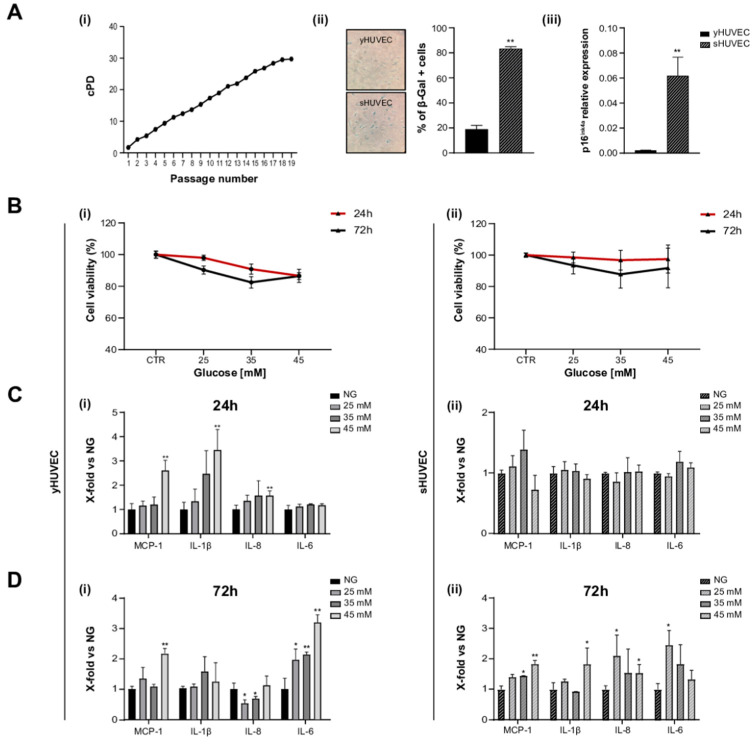
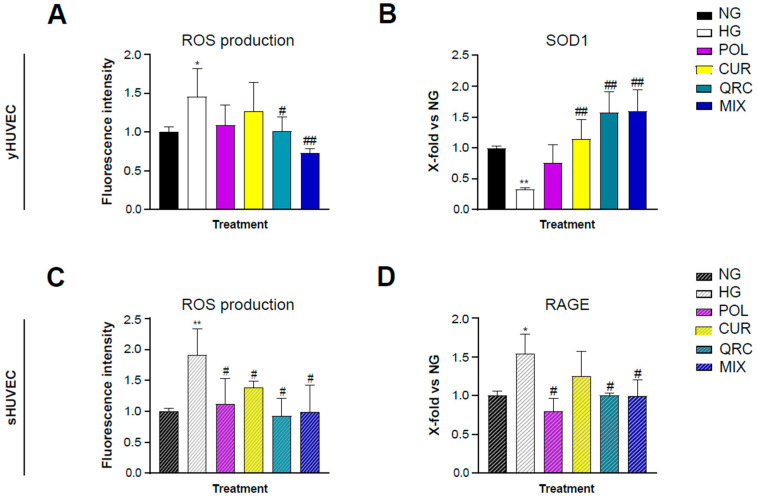
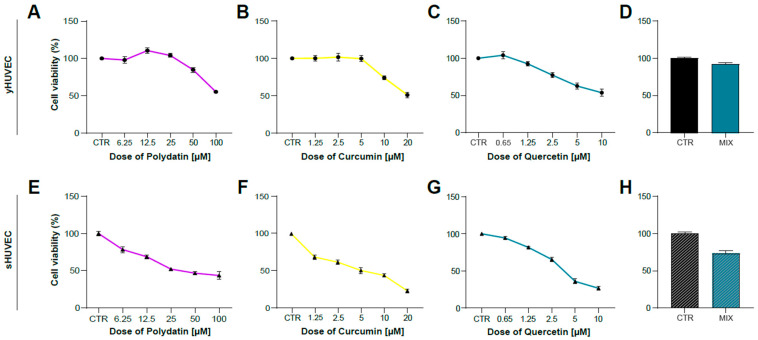
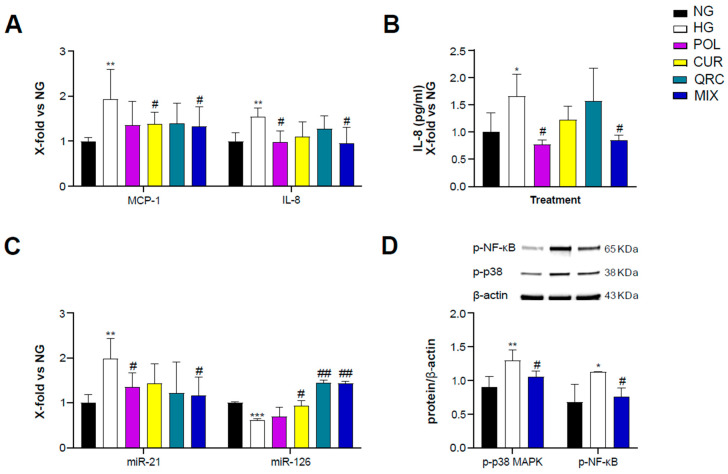
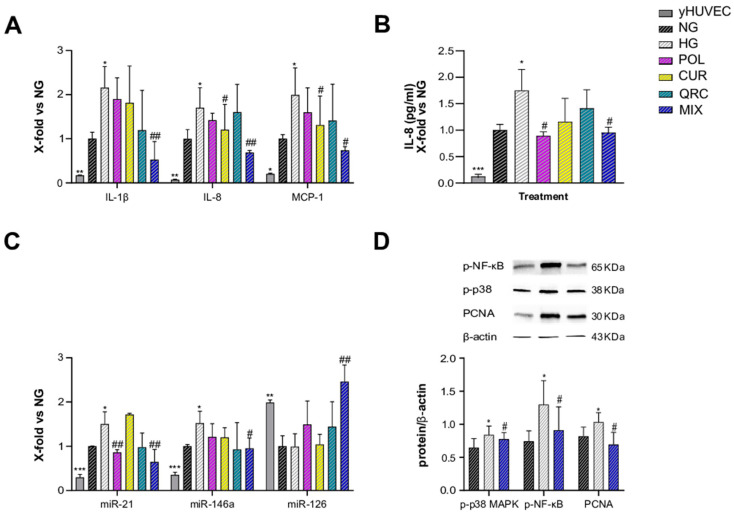
Chronic hyperglycemia, the diagnostic biomarker of Type 2 Diabetes Mellitus (T2DM), is a condition that fosters oxidative stress and proinflammatory signals, both involved in the promotion of cellular senescence. Senescent cells acquire a proinflammatory secretory phenotype, called SASP, exacerbating and perpetuating the detrimental effects of hyperglycemia. Bioactive compounds can exert antioxidant and anti-inflammatory properties. However, the synergistic anti-inflammatory and antioxidant effects of the most extensively investigated natural compounds have not been confirmed yet in senescent cells and in hyperglycemic conditions. Here, we exposed young and replicative senescent HUVEC (yHUVEC and sHUVEC) to a high-glucose (HG) condition (45 mM) and treated them with Polydatin (POL), Curcumin (CUR) and Quercetin (QRC), alone or in combination (MIX), to mirror the anti-inflammatory component OxiDef contained in the novel nutraceutical Glicefen (Mivell, Italy). In both yHUVEC and sHUVEC, the MIX significantly decreased the expression levels of inflammatory markers, such as MCP-1, IL-1β and IL-8, and ROS production. Importantly, in sHUVEC, a synergistic effect of the MIX was observed, suggesting its senomorphic activity. Moreover, the MIX was able to reduce the expression level of RAGE, a receptor involved in the activation of proinflammatory signaling. Overall, our data suggest that the consumption of nutraceuticals containing different natural compounds could be an adjuvant supplement to counteract proinflammatory and pro-oxidative signals induced by both hyperglycemic and senescence conditions.
慢性高血糖是2型糖尿病(T2DM)的诊断生物标志物,它会引发氧化应激和促炎信号,二者均参与细胞衰老的促进过程。衰老细胞会获得一种促炎分泌表型,称为衰老相关分泌表型(SASP),从而加剧并使高血糖的有害影响长期存在。生物活性化合物可发挥抗氧化和抗炎特性。然而,在衰老细胞和高血糖条件下,最广泛研究的天然化合物的协同抗炎和抗氧化作用尚未得到证实。在此,我们将年轻的和复制性衰老的人脐静脉内皮细胞(yHUVEC和sHUVEC)置于高糖(HG)条件(45 mM)下,并用白藜芦醇(POL)、姜黄素(CUR)和槲皮素(QRC)单独或联合处理(MIX),以模拟新型营养保健品Glicefen(意大利Mivell公司)中含有的抗炎成分OxiDef。在yHUVEC和sHUVEC中,MIX均显著降低了炎症标志物如单核细胞趋化蛋白-1(MCP-1)、白细胞介素-1β(IL-1β)和白细胞介素-8(IL-8)的表达水平以及活性氧的产生。重要的是,在sHUVEC中观察到了MIX的协同作用,表明其具有衰老形态调节活性。此外,MIX能够降低晚期糖基化终末产物受体(RAGE)的表达水平,RAGE是一种参与促炎信号激活的受体。总体而言,我们的数据表明,食用含有不同天然化合物的营养保健品可能是一种辅助补充剂,可对抗高血糖和衰老条件诱导的促炎和促氧化信号。