Su Meiming, Zhao Wenqi, Xu Suowen, Weng Jianping
Department of Endocrinology, Institute of Endocrine and Metabolic Diseases, The First Affiliated Hospital of USTC, Division of Life Sciences and Medicine, Clinical Research Hospital of Chinese Academy of Sciences (Hefei), University of Science and Technology of China, Hefei 230001, China.
Antioxidants (Basel). 2022 May 30;11(6):1085. doi: 10.3390/antiox11061085.
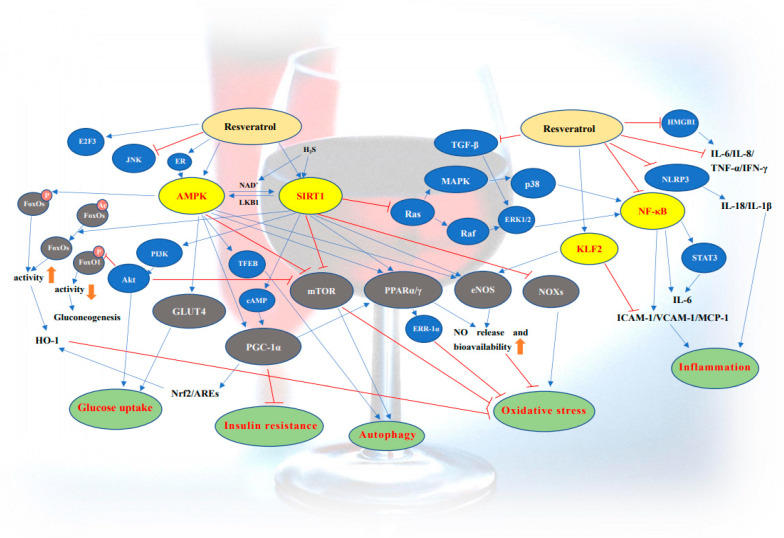
Diabetes mellitus (DM) is one of the most prevalent chronic diseases worldwide. High morbidity and mortality caused by DM are closely linked to its complications in multiple organs/tissues, including cardiovascular complications, diabetic nephropathy, and diabetic neuropathy. Resveratrol is a plant-derived polyphenolic compound with pleiotropic protective effects, ranging from antioxidant and anti-inflammatory to hypoglycemic effects. Recent studies strongly suggest that the consumption of resveratrol offers protection against diabetes and its cardiovascular complications. The protective effects of resveratrol involve the regulation of multiple signaling pathways, including inhibition of oxidative stress and inflammation, enhancement of insulin sensitivity, induction of autophagy, regulation of lipid metabolism, promotion of GLUT4 expression, and translocation, and activation of SIRT1/AMPK signaling axis. The cardiovascular protective effects of resveratrol have been recently reviewed in the literature, but the role of resveratrol in preventing diabetes mellitus and its cardiovascular complications has not been systematically reviewed. Therefore, in this review, we summarize the pharmacological effects and mechanisms of action of resveratrol based on in vitro and in vivo studies, highlighting the therapeutic potential of resveratrol in the prevention and treatment of diabetes and its cardiovascular complications.
糖尿病(DM)是全球最常见的慢性病之一。DM所致的高发病率和高死亡率与其在多个器官/组织中的并发症密切相关,包括心血管并发症、糖尿病肾病和糖尿病神经病变。白藜芦醇是一种植物来源的多酚类化合物,具有多种保护作用,从抗氧化、抗炎到降血糖作用。最近的研究有力地表明,食用白藜芦醇可预防糖尿病及其心血管并发症。白藜芦醇的保护作用涉及多种信号通路的调节,包括抑制氧化应激和炎症、增强胰岛素敏感性、诱导自噬、调节脂质代谢、促进葡萄糖转运蛋白4(GLUT4)的表达和转位,以及激活沉默信息调节因子1(SIRT1)/腺苷酸活化蛋白激酶(AMPK)信号轴。白藜芦醇对心血管的保护作用最近已有文献综述,但白藜芦醇在预防糖尿病及其心血管并发症中的作用尚未得到系统综述。因此,在本综述中,我们基于体外和体内研究总结了白藜芦醇的药理作用和作用机制,强调了白藜芦醇在预防和治疗糖尿病及其心血管并发症方面的治疗潜力。