Cheng Vincent Chi-Chung, Wong Shuk-Ching, So Simon Yung-Chun, Chen Jonathan Hon-Kwan, Chau Pui-Hing, Au Albert Ka-Wing, Chiu Kelvin Hei-Yeung, Li Xin, Ip Patrick, Chuang Vivien Wai-Man, Lung David Christopher, Tse Cindy Wing-Sze, Lee Rodney Allan, Fung Kitty Sau-Chun, To Wing-Kin, Lai Raymond Wai-Man, Que Tak-Lun, Lo Janice Yee-Chi, Yuen Kwok-Yung
Infection Control Team, Queen Mary Hospital, Hong Kong West Cluster, Hong Kong, China.
Department of Microbiology, Queen Mary Hospital, Hong Kong, China.
Antibiotics (Basel). 2022 May 31;11(6):746. doi: 10.3390/antibiotics11060746.
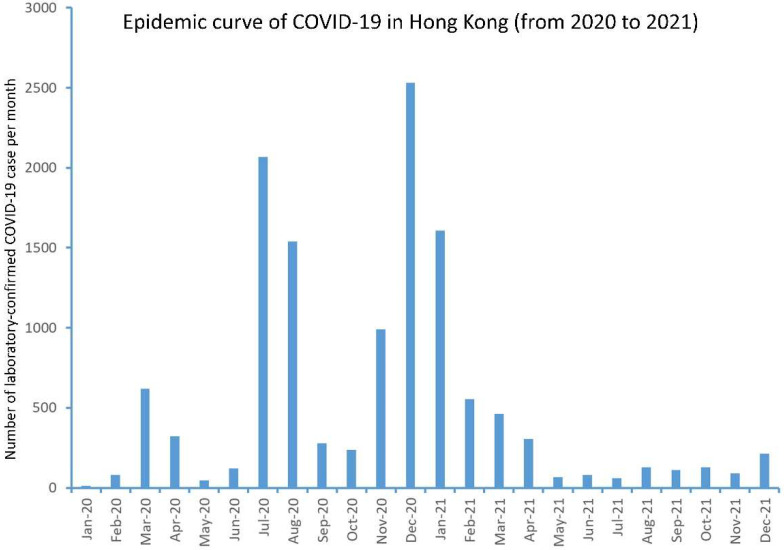
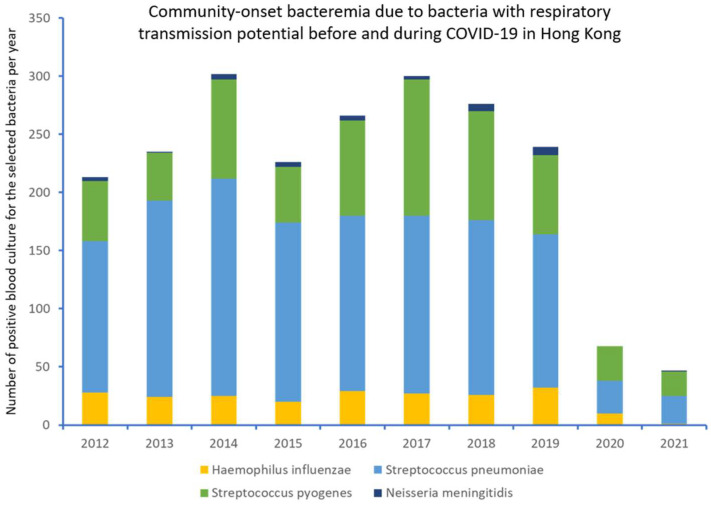
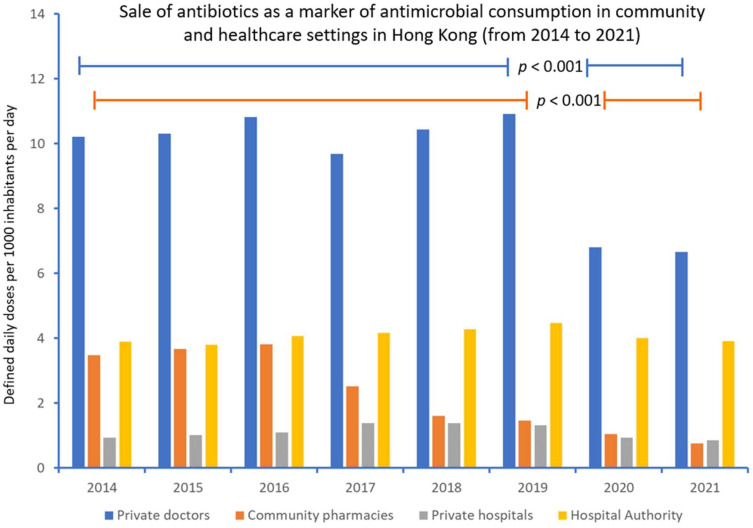
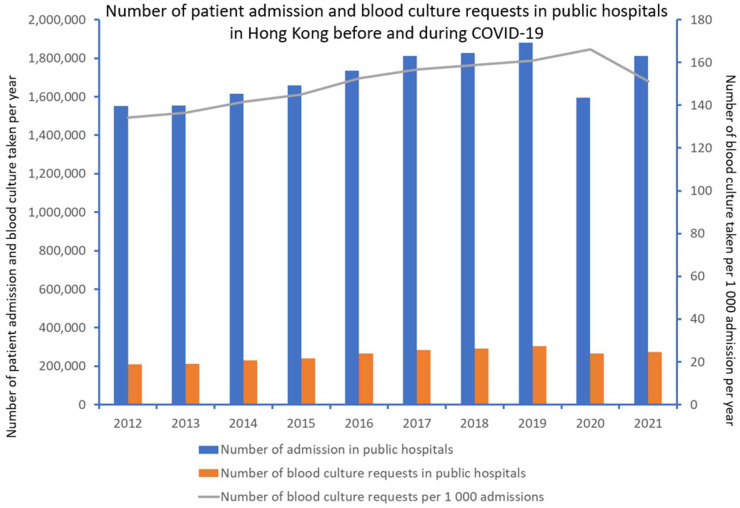
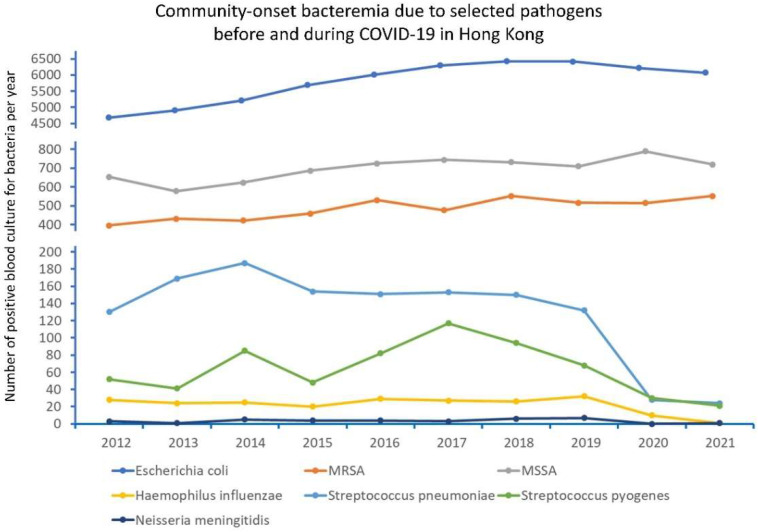
Nonpharmaceutical interventions implemented during the COVID-19 pandemic (2020−2021) have provided a unique opportunity to understand their impact on the wholesale supply of antibiotics and incidences of infections represented by bacteremia due to common bacterial species in Hong Kong. The wholesale antibiotic supply data (surrogate indicator of antibiotic consumption) and notifications of scarlet fever, chickenpox, and tuberculosis collected by the Centre for Health Protection, and the data of blood cultures of patients admitted to public hospitals in Hong Kong collected by the Hospital Authority for the last 10 years, were tabulated and analyzed. A reduction in the wholesale supply of antibiotics was observed. This decrease coincided with a significant reduction in the incidence of community-onset bacteremia due to Streptococcus pyogenes, Streptococcus pneumoniae, Haemophilus influenzae, and Neisseria meningitidis, which are encapsulated bacteria with respiratory transmission potential. This reduction was sustained during two pandemic years (period 2: 2020−2021), compared with eight pre-pandemic years (period 1: 2012−2019). Although the mean number of patient admissions per year (1,704,079 vs. 1,702,484, p = 0.985) and blood culture requests per 1000 patient admissions (149.0 vs. 158.3, p = 0.132) were not significantly different between periods 1 and 2, a significant reduction in community-onset bacteremia due to encapsulated bacteria was observed in terms of the mean number of episodes per year (257 vs. 58, p < 0.001), episodes per 100,000 admissions (15.1 vs. 3.4, p < 0.001), and per 10,000 blood culture requests (10.1 vs. 2.1, p < 0.001), out of 17,037,598 episodes of patient admissions with 2,570,164 blood culture requests. Consistent with the findings of bacteremia, a reduction in case notification of scarlet fever and airborne infections, including tuberculosis and chickenpox, was also observed; however, there was no reduction in the incidence of hospital-onset bacteremia due to Staphylococcus aureus or Escherichia coli. Sustained implementation of non-pharmaceutical interventions against respiratory microbes may reduce the overall consumption of antibiotics, which may have a consequential impact on antimicrobial resistance. Rebound of conventional respiratory microbial infections is likely with the relaxation of these interventions.
2020 - 2021年新冠疫情期间实施的非药物干预措施,为了解其对香港抗生素批发供应以及由常见细菌种类引起的菌血症所代表的感染发生率的影响提供了独特契机。整理并分析了卫生防护中心收集的抗生素批发供应数据(抗生素消费的替代指标)以及猩红热、水痘和结核病的通报数据,还有医院管理局收集的香港公立医院过去10年患者血培养数据。观察到抗生素批发供应量有所减少。这种减少与化脓性链球菌、肺炎链球菌、流感嗜血杆菌和脑膜炎奈瑟菌引起的社区获得性菌血症发病率的显著降低同时出现,这些都是具有呼吸道传播潜力的包膜细菌。与疫情前的八年(时期1:2012 - 2019年)相比,在两个疫情年份(时期2:2020 - 2021年)这种降低态势持续存在。尽管时期1和时期2之间每年的患者入院平均数量(1,704,079对1,702,484,p = 0.985)以及每1000例患者入院的血培养申请数量(149.0对158.3,p = 0.132)没有显著差异,但在每年的发作平均数量(257对58,p < 0.001)、每10万例入院中的发作次数(15.1对3.4,p < 0.001)以及每10000次血培养申请中的发作次数(10.1对2.1,p < 0.001)方面,观察到包膜细菌引起的社区获得性菌血症显著减少,在17,037,598例患者入院发作中有2,570,164次血培养申请。与菌血症的研究结果一致,还观察到猩红热以及包括结核病和水痘在内的空气传播感染的病例通报有所减少;然而,金黄色葡萄球菌或大肠杆菌引起的医院获得性菌血症发病率没有降低。持续实施针对呼吸道微生物的非药物干预措施可能会减少抗生素的总体消费,这可能对抗菌素耐药性产生相应影响。随着这些干预措施的放松,传统呼吸道微生物感染可能会反弹。