Doubravská Lenka, Htoutou Sedláková Miroslava, Fišerová Kateřina, Pudová Vendula, Urbánek Karel, Petrželová Jana, Röderová Magdalena, Langová Kateřina, Mezerová Kristýna, Kučová Pavla, Axmann Karel, Kolář Milan
Department of Anesthesiology, Resuscitation and Intensive Care, University Hospital Olomouc, I. P. Pavlova 6, 779 00 Olomouc, Czech Republic.
Department of Microbiology, University Hospital Olomouc, I. P. Pavlova 6, 779 00 Olomouc, Czech Republic.
Antibiotics (Basel). 2022 Jun 8;11(6):783. doi: 10.3390/antibiotics11060783.
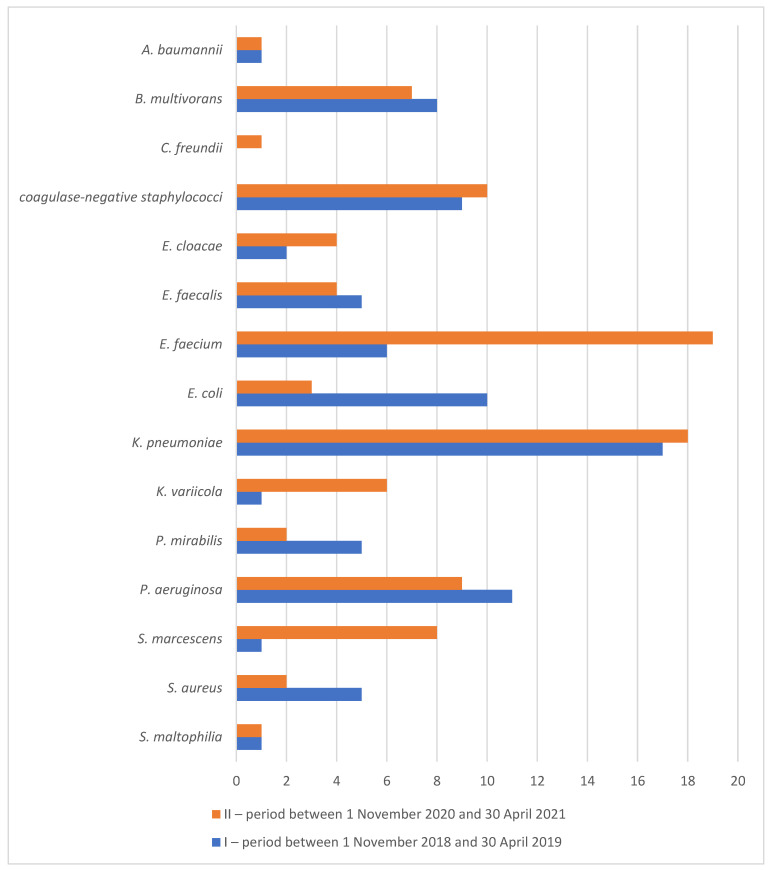
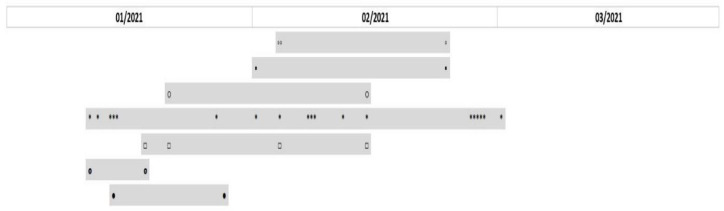
This observational retrospective study aimed to analyze whether/how the spectrum of bacterial pathogens and their resistance to antibiotics changed during the worst part of the COVID-19 pandemic (1 November 2020 to 30 April 2021) among intensive care patients in University Hospital Olomouc, Czech Republic, as compared with the pre-pandemic period (1 November 2018 to 30 April 2019). A total of 789 clinically important bacterial isolates from 189 patients were cultured during the pre-COVID-19 period. The most frequent etiologic agents causing nosocomial infections were strains of Klebsiella pneumoniae (17%), Pseudomonas aeruginosa (11%), Escherichia coli (10%), coagulase-negative staphylococci (9%), Burkholderia multivorans (8%), Enterococcus faecium (6%), Enterococcus faecalis (5%), Proteus mirabilis (5%) and Staphylococcus aureus (5%). Over the comparable COVID-19 period, a total of 1500 bacterial isolates from 372 SARS-CoV-2-positive patients were assessed. While the percentage of etiological agents causing nosocomial infections increased in Enterococcus faecium (from 6% to 19%, p < 0.0001), Klebsiella variicola (from 1% to 6%, p = 0.0004) and Serratia marcescens (from 1% to 8%, p < 0.0001), there were significant decreases in Escherichia coli (from 10% to 3%, p < 0.0001), Proteus mirabilis (from 5% to 2%, p = 0.004) and Staphylococcus aureus (from 5% to 2%, p = 0.004). The study demonstrated that the changes in bacterial resistance to antibiotics are ambiguous. An increase in the frequency of ESBL-positive strains of some species (Serratia marcescens and Enterobacter cloacae) was confirmed; on the other hand, resistance decreased (Escherichia coli, Acinetobacter baumannii) or the proportion of resistant strains remained unchanged over both periods (Klebsiella pneumoniae, Enterococcus faecium). Changes in pathogen distribution and resistance were caused partly due to antibiotic selection pressure (cefotaxime consumption increased significantly in the COVID-19 period), but mainly due to clonal spread of identical bacterial isolates from patient to patient, which was confirmed by the pulse field gel electrophoresis methodology. In addition to the above shown results, the importance of infection prevention and control in healthcare facilities is discussed, not only for dealing with SARS-CoV-2 but also for limiting the spread of bacteria.
这项观察性回顾性研究旨在分析在捷克共和国奥洛穆茨大学医院的重症监护患者中,2019年冠状病毒病大流行最严重时期(2020年11月1日至2021年4月30日)与大流行前时期(2018年11月1日至2019年4月30日)相比,细菌病原体谱及其对抗生素的耐药性是否/如何发生了变化。在2019年冠状病毒病之前的时期,共培养了来自189名患者的789株具有临床重要性的细菌分离株。引起医院感染最常见的病原体是肺炎克雷伯菌(17%)、铜绿假单胞菌(11%)、大肠埃希菌(10%)、凝固酶阴性葡萄球菌(9%)、多食伯克霍尔德菌(8%)、粪肠球菌(6%)、屎肠球菌(5%)、奇异变形杆菌(5%)和金黄色葡萄球菌(5%)。在可比的2019年冠状病毒病时期,共评估了来自372名新型冠状病毒2阳性患者的1500株细菌分离株。虽然引起医院感染的病原体百分比在屎肠球菌(从6%增至19%,p<0.0001)、 variicola克雷伯菌(从1%增至6%,p=0.0004)和粘质沙雷菌(从1%增至8%,p<0.0001)中有所增加,但大肠埃希菌(从10%降至3%,p<0.0001)、奇异变形杆菌(从5%降至2%,p=0.004)和金黄色葡萄球菌(从5%降至2%,p=0.004)显著减少。该研究表明,细菌对抗生素的耐药性变化并不明确。证实了某些菌种(粘质沙雷菌和阴沟肠杆菌)产超广谱β-内酰胺酶阳性菌株的频率增加;另一方面,耐药性降低(大肠埃希菌、鲍曼不动杆菌)或两个时期耐药菌株的比例保持不变(肺炎克雷伯菌、屎肠球菌)。病原体分布和耐药性的变化部分是由于抗生素选择压力(2019年冠状病毒病时期头孢噻肟的消耗量显著增加),但主要是由于相同细菌分离株在患者之间的克隆传播,这通过脉冲场凝胶电泳方法得到了证实。除上述所示结果外,还讨论了医疗机构中感染预防和控制的重要性,不仅是为了应对新型冠状病毒2,也是为了限制细菌的传播。