• 文献检索
  • 文档翻译
  • 深度研究
  • 学术资讯
  • Suppr Zotero 插件Zotero 插件
  • 邀请有礼
  • 套餐&价格
  • 历史记录
应用&插件
Suppr Zotero 插件Zotero 插件浏览器插件Mac 客户端Windows 客户端微信小程序
定价
高级版会员购买积分包购买API积分包
服务
文献检索文档翻译深度研究API 文档MCP 服务
关于我们
关于 Suppr公司介绍联系我们用户协议隐私条款
关注我们

Suppr 超能文献

核心技术专利:CN118964589B侵权必究
粤ICP备2023148730 号-1Suppr @ 2026

文献检索

告别复杂PubMed语法,用中文像聊天一样搜索,搜遍4000万医学文献。AI智能推荐,让科研检索更轻松。

立即免费搜索

文件翻译

保留排版,准确专业,支持PDF/Word/PPT等文件格式,支持 12+语言互译。

免费翻译文档

深度研究

AI帮你快速写综述,25分钟生成高质量综述,智能提取关键信息,辅助科研写作。

立即免费体验

高流量鼻导管治疗对口腔/鼻腔分泌物气溶胶颗粒的弥散作用评估。

Assessment of dispersion of airborne particles of oral/nasal fluid by high flow nasal cannula therapy.

机构信息

Department of Mechanical Engineering, University of Canterbury, Christchurch, New Zealand.

Fisher and Paykel Healthcare, Auckland, New Zealand.

出版信息

PLoS One. 2021 Feb 12;16(2):e0246123. doi: 10.1371/journal.pone.0246123. eCollection 2021.

DOI:10.1371/journal.pone.0246123
PMID:33577565
原文链接:https://pmc.ncbi.nlm.nih.gov/articles/PMC7880466/
Abstract

BACKGROUND

Nasal High Flow (NHF) therapy delivers flows of heated humidified gases up to 60 LPM (litres per minute) via a nasal cannula. Particles of oral/nasal fluid released by patients undergoing NHF therapy may pose a cross-infection risk, which is a potential concern for treating COVID-19 patients.

METHODS

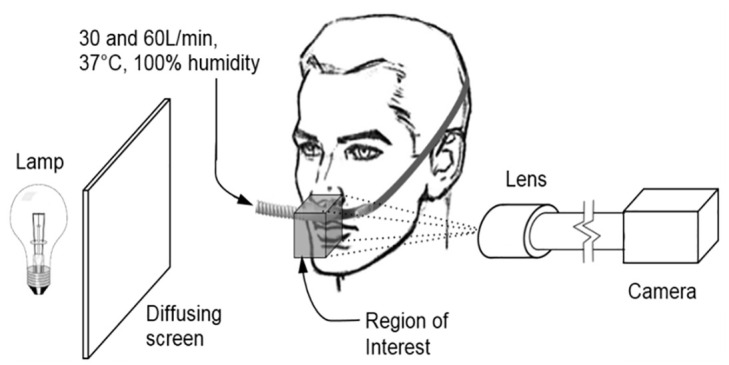
Liquid particles within the exhaled breath of healthy participants were measured with two protocols: (1) high speed camera imaging and counting exhaled particles under high magnification (6 participants) and (2) measuring the deposition of a chemical marker (riboflavin-5-monophosphate) at a distance of 100 and 500 mm on filter papers through which air was drawn (10 participants). The filter papers were assayed with HPLC. Breathing conditions tested included quiet (resting) breathing and vigorous breathing (which here means nasal snorting, voluntary coughing and voluntary sneezing). Unsupported (natural) breathing and NHF at 30 and 60 LPM were compared.

RESULTS

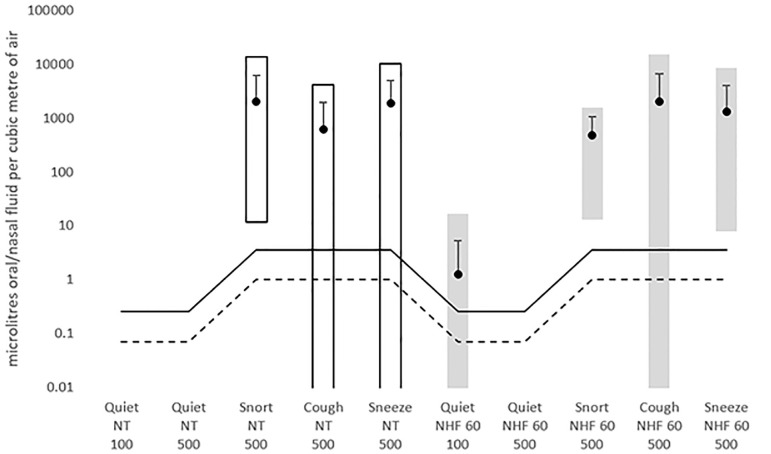
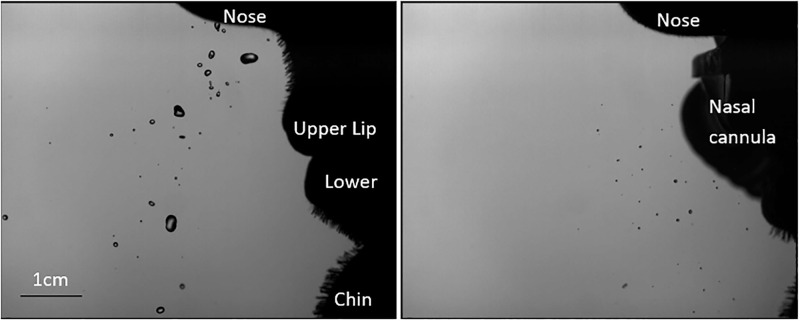
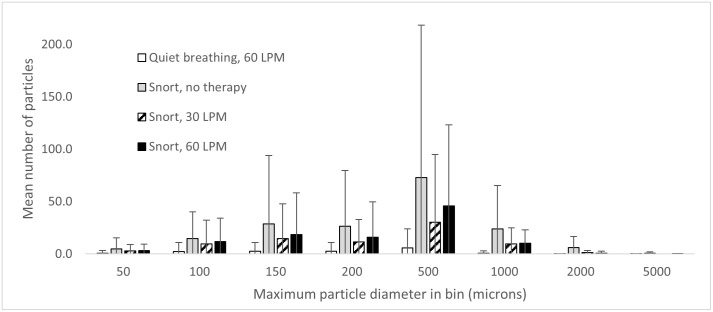
Imaging: During quiet breathing, no particles were recorded with unsupported breathing or 30 LPM NHF (detection limit for single particles 33 μm). Particles were detected from 2 of 6 participants at 60 LPM quiet breathing at approximately 10% of the rate caused by unsupported vigorous breathing. Unsupported vigorous breathing released the greatest numbers of particles. Vigorous breathing with NHF at 60 LPM, released half the number of particles compared to vigorous breathing without NHF.Chemical marker tests: No oral/nasal fluid was detected in quiet breathing without NHF (detection limit 0.28 μL/m3). In quiet breathing with NHF at 60 LPM, small quantities were detected in 4 out of 29 quiet breathing tests, not exceeding 17 μL/m3. Vigorous breathing released 200-1000 times more fluid than the quiet breathing with NHF. The quantities detected in vigorous breathing were similar whether using NHF or not.

CONCLUSION

During quiet breathing, 60 LPM NHF therapy may cause oral/nasal fluid to be released as particles, at levels of tens of μL per cubic metre of air. Vigorous breathing (snort, cough or sneeze) releases 200 to 1000 times more oral/nasal fluid than quiet breathing (p < 0.001 with both imaging and chemical marker methods). During vigorous breathing, 60 LPM NHF therapy caused no statistically significant difference in the quantity of oral/nasal fluid released compared to unsupported breathing. NHF use does not increase the risk of dispersing infectious aerosols above the risk of unsupported vigorous breathing. Standard infection prevention and control measures should apply when dealing with a patient who has an acute respiratory infection, independent of which, if any, respiratory support is being used.

CLINICAL TRIAL REGISTRATION

ACTRN12614000924651.

摘要

背景

鼻高流量(NHF)治疗通过鼻插管输送加热加湿的气体,流速可达 60 升/分钟(升/分钟)。接受 NHF 治疗的患者释放的口腔/鼻腔液体颗粒可能会带来交叉感染的风险,这是治疗 COVID-19 患者的一个潜在问题。

方法

使用两种方案测量健康参与者呼出的液体颗粒:(1)高速摄像成像并在高倍放大下计数呼出的颗粒(6 名参与者)和(2)通过在距滤纸 100 和 500 毫米处测量化学标记物(核黄素-5-单磷酸盐)的沉积量,空气通过滤纸(10 名参与者)。滤纸用 HPLC 进行分析。测试的呼吸条件包括安静(休息)呼吸和剧烈呼吸(这里指的是鼻吸气、自愿咳嗽和自愿打喷嚏)。比较了无支撑(自然)呼吸和 30 和 60 升/分钟的 NHF。

结果

成像:在安静呼吸期间,未记录到无支撑呼吸或 30 升/分钟 NHF 时的颗粒(单个颗粒的检测限为 33 μm)。在 6 名参与者中的 2 名参与者以大约 10%的速度在 60 升/分钟的安静呼吸中检测到颗粒,而不受支持的剧烈呼吸速度更快。无支撑剧烈呼吸释放的颗粒数量最多。与无 NHF 的剧烈呼吸相比,60 升/分钟 NHF 下的剧烈呼吸释放的颗粒数量减少了一半。

化学标记物测试

无 NHF 的安静呼吸中未检测到口腔/鼻腔液体(检测限 0.28 μL/m3)。在 60 升/分钟 NHF 的安静呼吸中,在 29 次安静呼吸测试中的 4 次中检测到少量(不超过 17 μL/m3)。剧烈呼吸释放的液体量是安静呼吸时使用 NHF 的 200-1000 倍。使用 NHF 或不使用 NHF 时,剧烈呼吸释放的液体量相似。

结论

在安静呼吸期间,60 升/分钟的 NHF 治疗可能会导致口腔/鼻腔液体以数十微升/立方米空气的水平作为颗粒释放。剧烈呼吸(鼻吸气、咳嗽或打喷嚏)释放的口腔/鼻腔液体量比安静呼吸多 200 到 1000 倍(两种成像和化学标记方法均 p < 0.001)。在剧烈呼吸时,与无支撑呼吸相比,60 升/分钟 NHF 治疗对释放的口腔/鼻腔液体量没有统计学上的显著差异。与无支撑剧烈呼吸相比,使用 NHF 不会增加传染性气溶胶分散的风险。在处理患有急性呼吸道感染的患者时,应采用标准的感染预防和控制措施,无论患者正在使用哪种呼吸支持,无论使用何种呼吸支持。

临床试验注册

ACTRN12614000924651。

https://cdn.ncbi.nlm.nih.gov/pmc/blobs/e698/7880466/76a7e5485fee/pone.0246123.g004.jpg
https://cdn.ncbi.nlm.nih.gov/pmc/blobs/e698/7880466/108d9a89f8e7/pone.0246123.g001.jpg
https://cdn.ncbi.nlm.nih.gov/pmc/blobs/e698/7880466/c39221147244/pone.0246123.g002.jpg
https://cdn.ncbi.nlm.nih.gov/pmc/blobs/e698/7880466/38dff7daf389/pone.0246123.g003.jpg
https://cdn.ncbi.nlm.nih.gov/pmc/blobs/e698/7880466/76a7e5485fee/pone.0246123.g004.jpg
https://cdn.ncbi.nlm.nih.gov/pmc/blobs/e698/7880466/108d9a89f8e7/pone.0246123.g001.jpg
https://cdn.ncbi.nlm.nih.gov/pmc/blobs/e698/7880466/c39221147244/pone.0246123.g002.jpg
https://cdn.ncbi.nlm.nih.gov/pmc/blobs/e698/7880466/38dff7daf389/pone.0246123.g003.jpg
https://cdn.ncbi.nlm.nih.gov/pmc/blobs/e698/7880466/76a7e5485fee/pone.0246123.g004.jpg

相似文献

1
Assessment of dispersion of airborne particles of oral/nasal fluid by high flow nasal cannula therapy.高流量鼻导管治疗对口腔/鼻腔分泌物气溶胶颗粒的弥散作用评估。
PLoS One. 2021 Feb 12;16(2):e0246123. doi: 10.1371/journal.pone.0246123. eCollection 2021.
2
Modelling nasal high flow therapy effects on upper airway resistance and resistive work of breathing.模拟经鼻高流量治疗对上气道阻力及呼吸阻力功的影响。
Respir Physiol Neurobiol. 2018 Aug;254:23-29. doi: 10.1016/j.resp.2018.03.014. Epub 2018 Apr 7.
3
Aerosol Generation from the Respiratory Tract with Various Modes of Oxygen Delivery.各种供氧模式下呼吸道产生的气溶胶。
Am J Respir Crit Care Med. 2020 Oct 15;202(8):1115-1124. doi: 10.1164/rccm.202006-2309OC.
4
Exhalation Spreading During Nasal High-Flow Therapy at Different Flow Rates.不同流速下鼻高流量治疗期间的呼气扩散
Crit Care Med. 2021 Jul 1;49(7):e693-e700. doi: 10.1097/CCM.0000000000005009.
5
Effect of respiratory rate and size of cannula on pressure and dead-space clearance during nasal high flow in patients with COPD and acute respiratory failure.COPD 合并急性呼吸衰竭患者行鼻高流量时呼吸频率和导管大小对压力及死腔清除的影响。
J Appl Physiol (1985). 2022 Feb 1;132(2):553-563. doi: 10.1152/japplphysiol.00769.2021. Epub 2022 Jan 27.
6
Mechanisms of nasal high flow therapy in newborns.鼻塞式高流量湿化氧疗治疗新生儿的机制。
J Appl Physiol (1985). 2020 Apr 1;128(4):822-829. doi: 10.1152/japplphysiol.00871.2019. Epub 2020 Feb 20.
7
A study on respiratory management in acute postoperative period by nasal high flow for patients undergoing surgery under general anesthesia.全麻手术患者术后急性期经鼻高流量呼吸管理的研究
Medicine (Baltimore). 2020 Jul 31;99(31):e21537. doi: 10.1097/MD.0000000000021537.
8
Nasal high flow oxygen in acute respiratory failure.急性呼吸衰竭中的经鼻高流量氧疗。
Pulmonology. 2021 May-Jun;27(3):240-247. doi: 10.1016/j.pulmoe.2021.01.005. Epub 2021 Feb 13.
9
Evaluation of a New Interface Combining High-Flow Nasal Cannula and CPAP.评估一种结合高流量鼻导管和 CPAP 的新型接口。
Respir Care. 2019 Oct;64(10):1231-1239. doi: 10.4187/respcare.06871. Epub 2019 Jun 4.
10
Mechanisms of nasal high flow on ventilation during wakefulness and sleep.清醒和睡眠期间经鼻高流量通气的作用机制。
J Appl Physiol (1985). 2013 Apr;114(8):1058-65. doi: 10.1152/japplphysiol.01308.2012. Epub 2013 Feb 14.

引用本文的文献

1
Novel co-axial, disposable, low-cost 3D printed videolaryngoscopes for patients with COVID-19: a manikin study.用于新冠肺炎患者的新型同轴、一次性、低成本3D打印视频喉镜:一项人体模型研究。
Eur J Anaesthesiol Intensive Care. 2022 Dec 19;2(1):e0015. doi: 10.1097/EA9.0000000000000015. eCollection 2023 Feb.
2
Generation of Aerosols by Noninvasive Respiratory Support Modalities: A Systematic Review and Meta-Analysis.无创性呼吸支持模式产生的气溶胶:系统评价和荟萃分析。
JAMA Netw Open. 2023 Oct 2;6(10):e2337258. doi: 10.1001/jamanetworkopen.2023.37258.
3
Can nonvolatile tastants be smelled during food oral processing?

本文引用的文献

1
Aerosol Generation from the Respiratory Tract with Various Modes of Oxygen Delivery.各种供氧模式下呼吸道产生的气溶胶。
Am J Respir Crit Care Med. 2020 Oct 15;202(8):1115-1124. doi: 10.1164/rccm.202006-2309OC.
2
Detection of air and surface contamination by SARS-CoV-2 in hospital rooms of infected patients.检测感染患者病房空气中和表面的 SARS-CoV-2 污染情况。
Nat Commun. 2020 May 29;11(1):2800. doi: 10.1038/s41467-020-16670-2.
3
Fighting COVID-19 with water.用水抗击新冠疫情。
食物口腔加工过程中能否嗅到非挥发型味觉物质?
Chem Senses. 2023 Jan 1;48. doi: 10.1093/chemse/bjad028.
4
Application of High-Flow Nasal Cannula in COVID-19: A Narrative Review.高流量鼻导管在新型冠状病毒肺炎中的应用:一项叙述性综述
Life (Basel). 2022 Sep 12;12(9):1419. doi: 10.3390/life12091419.
5
Oral Lesions Associated with COVID-19 and the Participation of the Buccal Cavity as a Key Player for Establishment of Immunity against SARS-CoV-2.与 COVID-19 相关的口腔病变及口腔作为 SARS-CoV-2 建立免疫关键部位的作用。
Int J Environ Res Public Health. 2022 Sep 9;19(18):11383. doi: 10.3390/ijerph191811383.
6
Bacterial Resistance to Antibiotics and Clonal Spread in COVID-19-Positive Patients on a Tertiary Hospital Intensive Care Unit, Czech Republic.捷克共和国一家三级医院重症监护病房中新冠病毒检测呈阳性患者的细菌对抗生素的耐药性及克隆传播情况
Antibiotics (Basel). 2022 Jun 8;11(6):783. doi: 10.3390/antibiotics11060783.
7
Airborne particle dispersion by high flow nasal oxygen: An experimental and CFD analysis.高流量鼻氧通气时的空气传播颗粒弥散:实验与 CFD 分析。
PLoS One. 2022 Jan 21;17(1):e0262547. doi: 10.1371/journal.pone.0262547. eCollection 2022.
8
High-Flow Nasal Cannula Treatment in Patients with COVID-19 Acute Hypoxemic Respiratory Failure: A Prospective Cohort Study.高流量鼻导管治疗新型冠状病毒肺炎急性低氧性呼吸衰竭患者:一项前瞻性队列研究
Saudi J Med Med Sci. 2021 Sep-Dec;9(3):215-222. doi: 10.4103/sjmms.sjmms_316_21. Epub 2021 Aug 31.
9
High flow nasal cannula for adult acute hypoxemic respiratory failure in the ED setting.高流量鼻导管在急诊科成人急性低氧性呼吸衰竭中的应用。
Am J Emerg Med. 2021 Nov;49:352-359. doi: 10.1016/j.ajem.2021.06.074. Epub 2021 Jul 3.
10
High flow nasal cannula oxygenation in COVID-19 related acute respiratory distress syndrome: a safe way to avoid endotracheal intubation?高流量鼻导管氧疗在 COVID-19 相关急性呼吸窘迫综合征中的应用:一种避免气管插管的安全方法?
Ther Adv Respir Dis. 2021 Jan-Dec;15:17534666211019555. doi: 10.1177/17534666211019555.
J Glob Health. 2020 Jun;10(1):010344. doi: 10.7189/jogh.10.010344.
4
Respiratory virus shedding in exhaled breath and efficacy of face masks.呼气中呼吸道病毒的释放和口罩的效果。
Nat Med. 2020 May;26(5):676-680. doi: 10.1038/s41591-020-0843-2. Epub 2020 Apr 3.
5
Aerodynamic analysis of SARS-CoV-2 in two Wuhan hospitals.SARS-CoV-2 的空气动力学分析在两家武汉医院进行。
Nature. 2020 Jun;582(7813):557-560. doi: 10.1038/s41586-020-2271-3. Epub 2020 Apr 27.
6
Airborne transmission of severe acute respiratory syndrome coronavirus-2 to healthcare workers: a narrative review.空气传播严重急性呼吸综合征冠状病毒 2 对医护人员的影响:叙事性综述。
Anaesthesia. 2020 Aug;75(8):1086-1095. doi: 10.1111/anae.15093. Epub 2020 May 8.
7
Airborne or Droplet Precautions for Health Workers Treating Coronavirus Disease 2019?医护人员治疗 2019 冠状病毒病时应采取空气传播预防还是飞沫传播预防措施?
J Infect Dis. 2022 May 4;225(9):1561-1568. doi: 10.1093/infdis/jiaa189.
8
Visualizing Speech-Generated Oral Fluid Droplets with Laser Light Scattering.用激光散射可视化语音产生的口腔飞沫
N Engl J Med. 2020 May 21;382(21):2061-2063. doi: 10.1056/NEJMc2007800. Epub 2020 Apr 15.
9
Aerosol and Surface Distribution of Severe Acute Respiratory Syndrome Coronavirus 2 in Hospital Wards, Wuhan, China, 2020.2020 年中国武汉医院病房中严重急性呼吸综合征冠状病毒 2 的气溶胶和表面分布。
Emerg Infect Dis. 2020 Jul;26(7):1583-1591. doi: 10.3201/eid2607.200885. Epub 2020 Jun 21.
10
The experience of high-flow nasal cannula in hospitalized patients with 2019 novel coronavirus-infected pneumonia in two hospitals of Chongqing, China.中国重庆两家医院对新型冠状病毒感染的肺炎住院患者使用高流量鼻导管的经验。
Ann Intensive Care. 2020 Mar 30;10(1):37. doi: 10.1186/s13613-020-00653-z.